The per capita income at current prices for the year 2004-05 is estimated at Rs 16,414 in rural areas and Rs 44,172 in urban areas.

The answer is to be found in the rise of the global south and in particular, the rise of China, explains Aakar Patel.

On his 200th birth anniversary, Utkarsh Mishra traces the life, thought, and legacy of Dadabhai Naoroji, the Grand Old Man of India.

Chandigarh has highest per capita income of Rs 67,370 per annum, followed by Pondicherry (Rs 56,034) and Delhi (Rs 53,976).\n\n

'Peninsular Indians could ask 'Why should we contribute half of India's tax revenues if we account for only a quarter of the seats in the Lok Sabha?'.' 'The rest of the country seems likely to counter that 'democracy means one vote per person irrespective of where that person resides in India'.' 'With no easy answers to this thorny debate, the south's economic ascendancy could end up creating a Hobson's choice.' A revealing excerpt from Nandita Rajhansa and Saurabh Mukherjea's book, Behold the Leviathan: The Unusual Rise of Modern India.
Gross state domestic product of the city went up by 10.53 per cent.
Let's take a look at per capita income in India and around the world.
Per capita income of Indians grew by 14.5 per cent to Rs 46,492 in 2009-10 from Rs 40,605 in the year-ago period, as per the revised data released by the government on Monday.
Each employee is generating more business than before -- driven by cost rationalisation, digital adoption, and better resource utilisation -- signalling a stronger foundation for sustainable growth and profitability.

Siam argues that a 2040 ban could destabilise ongoing and future investments and threaten millions of jobs in the automotive value chain.

The point to note for India is that we must not panic. The United States may be our largest export destination, but high tariffs will not exactly mean gloom and doom. Sure, we can throw some morsels as we continue negotiating, but we must be firm that some red lines cannot be crossed, no matter what, asserts Shreekant Sambrani.
The per capita annual income in the national capital has increased to Rs. 2.01 lakh in 2012-13 compared to Rs 1.73 lakh in the previous fiscal, which is three times the national average and highest in the country.

Uttar Pradesh, Gujarat and Odisha budgets maintain revenue surpluses despite welfare schemes while Rajasthan and West Bengal face high debt, fiscal deficits and low capital outlay.

According to data released by the Central Statistical Organisation, India's per capita income has increased by over one-third from Rs 26,003 in 2005-06 to Rs 37,490 in 2008-09, Minister of State for Finance Namo Narain Meena told the Rajya Sabha in a written reply.

'The quality of justice is directly linked to the quality of judges -- if that suffers, justice delivery suffers.'

Even as New Delhi turns up the heat on Turkish firms over Ankara's public embrace of Islamabad, Indian companies rooted in Trkiye are staying put. Mahindra & Mahindra (M&M), Dabur India, and Jubilant FoodWorks say it's business as usual, with no plans to alter course despite the geopolitical chill.

The national per capita income in 2013-14 stood at Rs 87,748.
An abysmally low government spending on health -- at $32 per capita -- characterises the poor state of healthcare in India which is facing a 'double burden' of diseases afflicting both the poor and rich classes, a new WHO report has warned.

The per capita income of India has grown 209 per cent from Rs 17,736 to Rs 54,835 during the years 2001 to 2011. Explore the map to see where your state stands.

South Indian filmmakers have kept their focus on the single-screen cinemagoer. They have kept their finger on the pulse of the single-screen cinema fan, who goes to movies once a month or more, to forget his weekly chores, explains Ambi Parameswaran.

Against the all-state average of Rs 3,049 per capita development expenditure, Bihar registered Rs 1,446 during 2005-06. Similarly agaisnt all-state average of Rs 3,826 and Rs 4,208, Bihar recorded per capita development expenditure of Rs 2,123 and Rs 2,184 during 2006-07 and 2007-08 respectively.
An average Indian will see only 5.2 per cent rise in income at Rs 12,414 though the economy is expected to log 6.9 per cent growth this fiscal.
In consonance with the projected fall in GDP growth to 4.4 per cent during 2002-03, the national income and the per capita income are also estimated to fall to 4.2 per cent and 2.4 per cent respectively during the current fiscal.
Per capita income, according to advance estimates for national income released, is expected to grow by 14.4 per cent during the current fiscal, the highest growth rate recorded in a single year in the last decade. It is expected to soar by Rs 4,801 to Rs 38,084 during 2008-09, which means the per capita income has more than doubled in the last seven years.
India's per capita income, a gauge for measuring living standard, is estimated to have gone up 11.7 per cent to Rs 5,729 per month in 2012-13 at currentprices, compared with Rs 5,130 in the previous fiscal.

The Gross National Income (GNI) at 2011-12 prices is now estimated at Rs 112.13 trillion as against Rs 112.14 trillion estimated earlier for 2015-16.
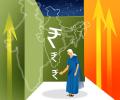
NITI Aayog member Arvind Virmani on Monday said India is set to become the fourth largest economy in the world by the end of 2025, an assertion which came days after NITI CEO BVR Subrahmanyam claimed India has already overtaken Japan to reach that spot. The International Monetary Fund (IMF), in its World Economic Outlook (WEO) report released in April had said that India is expected to be the fourth largest economy in the world with a GDP of $4.19 trillion in 2025, ahead of Japan.
Reflecting general rise in living standard, India's per capita income is estimated to grow above Rs 60,000 per annum or over Rs 5,000 per month, said the government data.

India's per capita income, a gauge for assessing standard of living, for 2013-14 is up at Rs 6,699 per month for 2013-14 as against the earlier estimate of Rs 6,198.33 after the government updated the base year for measuring national accounts.
The US is likely to have per capita GDP of $57,455, about 20 times India's, indicative of how far India will stand in about a decade.
The per capita income of Indians continued its climb up the ladder, increasing 11.1 per cent in 2004-05 to Rs 23,308 (at current prices) compared to Rs 20,989 in 2003-04.

An Indian would have got Rs 40,141 during 2008-09, if the country's wealth was equally distributed among its citizens, according to the revised estimates of the national income.

Per capita income is a crude indicator of the prosperity of a country.

'That combination of a rising economy, a growing middle class, and a deepening love of diamonds and jewellery is what we see really doubling the market for diamonds over the next five years.'
India has become the fourth largest economy in the world due to a strong economic growth but still has a low per capita income, the Economic Survey revealed.

Despite being the fourth largest economy, India's per capita emission levels are 70 per cent below world average and 93 per cent lower than those in the United States, says a latest report on climate change.

According to a report by the Association for Democratic Reforms (ADR), Andhra Pradesh Chief Minister N Chandrababu Naidu is the richest chief minister in India with assets worth over Rs 931 crore, while West Bengal's Mamata Banerjee is the poorest with just Rs 15 lakh. The average asset per chief minister is Rs 52.59 crore, and the total assets of 31 chief ministers are worth Rs 1,630 crores. The report also highlights that 13 chief ministers have declared criminal cases against themselves, with 10 of them having declared serious criminal cases.

Uttar Pradesh Chief Minister Yogi Adityanath, known for his hardline Hindutva views and 'bulldozer justice' approach, has spoken out about his policies toward Muslims, the Waqf board, and his vision for India. He asserts that Muslims will receive a fair share of development in Uttar Pradesh, but not special concessions. He also criticizes the Waqf board for its alleged appropriation of government properties and calls for its reform. Adityanath defends his 'bulldozer justice' policy, claiming it is necessary for infrastructure development and removal of encroachments. He also discusses his vision for India, emphasizing the importance of Hindi as a national language and the need for unity across different linguistic groups.
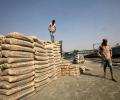
The 31st meeting of the Goods and Services Tax (GST) Council, held in December 2018, deferred a decision to reduce the GST rate for cement from 28 per cent to 18 per cent. This was despite recognising that cement - along with automobile parts - remained among the few mass-consumption items still taxed at the highest slab, which was originally meant for luxury and sin goods.
 © 2026 Rediff.com - Advertise with us - Disclaimer - Privacy Policy - Sitemap - Feedback - About us - Terms of use - Grievances