
Competitiveness helps states catch up with each other.

The biggest headwind to the consumption story in FY23 is a sharp decline in government subsidies on food, fertiliser and fuel, and overall decline in revenue expenditure net of interest payments. This, analysts say, will adversely impact purchasing power of households at the lower end of the income pyramid, translating into lower spending on consumer goods and services.
Carved out of southern Bihar as a new state on November 15, 2000, Jharkhand has been plagued by adverse conditions -- low average income, high incidence of poverty and little social development because of political instability -- there have been seven government changes.

With 56,000 dollar-millionaire households, Maharashtra leads the country in wealth creation followed by Uttar Pradesh, Tamil Nadu, Karnataka and Gujarat, says a report. These states together account for 46 per cent of the 4.12-lakh millionaire households in the country. According to a wealth report by Hurun India, known for its annual rich list, there were 4.12 lakh dollar-millionaire households last year in the country, which has been one of the fastest wealth-creating economies producing the third-most number of billionaires annually.

Per capita availability of milk in India is lower than the world average.
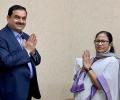
The words 'industry', 'industrial development', 'jobs', and 'employment' have been ringing with higher frequency since Mamata Banerjee stepped into her third term with landslide victory after a high-octane election last year. "Our government's next target is industrial development," the chief minister (CM) had been heard stating at different public meetings in the past few months - perhaps setting the tone for the sixth edition of the Bengal Global Business Summit (BGBS) slated for later this month. Investor summits by any state are about intent, big numbers, and tall claims. Yet in competitive federalism, its importance as a marketing tool is undeniable.
According to a study -- Global Growth Generators: Moving beyond 'Emerging Markets' and 'BRIC' -- conducted by global financial giant Citi, India will emerge as the world's number one economy and have a per capita GDP of $40,000 by the year 2050.
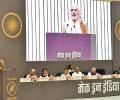
Make in India and Swacch Bharat initiatives are going to have tremendous impact on the Home and Personal Care industry.

The share of total health expenditure as part of the gross domestic product (GDP) went down to 3.3 per cent in 2017-18 from 3.8 per cent in the previous two years, according to the national health account data released on Monday by the health ministry. The share of government expenditure as part of total expenditure as well as GDP has gone up from from 3.78 per cent to 5.12 per cent between 2013-14 and 2017-18, which could also explain a decline seen in out of pocket expenditure in 2017-18. Health ministry also emphasised the increase in the government health expenditure as part of the total GDP from 1.15 per cent in 2013-14 to 1.35 per cent in 2017-18.

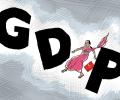
Fitch reaffirmed India's rating at 'BBB-' with a Stable Outlook saying the rating balances a still strong medium-term growth outlook compared with similar category peers and relative external resilience stemming from solid foreign-reserve buffers against high public debt, a weak financial sector and some lagging structural factors, including governance indicators and GDP per capita.

The earlier forecast expected to see 654 million working Indians overall by the fiscal year ending 2022.
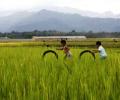
In urban India, the fall in rice consumption was 0.2 kg per person per month.

While India's GDP growth slowed to five-year low of 5.8% in Q4, China grew at 6.4%.

You can make all the speeches you want, you cannot argue against 39 straight months of slowing, observes Aakar Patel.

'The good news is the technology industry is creating a space for you somewhere else.'

Rediff Labs investigates the link between environment and economy in countries around the world.
As per Delhi Government's report on 'Household Consumer Expenditure' released today, the monthly per capita expenditure of urban population has increased from Rs 1,972 in 2007 to Rs 2,078 in the year 2008 -- topping all the States and Union Territories.

Fitch Solutions on Thursday said the new climate targets announced at the COP26 summit by Prime minister Narendra Modi pose an upside risk to its outlook for renewable growth in the country. With the new targets, it expected to see attempts to alleviate the issues regarding supply chains, manufacturing and project development that have long plagued renewable proliferation.
Though power reforms are the most important item on the government's agenda, it often leads to face-offs between the Centre and states.

The controversial interaction took place on Thursday when Rahul began taking questions from the audience.
Claiming that the cashback plan will help the city save 25-30 per cent of drinking water, Delhi Congress president Subhash Chopra alleged that the AAP government's free water scheme 'benefited water tanker mafia'.
Delhi gets more water than Paris, according to a report of the Planning Commission. If the national average water supply for cities is 140 litres per capita, Delhiites guzzle 240 litres per capita. But Delhi, which empties the river Yamuna as it enters the city to fulfill its water needs, says it is facing a water shortage of the intensity of a crisis.

In the excitement over the allocation of bank licences for the private sector, a new category of licence offered by the Reserve Bank of India (RBI) last year went almost unnoticed. That was when the RBI consolidated the rules for prepaid payment instruments (PPI), popularly understood as e-wallets or gift cards. In the process, the regulator has fast-forwarded a bottom-up card usage industry in India that is completely different from the world of bank-linked credit and debit cards.

Despite having the highest per capita income in the country, most city dwellers are unable to purchase a decent accommodation.
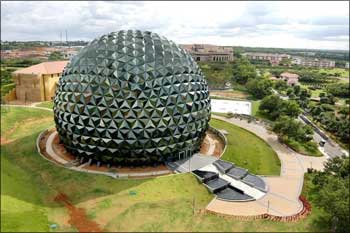
Infosys aims to commission 55 MW of solar plants by end of 2016.

The individuals and HUFs are seeking effective reduction in tax incidence through hike in threshold limit of income tax exemption, restoration of standard deduction, increase in exemptions U/s 80 C etc
The monthly income of an average Indian for the first time in the country's history has crossed Rs 3,000, thanks to economic reforms and a high growth rate of above 9 per cent achieved for three years since 2005-06.The per capita income, a measure of average income of a citizen, went up 12.2 per cent to Rs 37,490 per annum during 2008-09, said the advance estimate for national income released by the Central Statistical Organisation (CSO) on Friday.

The above map shows the highly consumed meat varieties all over the world from 1991 to 2015.

The number of Indians over 15 either working or looking for work is lower as a percentage than in the United States, China, Bangladesh or Pakistan, points out Aakar Patel.

Indian Oil Corporation (IOC) and two other public sector oil firms will install 22,000 electric vehicle (EV) charging stations over the next 3-5 years to support the nation's target to reduce its carbon intensity and reach net zero emissions by 2070. IOC, the country's largest state-controlled refiner by capacity, will set up EV charging facilities at 10,000 fuel outlets over the next three years, chairman Shrikant Madhav Vaidya said. Bharat Petroleum Corporation Ltd (BPCL) said it will set up 7,000 stations over the next five years while Hindustan Petroleum Corporation Ltd (HPCL) has plans for 5,000 stations.

After contracting for two quarters in a row, the Indian economy entered the positive territory with a growth of 0.4 per cent in the October-December quarter, mainly due to good performance by farm, services and construction sectors, official data showed on Friday. Trade and hotel industry registered a contraction of 7.7 per cent during the third quarter this fiscal, as the sectors continued to suffer on account of coronavirus pandemic. According to the data released by the National Statistical Office (NSO), the farm sector recorded a growth of 3.9 per cent, and the manufacturing sector output grew by 1.6 per cent in the quarter under review.

'God has given me everything -- wealth, success, a good wife and good friends. I wish He gives me good health.'

'I often see people try to put down China.'

India is among the top five Asia Pacific countries in terms of total private wealth held, but at the bottom in terms of per capita income.

Senior Congress leader Shashi Tharoor on Tuesday attacked the Centre over the glitches in the new income tax portal, alleging that even after spending Rs 4,200 crore on it, the government had "failed" to make it user-friendly and created a "mess" instead.

As a politician, Yadav is amiable and a consensus-maker, not hamstrung by dogma.
Now we must first compete with Bangladesh. This is not what we had been promised, notes Aakar Patel.

India has much paranoia in India about a new 'Terroristan' coming up between Pakistan and a Taliban-ruled Afghanistan. Pakistan has zero ability economically, diplomatically, geostrategically or militarily to create one. If they try, it will be great for India as they will destroy themselves yet again, asserts Shekhar Gupta.

'Health will continue to be at the centre of the government's attention as it underpins economic recovery and our collective well being.'
 © 2026 Rediff.com - Advertise with us - Disclaimer - Privacy Policy - Sitemap - Feedback - About us - Terms of use - Grievances