
Even as top Pegatron executives went to the factory near Chennai on Tuesday to make an assessment of the fire damage to decide on a possible date for resuming operations, sources said the impact of the closure will be minimal for Apple's iPhone production. Late in the evening sources said that the factory might be operational soon-but said they are waiting for a final update. It will also not impact the availability of the newly-launched iPhone 15 and iPhone 15 Plus, they said.

A day after news emerged that Foxconn Technology Group was "forced" by Beijing to send back its Chinese engineers and technicians from its Tamil Nadu plant, sources indicate that the global electronics giant has already drawn up an alternative plan to rescue its India iPhone 17 production by bringing in experts from mainly Taiwan and the US.

The state has clocked more than 8 per cent growth in the last three financial years, braving global headwinds and thriving on its manufacturing strength

US President Donald Trump on Thursday said he has asked Apple CEO Tim Cook to stop producing iPhones in India, and rather make them in the US.

The company is planning to invest Rs 1,100 crore in the new mobile phone manufacturing facility.

The Tamil Nadu government on Tuesday cleared the Rs 13,180 crore project by Yuzhan Technology, part of Taiwan's Foxconn Group, at Kancheepuram. The unit is reportedly expected to assemble smartphone display modules, which will be one of the first such units to cater to Apple's growing presence in the country. The unit is expected to generate at least 14,000 jobs. Of the 14 existing manufacturing units in the Apple supply chain, seven are based in Tamil Nadu.

Apple Inc's iPhones assembled in India achieved market revenues of Rs 162,000 crore. Tata Steel's revenue for the same period was Rs 162,324 crore.

India's smartphone exports have set a new benchmark, surging past the $2 billion mark in October - the highest monthly total ever recorded. This milestone, according to estimates from the Indian Cellular and Electronics Association (ICEA), an industry body representing both global and domestic mobile device manufacturers, underscores the country's growing prominence in global mobile supply chains.

In a sign of the expanding Apple supplier ecosystem in India, American multinational Jabil Inc will set up an electronics manufacturing facility in Tiruchirappalli, Tamil Nadu with an investment of Rs 2,000 crore. Jabil is one of the 14 Apple suppliers in India, of around 200 globally, while another 14 have reportedly received preliminary clearance to form joint ventures with Indian companies to set up facilities. Interestingly, of the 14 existing manufacturing units in the Apple supply chain, seven are already in Tamil Nadu.

Driven by smartphone, electronics exports have reached $22.5 billion in value in the first eight months of the current financial year (FY25), a near 28 per cent growth over the $17.66 billion electronics exports during the corresponding period of FY24.

Smartphones have been a key success story of the government's production-linked incentive scheme, helping India become the second-largest mobile phone manufacturing country, after China.

Technology giant Apple Inc has pushed the pedal on exporting iPhones from India by racking up exports valued at over $2 billion in the first two months of the current financial year (FY25), according to the data provided by vendors to the government. This accounts for 81 per cent of the country's total production of iPhones worth $2.6 billion. In May, Apple repeated its performance of April and once again crossed $1 billion of iPhone exports.

In FY22-23, Samsung exported $4.09 billion smartphones from India -- an increase of 42 per cent over 2021, when it was $2.8 billion -- accounting for 35 per cent of all smartphone exports.

Despite the robust growth in this country, Apple's India share in its overall global sales remained modest -- constituting 1.5 per cent of its overall turnover of $389 billion in FY23.

'Three manufacturing sectors can create jobs by the million: Apparel, food, and electronic assembly.' 'Let's talk to them and ask them what it would take to scale by a factor of ten,' suggests Naushad Forbes.

Local residents say until about two months ago, this board carried the name of Motorola, which once had a manufacturing unit in Sriperumbudur, 40-odd km from Chennai in Tamil Nadu. In May 2020, Luxshare Precision Industry Co, a China-headquartered AirPods and iPhone assembler, had entered into a deal with the Tamil Nadu government to take over the defunct Motorola unit.
Apple Inc is expected to produce iPhones worth $12 billion (freight on board value) in India during 2023-24, according to discussions between the company's vendors and the government. This would account for around 12 per cent of Apple's global iPhone production-higher than the earlier plan of shifting around 9 per cent of the total to India by FY24, which is the third year of the PLI (production-linked incentive) scheme.

The government's target of hitting $52 billion to $58 billion in mobile phone exports in FY26 has been faltering; an Indian corporate group with financial muscle will help.

If reports that Apple Inc plans to triple its iPhone production in India come true, it is likely to help the country become a supply hub for the American company. There are some 190 Apple suppliers globally, but only 12 have manufacturing facilities in India now. Apple's strategy is to focus on India and a clutch of other countries as it diversifies its supply chain out of China.
Tata Group is set to become India's first homegrown iPhone maker after Taiwan's Wistron Group agreed to sell a plant in Bengaluru to India's largest conglomerate. Wistron's board approved the sale of Wistron InfoComm Manufacturing (India) Private Ltd to Tata Electronics for $125 million, the Taiwanese electronics manufacturer said in a statement on Friday. The unit operates an iPhone assembly plant near Bengaluru.

Apple's three vendors in the country have hit the milestone of creating 30,000 new direct jobs since the production-linked incentive (PLI) scheme for mobile devices kicked off in April 2021. Based on the government's estimate that one direct job in the electronics industry helps to generate three indirect ones, Apple's vendors, Foxconn Hon Hai, Wistron and Pegatron, are close to creating 100,000 direct and indirect jobs. The direct jobs that the vendors have created account for a fourth of Apple's commitment to generate 60 per cent of the new direct jobs out of the 200,000 jobs targeted by the government under the PLI scheme within five years.

"Lady candidates need not apply." So read the postscript in a job notice from Telco (now Tata Motors) on a notice board in the corridors of the Indian Institute of Science, Bangalore (now Bengaluru), in 1974. Irked, Sudha Murty, who was then pursuing her masters in computer science at the institute, wrote a postcard to JRD Tata, expressing her surprise at this gender discrimination, especially since the Tata Group were pioneers on many fronts. Shortly, Murty became the first woman on the firm's shop floor.

The government is likely to extend fiscal incentives for production of toys, bicycles and leather and footwear in the forthcoming budget as it looks to expand production linked incentive (PLI) scheme to cover more high-employment potential sectors, sources said. The government has already rolled out the scheme with an outlay of about Rs 2 lakh crore for as many as 14 sectors, including automobiles and auto components, white goods, pharma, textiles, food products, high efficiency solar PV modules, advance chemistry cell and speciality steel. The scheme aims to make domestic manufacturing globally competitive and create global champions in manufacturing, and it is yielding solid results, sources said.

In the run-up to Apple CEO Tim Cook's visit to India, government officials are finalising the talk points with the Cupertino-headquartered tech major. Officials said that the government would like Apple to "deepen" the company's engagement in the manufacturing and assembly of iPhones in the country and not limit itself only to the minimum commitments made under the production-linked incentive (PLI) scheme for mobile devices. The conversations between the two sides are likely to focus on that.

Two of Apple Inc's global vendors -- Wistron and Foxconn (through Han Hoi), which already manufacture Apple phones in India -- and a third entity, Pegatron, which will be setting up a new plant, have applied to the government to be eligible under the PLI scheme for large-scale electronics manufacturers.

Allowing 12-hour shifts for all and night-time work for women was meant to benefit software firms, but is said to have clinched Foxconn's Rs 80 billion investment.

Apple is hoping to assemble in India 25 per cent of all iPhones produced globally to reduce its heavy dependence on China.
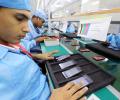
India's stiff labour laws were one key issue that Apple CEO Tim Cook discussed with Prime Minister Modi on his recent visit.

The new mantra was to align Apple's ambition with the government's, focusing on Modi's favourite themes of Make in India, employment generation and India as a high-tech export hub.

In a major push towards 'Make in India', Apple Inc is manufacturing 70 per cent of the mobile phones, in value terms, that it sells in the domestic market, in India, according to sources aware of the development. This is a sharp rise from the figure of 30 per cent just two years ago and marks a major shift in Apple's strategy following the government's Production Linked Incentive (PLI) scheme that kicked off in FY'21. One of Apple's three vendors here, Foxconn, is currently manufacturing the best-selling model, the Apple 11, along with the Apple 10 and the Apple 12. Another contract manufacturer, Wistron, makes the Apple SE 2020. (The third, Pegatron, has yet to start production). The only models that are imported (they have limited volumes but high value) are the Apple 12 Pro and Pro Max.

They are both electronic manufacturing services (EMS) companies, also known as contract manufacturers. One is Taiwan's Foxconn group, the undisputed global number one in this business with revenues of $223 billion. The other is Dixon Technologies, the biggest domestic player with revenues of over Rs 10,500 crore.

The government on Monday extended the period of production-linked incentive scheme for large-scale electronics manufacturing with a focus on mobile phones by a year until 2025-26. The base year of the scheme 2019-20 remains the same but the companies will have the option to choose their five-year period either from the base year or the year 2020-21 for calculation of the incentives under the scheme. "Now we have extended the tenure of the scheme from 2020-21 to 2025-26. "Earlier, it would have ended in 2024-25.

At a time when Apple delivered its flagship line of new products on schedule despite battling a year of supply-chain turmoil, India could account for at least 12 per cent of the free-on-board (FoB) value of Apple Inc's iPhones manufactured by its vendors globally by 2025-26 (FY26). The number represents a significant shift for the Cupertino-based company's over-dependence on China, where 95 per cent of its phones are still being made. India's growing importance can be seen from the fact that in 2021-22 (FY22) - the first year of the production-linked incentive (PLI) scheme (the scheme was extended by a year due to the pandemic) - the FoB value of iPhones made in the country was $1.75 billion, translating into less than 2 per cent of the global value.

The government gave clearance to five global and five Indian players that have made a commitment to a production value of 12.5-trillion phones in five years under the Production Linked Incentive scheme.

Tech giant Apple on Monday said it is undertaking a detailed investigation following the violent incident at its supplier Wistron's Narasapura facility in Karnataka last week.

Apple Inc has told manufacturers of its new iPhone 5C that it will cut orders of the smartphone for the final three months of the year.

Apple Inc's leading contract manufacturer, Taiwanese giant Wistron, has exceeded its investment obligation in India in just eight months, although the government's production-linked investment (PLI) scheme allowed it to complete the investment in four years. Between August 2020 and end March 2021, Wistron made an investment of Rs 1255 crore - 25 per cent more than the total investment it had committed to the government. Under the PLI scheme for mobile devices, the government had stipulated that each of the five participating global companies needed to invest Rs 250 crore every year for the first four years, totalling Rs 1,000 crore.

In a communication to the empowered committee on PLI recently, the Indian Cellular & Electronics Association (ICEA) has stated that except one player (Samsung), all the other eight players (which include vendors of Apple Inc) selected under the scheme were facing numerous challenges in fulfilling the qualification criteria.

The US tech major is planning to begin local production of its upcoming iPhone 12 by next April - within six months of its launch.

Recently, Prime Minister Narendra Modi met over 40 CEOs across broad swathes of industry, ranging from makers of mobile devices, auto components, food products to telecom networking equipment and pharmaceuticals. The agenda: To discuss how to make India an integral part of the global supply chain. The focus of the discussion would be the much touted yet not so well understood production-linked incentive scheme (PLI), the centrepiece of the government's drive to massively boost the manufacturing sector. To do so, the government has created a war chest of over Rs 197,000 crore to be paid out as incentives to over 14 industries in five years. There are three objectives to the scheme, two explicitly stated, one implied.
 © 2026 Rediff.com - Investor Information - Advertise with us - Disclaimer - Privacy Policy - Sitemap - Feedback - About us - Terms of use - Grievances