
The broader NSE Nifty moved between 10,705 and 10,785.55, before ending 25.15 points, or 0.23 per cent down at 10,716.55.

RIL was among the top gainers in the Sensex pack, jumping over 3 per cent to hit its record closing high. Tech Mahindra, HCL Tech, Bharti Airtel, Infosys, HUL and ITC were also among the prominent gainers.

After a weak opening, shares of the company further lost 3.89 per cent to trade at Rs 2,206 on the BSE.

The rupee depreciated 39 paise to an all-time low of 82.69 against the US dollar in early trade on Monday as elevated crude oil prices and risk-averse sentiment among investors weighed on the local unit. Moreover, a negative trend in domestic equities and firm American currency sapped investor appetite, forex traders said. At the interbank foreign exchange, the rupee opened at 82.68 against the greenback, then slipped further to 82.69, registering a fall of 39 paise over its previous close.

Benchmark Sensex pared early losses to close 242 points higher while Nifty settled above the 18,000-mark on Wednesday following gains in IT, oil and select banking stocks amid mixed global trends. Extending gains for a second day, the 30-share BSE Sensex advanced 242.83 points or 0.40 per cent to close at 61,275.09 with 20 of its constituents ending in the green. The index opened lower at 60,990.05 but later regained foot to touch a high of 61,352.55 in day trade.

However, in 2020, gold demand in India -- the world's second biggest consumer after China -- could increase to 700-800 tonnes on hopes of increased acceptance of high price level and likely economic reforms boosting consumer confidence, World Gold Council said.

From the Sensex pack, Reliance Industries fell the most by 2 per cent. Tata Steel, Bajaj Finserv, ITC, NTPC, Bharti Airtel, Tech Mahindra, Titan, Axis Bank and Bajaj Finance were among the other major laggards.

Fund managers are withdrawing after a two-year long run in public sector bank (PSB) stocks. Domestic mutual funds (MFs) were net sellers of PSB stocks for the first time in nine quarters, offloading shares worth Rs 1,800 crore in the March quarter, said a report by ICICI Securities. In the previous eight quarters, fund houses had invested more than Rs 10,000 in PSBs amid deep discounts in valuation vis--vis their private sector peers.

Why did the company zero in on RBL Bank to understand the business of banking? While the M&M investors heaved a sigh of relief, one gentleman must have been all smiles after this, RBL Bank MD and CEO R Subramaniakumar, notes Tamal Bandyopadhyay.

PowerGrid, Tech Mahindra, Infosys, Nestle India and HCL Tech too ended with losses.

As the dreary heat of May approaches, where are the stars headed?

Shares of RIL ended 2.4% higher as it pips TCS to become most valued firm

'The CM wants to develop a Film City that would provide the entire value chain of film-making services and infrastructure in one place.'

India's aviation industry could return to profitability in 2023-24 for the first time since the pandemic. The industry may pare aggregated net loss by 75-80 per cent year-on-year (YoY) to between Rs 3,500 crore and Rs 4,500 crore in 2022-23 (FY23), compared with Rs 17,500 crore of net losses in 2021-22 (FY22). A combination of recovery in passenger volumes and easing cost pressures due to stable fuel and foreign exchange (forex) costs could spark a turnaround. CRISIL says domestic and international passenger traffic recovered to 90 per cent and 98 per cent, respectively, of pre-pandemic traffic (2019-20, or FY20), in April-December 2022, compared with April-December 2019.

The United Nations on Wednesday pared down India's growth forecast by 20 basis points to 5.8 per cent for 2023 calendar year, citing higher interest rates and risks of recession in the developed world weighing on investment and exports. "Economic growth in India is projected to moderate in 2023, with higher interest rates weighing on investment and slower global growth weakening exports," it said in its latest World Economic Situation and Prospects report. The report has projected global trade to contract 0.4 per cent and the world economy to grow at 1.9 per cent in 2023.

Equity benchmarks snapped their six-session rally to close marginally lower on Thursday amid profit booking in banking and energy counters. Investors also stayed on the sidelines ahead of the RBI's policy meet outcome on Friday. In choppy trade, the 30-share BSE Sensex ended 51.73 points or 0.09 per cent lower at 58,298.80. During the day, it hit a low of 57,577.05 and a high of 58,712.66.
Target prices around Rs 400 suggest a significant upside.

HDFC and HDFC Bank's merger - touted as India's biggest-ever corporate merger - pumped up shares of the two entities on the bourses. Shares of Housing Finance Development Corporation (HDFC) skyrocketed 9 per cent while those of HDFC Bank zoomed 10 per cent. In comparison, the benchmark S&P BSESensex and the Nifty50 indices settled 2.2 per cent higher on Monday.
Tata Motors (down 1.7%) was the top loser on Sensex and Nifty, while Lupin (1.6%) gained the most.

Debt-ridden Future Group on Friday said it will sell part of its stake in Amar Chitra Katha Pvt Ltd (ACKPL), which publishes Amar Chitra Katha comics, for Rs 13.62 crore. It has entered into definitive agreements on Thursday to dispose of part of its investments held in ACKPL constituting to 18.58 per cent of the total paid-up share capital of ACKPL to Ramanaidu Daggubati and Spirit Media, according to a regulatory filing. Future Consumer Ltd (FCL), part of the Future Group, will be offloading the stake.

Benchmark indices turned highly volatile in the last hour of trade on Monday, with the Sensex falling 86.61 points after three days of gain amid heavy selling in IT counters and weak trends in global markets. The 30-share BSE benchmark declined 86.61 points or 0.16 per cent to settle at 54,395.23. During the day, it fell by 391.31 points or 0.71 per cent to 54,090.53.

The Dow has never lost more than 800 points in a day.

Mr Adani has a fight on his hands. It is not a fight to the death, asserts T N Ninan.

With its new premium Primus and Ampere NXG, it is targeting buyers seeking a faster and more stylish ride

S&P Global Ratings on Monday cut India's economic growth forecast for current fiscal year to 7 per cent, but said the domestic demand-led economy will be less impacted by the global slowdown. S&P had in September projected the Indian economy to grow 7.3 per cent in 2022-23 and 6.5 per cent in next fiscal year (2023-24). "The global slowdown will have less impact on domestic demand-led economies such as India... India's output will expand 7 per cent in fiscal year 2022-2023 and 6 per cent in next fiscal year," S&P Global Ratings Asia-Pacific chief economist Louis Kuijs said.

The broader markets traded flat with mid-caps up 0.01 per cent and small-caps shedding 0.05 per cent on the BSE.

Benchmark indices Sensex and Nifty gave up early gains to close lower for a fourth straight session on Thursday due to selling in IT and banking shares amid weak global equities. The 30-share BSE benchmark settled 98 points or 0.18 per cent lower at 53,416.15. During the day, it hit a high of 53,861.28 and a low of 53,163.77. The broader NSE Nifty also pared initial gains and ended 28 points or 0.18 per cent down to settle at 15,938.65.

Infosys slipped nearly 9% after the company cut full year revenue outlook for FY17.

Markets erased early morning gains towards the end of the day and ended flat. The Sensex dropped to a low of 17,182 after trading in a range bound fashion for most part of the day. The BSE benchmark index ended down 19 points at 17,214. Nifty ended down eight points at 5,227.

Shares of Yes Bank may face selling pressure as the Reserve Bank-mandated three-year lock-in period for individual investors and exchange-traded funds is ending on Monday, according to analysts. The analysts expect distress on the bank counter on Monday as they expect investors, primarily the nine banks led by State Bank, which picked up almost 49 per cent of its stocks in March 2020 for Rs 10 per share -- at a premium of Rs 8 on the face value as part of the RBI bailout, making an exit. Exchange-traded funds are also likely to press the exit button.
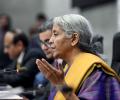
Let's wait for the monetary policy on February 8 -- to see how it complements the fiscal commitments, points out Tamal Bandyopadhyay.

Slowing growth and execution challenges for Cognizant (CTSH) may well allow Infosys to overtake the former after a decade. Cognizant had marched ahead of Infosys in terms of revenue in the first quarter of financial year 2012-13. The Nasdaq-listed IT services firm's performance in Q3 and the guidance for Q4 and full-year 2022 suggest that it could take time for Cognizant to see the expected improvement in performance from its decision to restructure.

'We will be celebrating our friend's ascension as king by distributing sweets.'

Investors' wealth on Thursday tumbled over Rs 2.81 lakh crore as stocks declined in line with selloff in global equities. The 30-share BSE benchmark index tanked 581.21 points or 1 per cent to settle at 57,276.94. During the day, it cracked 1,418.79 points to 56,439.36. In tandem with weak trend in equities, the market capitalisation of BSE-listed firms tanked Rs 2,81,147.38 crore to Rs 2,59,97,419.48 crore.

Twelve days of movie madness and 36 films later, Aseem Chhabra lists his top 10 favourite films from this year's Cannes Film Festival.
RIL and ITC accounted for 25% fall in the Nifty.
Markets slipped into negative terrain in late noon deals weighed down by profit taking in bank shares.
It had rallied to more than one-week high on Bernanke's comments in early trade.
The Sensex came under fag-end selling pressure to close in the red for the sixth straight session on Friday as risk-off sentiment prevailed amid unabated selling by foreign institutional investors and concerns over inflation. The 30-share BSE benchmark pared all intra-day gains and declined 136.69 points or 0.26 per cent to end at 52,793.62. During the day, it had rallied 855.4 points or 1.61 per cent to 53,785.71. On similar lines, the broader NSE Nifty dipped 25.85 points or 0.16 per cent to settle at 15,782.15.

In HDFC Life, the company has to pare 1.43 per cent, and in HDFC Ergo, it has to pare only 0.58 per cent.
 © 2026 Rediff.com - Investor Information - Advertise with us - Disclaimer - Privacy Policy - Sitemap - Feedback - About us - Terms of use - Grievances