
Israel wishes to continue its bombing campaign until Iran's military and industrial infrastructure are degraded to a point where it ceases to pose a threat to Israel. Iran, for its part, has learnt from its experience in the 12-day war of last June. Any ceasefire, it believes, will only be a prelude to another attack on itself. It is determined to convey that any attack on Iran will impose heavy costs on Israel, the US, America's allies in the Gulf -- and on the world at large, points out T T Ram Mohan.

The big question is whether Trump is any longer in command of the situation. For all practical purposes, the war seems set to cascade as the US is preparing for a potential ground operation in Iran and threatens to destroy 'bridges next, then electric power plants', points out Ambassador M K Bhadrakumar.

'US and Iran have not annulled the ceasefire, and the possibility of continuing negotiations remains open.'

Financial year 2025-26 (FY26) saw a significant shift in corporate fundraising, with rights issues more than doubling to a multi-decade high of 51, raising 44,290 crore, while qualified institutional placements (QIPs) more than halved to 29 issues, mobilising 62,954 crore, driven by sharp equity market corrections and regulatory changes.

Reserve Bank of India (RBI) Governor Sanjay Malhotra stated that recent regulatory measures to address foreign exchange market volatility, such as capping banks' net open positions, are temporary and aligned with current market conditions, not signalling any structural shift in policy.

Analysts predict continued volatility in Indian equity markets due to domestic macroeconomic data, F&O expiry, global developments including US tariff policies, and geopolitical tensions.
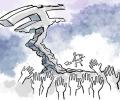
Revenue collection next financial year may be affected, and, along with this, subsidies on food and fertilisers can go up if the war in West Asia drags for long, according to experts.
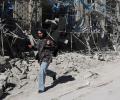
India has relocated the majority of its students from Tehran due to the escalating conflict in West Asia. The Indian embassy has arranged for their transportation, food, and accommodation outside of Tehran. An advisory remains in place for other Indian nationals in Iran to stay indoors and exercise caution.

Indian equity investors experienced a significant loss of 16.32 lakh crore due to a two-day stock market decline fueled by escalating geopolitical tensions involving the US, Israel, and Iran.
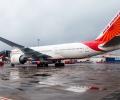
Indian carriers have cancelled over 10,000 flights since the onset of the West Asia conflict, as escalating tensions and airspace restrictions disrupted international operations, a senior government official said.

TMC leader Abhishek Banerjee criticised the Union government over the hike in commercial LPG prices, accusing the Centre of taking from the people while the Mamata Banerjee administration provides relief. He challenged the Prime Minister to release a white paper detailing central funds allocation in Cooch Behar.

Amid the ongoing conflict in West Asia, Israeli Ambassador to India, Reuven Azar, stated that Israel is willing to cease hostilities if Iran changes its course, emphasising that Tel Aviv has consulted diplomatic channels, including the US and regional partners.

Indian investors have seen their wealth erode by a staggering Rs 48.29 lakh crore since the West Asia war began on February 28, leading to a significant downturn in the BSE Sensex and NSE Nifty, driven by geopolitical tensions and rising crude oil prices.
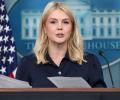
The US has temporarily permitted India to accept Russian oil already on ships to ensure energy supplies amid the conflict with Iran. This short-term measure is not expected to significantly benefit Russia financially.

India has refuted claims of payment issues hindering crude oil imports from Iran, clarifying that refiners have the flexibility to source oil from various global suppliers. The Ministry of Petroleum and Natural Gas addressed reports of a tanker rerouting to China, emphasising standard industry practices and secured oil requirements.

Indian stock markets recovered from early losses to close higher, driven by value buying in IT and banking shares and a rebound in the rupee.

The cost of the war is being counted not in the corridors of power in Washington or Tehran, but in Firozabad's darkened furnace rooms, Howrah's idle casting sheds, and a barbershop in Kochi where the wait is suddenly, inexplicably, an hour long, notes Prem Panicker in his must read blog on the Iran War.

Haryana Chief Minister Nayab Singh Saini has launched development projects worth 253 crore in Jind district, focusing on irrigation, infrastructure, health, and water supply.

A fall in the Nifty 50 to around 19,000 is not impossible, but that would likely require nuclear options to be exercised.

The Reserve Bank of India (RBI) Governor Sanjay Malhotra is now confronting the classic growth-inflation tradeoff, a situation exacerbated by the West Asia war, which threatens to end the 'goldilocks period' of low inflation and robust growth.

The Indian government has refuted reports suggesting a deal with Iran involving the release of seized oil tankers in exchange for safe passage of Indian vessels through the Strait of Hormuz.

Fixed deposits from nationalised banks delivered higher returns than equities, outperforming both inflation and stock market benchmarks.

The ceasefire is still technically holding, to the extent that no overt hostilities have been reported yet, but the rhetoric has hardened dangerously. The week ahead will also clarify whether the Islamabad failure was a negotiating tactic or whether Washington has genuinely locked itself into a position from which the only exits are climb-down, escalation, or the slow bleed of a new status quo that nobody chose and nobody controls. Prem Panicker continues his must read blog on the Iran War.

Trump has made it clear: the US will not lift its blockade of Iranian ports until a deal is signed.

India's electric vehicle (EV) market experienced a significant surge in financial year 2025-26 (FY26), with e4W registrations nearly doubling and e2Ws growing by over 20%, propelled by expanding charging infrastructure, diverse model launches, and accessible financing.

The benchmark BSE Sensex's trailing 12-month price-to-earnings (P/E) multiple has declined to 20.2x, its lowest since May 2020, driven by a record $42 billion FPI selloff since September 2024 and concerns over corporate earnings and economic growth.

A US-sanctioned tanker carrying Iranian crude oil has rerouted mid-voyage from its previously indicated destination of India to China, raising questions about payment issues and the future of India's Iranian oil imports.

The core issues to be settled -- access to Hormuz, Israel's aggression in Lebanon, the question of Iran's nuclear programme, sanctions relief and compensation -- are thorny enough to require weeks of patient negotiation. The most likely outcome of the opening sessions is that both sides take the measure of each other, establish what is and is not negotiable, and return home without having broken anything. That would count as progress.

The question is whether the clocks allow enough time for two deeply mistrustful sides to get there, and whether the surface calm holds long enough for the paddling to produce something before the ceasefire ends on April 22, notes Prem Panicker in his must read blog on the Iran War.

In the present hyper-connected world, there are many domestic and global factors that affect financial markets. Of them, the most powerful and often least predictable are geopolitical events, which often boil down to one diplomatic headline.

Indian markets on Dalal Street rallied sharply as easing tensions in the US-Iran conflict and stable oil prices boosted sentiment. Track Nifty 50 and BSE Sensex performance and key global triggers.

Both sides have now revealed a preference for escalation over strategic defeat, and each new provocation narrows the space for the next pause. The Touska seizure, Iran's refusal to negotiate under blockade, Israel's strikes on Iranian oil infrastructure -- all of these add up to an increasingly untenable situation. This makes the wild card -- Trump and his motormouth -- more consequential than ever, notes Prem Panicker in his must read blog on the Iran War.

US President Donald Trump has threatened to target Iran's civilian energy infrastructure, including power plants, oil wells and Kharg Island, if Tehran does not reopen the Strait of Hormuz.

The United States, which entered this war in expectation of a short, sharp win along the Venezuela model, is now preparing for deeper involvement in a conflict it does not fully control, without the allies it typically relies on, against an adversary that is not behaving as expected, in a global environment that is already absorbing economic shock. Prem Panicker continues his must read daily blog on the Gulf War.

The Indian government is considering additional relief packages for vulnerable sectors like MSMEs to mitigate the impact of the ongoing West Asia crisis on the economy and inflation.

Ali Mousavi stated that such cooperation is essential for maintaining stability in the strategic waterway.

Amidst escalating tensions in West Asia, India strongly condemns the recent attacks on energy infrastructure, warning of further destabilisation to the already uncertain global energy market.
Indian banks are urging the Reserve Bank of India (RBI) to reconsider its new $100 million cap on net open foreign-exchange positions, warning that the directive could lead to significant mark-to-market (MTM) losses and force an accelerated unwinding of trades, potentially impacting FY26 earnings.

'The West Asia or the Gulf crisis has shown that what we develop as national infrastructure when things are not as bad as they could be, we forget to plan for adversities.'
TMC leader Abhishek Banerjee criticises the Union government over the hike in commercial LPG prices, accusing the Centre of 'taking' from people while the Mamata Banerjee administration provides relief. He also challenged the BJP to present a report card of its work in Rajganj constituency.
