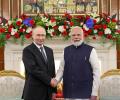
Luckily for us, a Russia that is desperate to stay relevant in an emerging multipolar world finds in India a reliable geostrategic partner. The Russian proximity to India also keeps China from exploiting its economic dominance vis a vis Russia, points out Colonel Anil A Athale (retd).
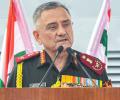
Possible convergence of interest among China, Pakistan, and Bangladesh may result in serious implications for India's stability and security dynamics, Chief of Defence Staff General Anil Chauhan said on Tuesday.

Declaring that they consider the avoidance of war between Nuclear-Weapon States and the reduction of strategic risks as their foremost responsibilities, the leaders of the five countries in a joint statement said, "we affirm that a nuclear war cannot be won and must never be fought."

The US assessment of nuclear weapons security in Pakistan appears to have changed considerably from confidence to concern, particularly as a result of the introduction of tactical nuclear weapons, the report said.
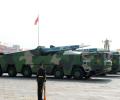
On Thursday, the Chinese military published its ICBM launch photos, shedding its secrecy.
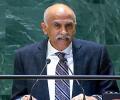
The first issue in engaging with Pakistan is the cessation of terrorism, India's envoy at the United Nations said, underlining that India has been a long-standing victim of cross-border and global terrorism and has zero tolerance towards the scourge.

India's second nuclear-powered ballistic missile submarine was commissioned into the Navy on Thursday in the presence of Defence Minister Rajnath Singh who said this will further strengthen the country's nuclear triad and enhance nuclear deterrence.

India failed to extract the 'price' from Pakistan for its Kargil misadventure.
The price could have been military in terms of loss of territory/soldiers/equipment or destruction of terrorist training infrastructure. Giving a 'face saving' option to Pakistan proved disastrous for the future, asserts Colonel Anil A Athale (retd).

'His emphasis on self-reliance is essentially due to the fact he wanted India to be a nuclear weapons country.' Dr P K Iyengar remembers the father of India's nuclear programme.

India's tactical and operational response demonstrated its ability to prosecute tri-service operations, even without a formal tri-service doctrine or the higher command structure needed to coordinate it, points out Ajai Shukla.
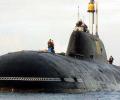
China on Tuesday angrily denounced the nuclear-powered submarine deal announced by the US, UK and Australia, saying the pact violates the Non-Proliferation Treaty (NPT) and the three countries are travelling "further down the dangerous and wrong path."

The old Parliament building will now be known as 'Samvidhan Sadan', Lok Sabha Speaker Om Birla said on Tuesday as the functioning of Parliament shifted to its new building in New Delhi.

Although the credit for acquiring the technological skill must be given to India's outstanding nuclear scientists, the decision to go nuclear was a political one that entailed clarity of vision, courage and resolve, points out Rup Narayan Das.
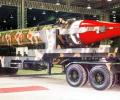
Ambassador Pankaj Sharma, Permanent Representative of India to the Conference on Disarmament (CD), Geneva, said India has been drawing the attention of the world towards these threats and the need to strengthen international cooperation to address them through its annual consensus UNGA resolution titled 'Measures to prevent terrorists from acquiring weapons of mass destruction'.

Promising to strictly adhere to policy of no-first-use of atomic weapons, China on Monday called on other nuclear weapons states to "abandon the nuclear deterrence policy based on first use".
An international commission on disarmament has recognised that India will not sign Non Proliferation Treaty, but has disappointed it by clubbing it with Pakistan and Israel in terms of non-proliferation and disarmament obligations.
Prime Minister Manmohan Singh hopes that the United States will help India get the official status of a nuclear weapons state, given its impeccable record in the field of non-proliferation.

Would Ukraine be such a pushover if it had that nuclear stockpile?' asks Shekhar Gupta.
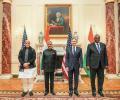
The Biden administration has reaffirmed its commitment to support India's permanent membership in a reformed UN Security Council and New Delhi's entry to the Nuclear Suppliers' Group.
If nuclear weapon states take the plea that they need them for their own defence, they cannot tell the non-nuclear weapon states that they don't need them for the same purpose, he said.

Although the pact would focus mainly on the Pacific and the South China Sea region, any action designed to deter China with or without New Delhi's active participation is a welcome move, notes Commodore Venugopal Menon (retd).

India has voted against the provisions of draft resolutions that would have required it to accede to the Nuclear Non-Proliferation Treaty, saying there is "no question" of it joining the treaty as a non-nuclear weapon state.

Kim Jong-un declared he would never surrender North Korea's nuclear weapons weapons even if his country faced 100 years of sanctions. Dr Rajaram Panda explains Pyongyang's new nuclear doctrine that makes the world a much more dangerous place.
Sanjay Gupta, author of The Himalayan Face-off: Chinese Assertion and the Indian Riposte and deputy executive editor with the Hindustan Times, talks to Rediff.com's Vicky Nanjappa on Chinese incursions, Beijing's worrying defence budget, the curiosity generated over ties with our neighbours and more.
India may resume its nuclear tests taking advantage of the unrest in Middle East to counter China which it considers "a slumbering threat at its bedside," a state-run newspaper in Beijing said, describing New Delhi as a "super antagonist".
China is the world's second-largest economy, after the United States.
Stockpiles of the nations that are not recognised as nuclear weapon states under the Nuclear Non-Proliferation Treaty -- India, Pakistan, Israel and North Korea -- are minuscule in comparison with those of Russia and the United States.
Breaking the tradition of not naming countries, the first draft of the final document of the 2010 Nuclear-Non Proliferation Treaty Review conference has asked India, Pakistan and Israel to sign the NPT and the CTBT. "The conference calls upon India, Israel and Pakistan to accede to the treaty as non-nuclear weapon States, promptly and without conditions, thereby accepting an internationally legally binding commitment not to acquire nuclear weapons," it said.
The reported affirmative reply of Prime Minister Manmohan Singh to Fareed Zakaria's question whether India would be willing to sign the NPT (Nuclear Non Proliferation Treaty) as a nuclear weapon state (NWS) has evoked some debate amongst the Indian security analyst community about the wisdom of such a move.

Pitching for a nuclear weapon free world, Prime Minister Manmohan Singh on Wednesday proposed a global convention for 'no-first-use' of atomic arsenal to make the world a safer place.
India has to leverage its "swing" status, engage with all and align with none, observes Shyam Saran

"We know that Pakistan matters not just because it is the location for the Afghanistan Taliban leadership; it is also important in its own right. It's the base for Al Qaeda, it is a nuclear weapons state with the long-term risk of radicalisation," Miliband said in his testimony before the Senate Foreign Relations Committee, which had convened a special hearing on Afghanistan and Pakistan.
A leading Chinese scholar has demanded that India should make its atomic programme"transparent" and questioned its status as a legitimate nuclear weapon state, in a commentary that comes in the midst of intense media focus on reports of Chinese incursions along the border.

Expressing grave concern over a US nuclear-powered submarine sustaining damage in the disputed South China Sea, China on Friday demanded Washington to reveal the details and the location of the accident and blamed America's frequent air and naval sorties in the Indo-Pacific to assert the "freedom of navigation" as the "root cause" of the incident.
The cooling of the strategic partnership built by the Bush administration, which conferred on India the de facto nuclear weapon state status, introduces new uncertainties in Asia.
India has sought an 'unequivocal commitment' from all nuclear-weapon states to prohibit development, production and stockpiling of nuclear weapons for their non-discriminatory and verifiable elimination within a specified framework. Indian Ambassador to the UN, Nirupam Sen appealed to member states to use the UN forum for an intense dialogue and strengthen the international community to initiate concrete steps for a nuclear weapons-free world.

"We estimate that Pakistan now has a nuclear weapons stockpile of 130-140 warheads. This stockpile exceeds the projection made by the US Defense Intelligence Agency in 1999 that Pakistan by 2020 would have 60-80 warheads," said the report released last month.
Pakistan today said that nuclear proliferation network of atomic scientist A Q Khan was a "closed chapter" and the country is "mindful of its responsibilities as a nuclear weapon state as well as its international obligations."

AQ Khan, a controversial scientist known as the father of Pakistan's clandestine nuclear programme, passed away here on Sunday after a brief illness. He was 85.
Pakistan on Monday said a media report about the United States secretly providing aid to the country to guard its nuclear weapons painted a "distorted and exaggerated" picture of Islamabad's efforts to ensure safety of its atomic arsenal.
 © 2026 Rediff.com - Investor Information - Advertise with us - Disclaimer - Privacy Policy - Sitemap - Feedback - About us - Terms of use - Grievances