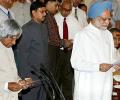
The landmark India-US civil nuclear deal of 2008, brokered during Manmohan Singh's tenure as Prime Minister, is seen as a crowning achievement in his foreign policy legacy. The agreement ended India's nuclear isolation, fostered a strategic partnership with the US, and opened doors to advanced technologies and defense cooperation. This historic deal also laid the groundwork for India's engagement with the global nuclear community.

India's second nuclear-powered ballistic missile submarine was commissioned into the Navy on Thursday in the presence of Defence Minister Rajnath Singh who said this will further strengthen the country's nuclear triad and enhance nuclear deterrence.

India has abstained in the UN General Assembly on a resolution that demanded that Russia immediately cease its aggression against Ukraine and urgently withdraw its military and other unauthorised personnel from the Zaporizhzhia nuclear power plant.

In a year bookended by intractable conflicts and geopolitical fragmentation, India focused on ramping up military prowess by broadly firming up defence procurement worth Rs 4.22 lakh crore even as Indian and Chinese militaries completed pulling back their troops from border face-off points in eastern Ladakh.

On board the INS Vikrant, the supreme commander of India's defence services witnessed several naval operations including a MiG 29K take-off and landing, missile firing drills from warship and submarine operations.

While there are growing calls to reduce dependence on nuclear power, some states in the United States are still reliant on it.

Anil Ambani Group firm Reliance Energy, Tata Power, GMR and aluminium manufacturer Nalco are keen to enter nuclear power business, NPCIL Director (Finance) JK Ghai said.
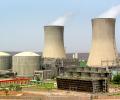
With this, the unit has exited the construction phase and began the operational phase.

Tensions between the United States and Russia have reached new heights amid the ongoing Ukraine conflict, with a series of developments marking a dangerous escalation.

'There's a misconception that all Rs 1 lakh crore will be spent immediately, leading to higher consumption of FMCG goods, travel, and vehicle purchases.' 'While some of this money will go toward consumption, not all of it will.' 'The impact depends on where people deploy their savings.'
Indian Oil Corp, the nation's largest oil firm, will set up a Rs 10,000 crore (Rs 100 billion) nuclear power plant in association with Nuclear Power Corp of India Ltd.
NPCIL Chairman and Managing Director SK Jain said the company had cash reserves of over $2.75 billion to fund the equity portion of the projects, which will have a debt-to-equity ratio of 70:30. India is working on raising its nuclear power generation capacity to 60,000 Mw by 2032 against the current 4,120 Mw. Another 3,160 Mw capacity is under construction.
Strongly favouring nuclear power, Prime Minister Manmohan Singh on Wednesday said there would be no compromise on safety of atomic plants and it would be harmful to close the additional source of energy.
As fossil fuel reserves are fast depleting, nuclear power is becoming the inevitable option for the industrial sector to support the growing Indian economy
India's target of nuclear power generation of 20,000 megawatt by 2020 has been quietly lowered by the Nuclear Power Corporation of India Limited (NPCIL), the only government agency setting up the nuclear power plants in the country, to 11,080 MW.

Indian Oil Corp (IOC), nation's largest oil firm, is likely to sign a joint venture agreement with Nuclear Power Corporation of India (NPCIL) this month to foray into nuclear power generation.
There is no shortage of uranium on the planet.

"We are in discussions with NPCIL for incorporating a joint venture for setting up a nuclear power plant. NPCIL will have a minimum of 51 per cent stake in the joint venture while ONGC would have a maximum of 49 per cent," a company official said.
Prime Minister Manmohan Singh on Tuesday said that nuclear power was an essential component of India's energy mix and he will ensure that the safety and livelihoods of people are not jeopardised in its pursuit.
When dealing with risky technology, it is most important to take people into confidence and tell them what the real risks are, says environment justice activist Nityanand Jayaraman.
Leader of the anti-nuclear plant project, S P Udaykumar, while boycotting the meeting with Central government-appointed experts, said that his group had lost faith in the Central government and would now only hold meetings with state government officials. Ganesh Nadar reports from Tirunelveli.
The rising prices of fossil fuels and the unreliability of alternative sources like solar and wind power means that the charms of nuclear power may still returns, thanks to improvements in safety and technology, says Dr K S Parthasarathy.
The US has categorically told Pakistan that it would not get any atomic power plant or civilian nuclear deal on the lines of the one signed with India.
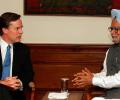
The India-US nuclear deal was aimed at ending India's nuclear isolation and nuclear apartheid, recalls Rup Narayan Das.
Nuclear power forms a big part of energy production in some countries.

The government has approved the construction of two indigenously designed nuclear attack submarines and is expected to ink contracts next month to procure 26 naval variant of Rafale jets and three Scorpene submarines, Navy Chief Admiral Dinesh Tripathi said on Monday.
Let's take a look at some nations, including India, that depend on nuclear power to provide energy needs.
Contrary to perception, the cost of nuclear power based on imported fuel and equipment will be "comparable" to that from the conventional power plants, says Shreyans Kumar Jain, chairman and managing director of the Nuclear Power Corporation of India.
The government is open to specific offers of foreign investment in the nuclear power sector, Minister of State for Atomic Energy and Space Vasundhara Raje said on Thursday.

India and the US signed a historic agreement to cooperate in civil nuclear energy sector in October 2008.
SK Jain, who heads NPCIL and Bhavini, tells Vandana Gombar Ayyagary and Sumana Guha Ray about how NPCIL is best placed to take India's nuclear power ambitions forward.
Prime Minister Manmohan Singh on Saturday opposed 'artificial restrictions' on the peaceful use of nuclear technology

'Modi knows the people here are opposed to this project, but he is using the might of government to push this port down our throats.'

With the fight now having been taken to the seizure of nuclear plants, it is one more warning to Europe that this prolonged war could end up with disastrous consequences, observes Rashme Sehgal
The share of nuclear power in India's energy basket could go up from 3 per cent to 6-10 per cent over the next 25 years, according to industry experts.
"It is time to recognise that nuclear power is not a clean, safe or affordable source of energy," said the letter written by nine laureates including Archbishop Desmond Tutu, Adolfo Perez Esquivel and Jose Ramos Horta.
'We need abundant affordable clean energy to help lift out of poverty the remaining part of humanity that is still living in poverty. I don't see any other viable candidate on the scene for doing that except advanced generation nuclear power,' says Dr James Hansen, a stout opponent of energy based on fossil fuels.
 © 2026 Rediff.com - Advertise with us - Disclaimer - Privacy Policy - Sitemap - Feedback - About us - Terms of use - Grievances