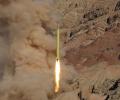
The United States on Thursday put Iran "on notice" for test-firing a ballistic missile and warned of consequences for its "malign actions", signalling a more hardline stance against Tehran that could set the stage for renewed confrontation between the two nations.

India and Japan adopted a mutually acceptable stance, in Tokyo on Monday, to speed up negotiations on a civil nuclear agreement, resolving to bring it to fruition at the earliest.
A delegation of Indian lawmakers have asked United States Secretary of State Hillary Clinton to press Pakistan to bring Mumbai terror attack accused like Hafiz Saeed and Zakiur Rehman Lakhvi to book and ensure that Islamabad does not divert US aid for anti-India activities.The delegation led by Congress spokesperson Abhishek Manu Singhvi met Clinton in Washington and also expressed concern over the proposed China-Pakistan nuclear deal.
Ahead of its engagement in the process of bridging "trust deficit" with Pakistan, India has asked it to "shed its insecurity" on asymmetries in sizes and capabilities between them, including the strategic leverage gained after Indo-US nuclear deal, as they were not targeted against it.
In yet another step towards full implementation of the United States-India civilian nuclear deal -- which the Obama administration has been accused in some quarters of not being fully committed to -- US President Barack Obama on Wednesday issued a memorandum certifying the agreement between India and the International Atomic Energy Agency of the Safeguards Agreement on India's civilian nuclear facilities.
Terming the passing of the civil nuclear liability bill by the Parliament as 'flawed', an eminent American expert on South Asian affairs has said the US policy makers and industrial leaders have been taken off guard by this and it threatens to cast a pall over the historic Indo-US civilian nuclear deal.
An obviously chagrined United States-India Business Council, which has lobbied feverishly for the passage of the US-India civilian nuclear deal in the US Congress, on Monday issued a guarded reaction to the passage of the nuclear liability bill in the Parliament that had 'compromised on the indemnity clause demanded by American companies to protect it from liability in case of a nuclear accident.'
Missed out on the major national news this week? Don't worry. Rediff.com brings you a round-up of major stories this week.
A "well established, foolproof safety and security culture fully qualifies Pakistan for equal participation in civil nuclear cooperation at the international level, which would help us in addressing our immediate energy problems and would bring greater stability as well," Yousuf Raza Gilani said.
Foreign Policy, a global magazine on politics and economic, has chalked out a list of top thinkers of 2010. Nine Indians or those of Indian-origin make the cut. Here's a list.
The United States on Friday declined to comment on a WikiLeaks cable that sparked allegations that the Congress-led United Progressive Alliance government purchased the support of Members of Parliament to survive the trust vote over the Indo-US nuclear deal in 2008. "I am not going to say if it (the cable) is classified or not, but certainly if it is classified, we wouldn't speak about it, and we are not going to speak about it in way, shape or form," said a spokesperson.

Corporate America, which played a key role in clinching the civilian nuclear deal, wants the Obama Administration to elevate its relationship with India to the next level, bestowing "special status" on the country in various categories.
Pakistan has reportedly entered into a civil nuclear deal with China for setting up two nuclear power stations of 640 megawatts in Chashma.
A trust deficit still haunts Pakistan's ties with the United States, which is not entirely convinced of this country's commitment to the war on terror, the Pakistani media said on Thursday, seeking sustained efforts to build on bilateral strategic dialogue to achieve goals like getting a civil nuclear deal.Most Pakistani dailies described Wednesday's upgraded US-Pak strategic dialogue as the start of a new phase in bilateral relations.
With the United States indicating its readiness to discuss civil nuclear deal with Pakistan, India on Monday hoped it would keep in mind Pakistan's track record on proliferation before deciding on the issue.
The United States on Monday said a civil nuclear deal cannot be finalised with Pakistan till it addresses the world community's concerns about proliferation and explains its opposition to the proposed Fissile Material Cut-off Treaty.
As part of government's efforts to reach out to the Bharatiya Janata Party over the nuclear liability bill, National Security Adviser Shivshankar Menon met senior leaders of the main opposition party on Wednesday, to allay their apprehensions but failed to convince them.
The Sino-Pakistan nuclear pact highlights the growing assertiveness of China in global politics and its willingness to take on Washington. It also showcases China's penchant for viewing Pakistan as an important asset in countering India, writes Harsh V Pant.
As India scalps its third nuclear deal this month, the vindication and the victory cannot hide the fact that the all-powerful Nuclear Suppliers Group (NSG), which met in Christchurch, New Zealand last week, failed to dissuade China from supplying two nuclear power reactors to Pakistan in pursuance of two that had earlier been supplied.
Prime Minister Manmohan Singh said on Sunday in an interview to the Japanese media in Tokyo that India is confident of signing a 'win-win' civilian nuclear deal with Japan and is looking forward to a comprehensive economic partnership agreement to boost bilateral trade.

Amar Singh built an extensive network for the party, and was often spotted with celebrities, from the Bachchans to Anil Ambani to Subrata Roy.
Former Under Secretary of State Nicholas Burns, who was the star diplomat in the Bush Administration who negotiated the Indo-US civilian nuclear deal, has rubbished Pakistan's request for a similar accord saying the A Q Khan network was the mother of all nuclear technology proliferators and said Pakistan's concerns over India's involvement in Afghanistan are over-rated.
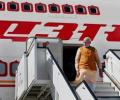
Prime Minister Narendra Modi will embark on a four-day trip to Japan from August 31 to bolster bilateral ties in key areas of civil nuclear cooperation, security, defence and trade.
According to the Wall Street Journal, Pakistan will again raise their demand for a deal -- similar to one the US has with India -- during US Secretary of State Hillary Clinton and Pakistan Foreign Minister Shah Mahmood Qureshi's meeting in Washington on October 22.

Yashwant Sinha on Elections 2009 and Narendra Modi's rise in the BJP.
Indra Nooyi, the outgoing chairman of the US-India Business Council, said that the two of the major achievements during her tenure were the signing of the US-India civilian nuclear deal - where the USIBC played a catalytic role in garnering support on Capitol Hill - and the univocal support extended by the members following the 26/11 Mumbai terror attacks.

USIBC has seen exponential growth in the last five years, from just 80 companies as its members to now more than 350 top American companies, including scores of Fortune 500 and global Indian companies.
At a time when the nuclear deal was being negotiated, the United States had tried to pressurise India over its ties with Iran and even objected to President Mahmoud Ahmadinejad's visit to Delhi, saying it would give 'platform for an enemy of the US', according to Wikileaks documents. The cables sent by the then US ambassador David Mulford to the State Department make it clear that India did not want America to tell it "what to do, especially in public".
The government refuted the charge that the Nuclear Liability Bill was being brought under foreign pressure and said it is willing to refer the measure to a Parliamentary Standing Committee for scrutiny on Thursday.
When she served in the United States Congress, Democrat Ellen Tauscher was one of the most vehement critics of the Indo-United States civilian nuclear deal.
The special cell of the Delhi police, which had earlier arrested the accused Mukesh Saini along with system analyast Shib Shankar Paul, alleged the latter had developed "intimate" and "close relationship" with the American diplomat Rosana Minschew to whom the secrets were passed on.

American Congressman Ed Royce, a ranking Republican on the House Foreign Affairs Committee, and the senior-most minority member on the Subcommittee on Terrorism and Nonproliferation, who was part of the Congressional leadership that met with Prime Minister Dr Manmohan Singh during his recent visit to Washington, is disappointed that the United States-India civilian nuclear deal wasn't completed to make it the signature highlight of the Obama-Singh summit.
Continuing with his agenda, Pakistani Prime Minister Yusuf Raza Gilani has sought a civil nuclear agreement with the United States and other atomic powers and asked for the adoption of 'non-discriminatory' criteria. Gilani raised the issue on Monday, during a working dinner hosted by United States President Barack Obama for the world leaders, which kicked off the 47-nation two-day Nuclear Security Summit in Washington.

US President Barack Obama on Sunday asked Pakistani Prime Minister Yusuf Raza Gilani to bring the perpetrators of the Mumbai terrorist attacks to justice, saying this would help improve the security situation in the region. Obama also did not commit any civilian nuclear deal with Pakistan on the lines of that of India.

US President Barack Obama and Prime Minister Manmohan Singh will meet in Washington on Sunday, during which the two leaders will discuss the civil nuclear deal and other bilateral and regional issues.
The delay in the Nuclear Liability Bill, which has faced vehement protests by the Opposition in Parliament, has become a worrying factor for United States business and industry circles.
US President Barack Obama and Prime Minister Manmohan Singh will meet in Washington on Sunday, during which the two leaders will discuss the civil nuclear deal and other bilateral and regional issues.
Nicholas Burns, the lead negotiator on the US-India nuclear deal in the Bush administration, has said that Washington must reassure New Delhi that it is a "valued strategic partner."
Prime Minister Manmohan Singh on Monday thanked US lawmakers for their enormous support to the historic civilian nuclear deal, which was signed between India and the United States last year, thus ending decades of nuclear apartheid against New Delhi.
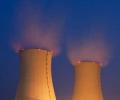
India will complete the process of putting its 14 civilian nuclear facilities under IAEA safeguards by the year end as part of a commitment made under the Indo-US nuclear deal.
 © 2026 Rediff.com - Investor Information - Advertise with us - Disclaimer - Privacy Policy - Sitemap - Feedback - About us - Terms of use - Grievances