
A Russian intelligence agency has claimed that the UK and France are covertly planning to transfer nuclear weapons to Ukraine, alleging a violation of international law.

'We were in a heavily nuclearised environment. China had tested for Pakistan in the 1980s and helped their missile programme stay just one step behind us.'

Satat Sampada, the organisation of climate activist Harjeet Singh and his wife, said the allegations made by the Enforcement Directorate against the firm and its founder were baseless, biased and misleading.

North Korea on Monday pledged to give up nuclear weapons and nuclear programs and also return to the nuclear non-proliferation treaty and submit to International Atomic Energy Agency safeguards.
The Uttar Pradesh excise department arrested climate activist Harjeet Singh for allegedly possessing excess liquor after the ED searched his premises in connection with a foreign exchange violation case. The ED is investigating the misuse of funds received from abroad and Singh's visits to Pakistan and Bangladesh.
Iran on Sunday vowed to avenge the United States bombing of three of its major nuclear facilities saying the American strikes will have 'everlasting consequences'.

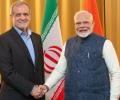
Prime Minister Narendra Modi on Sunday conveyed to Iranian President Masoud Pezeshkian India's 'deep concern' over Iran's conflict with Israel and called for immediate de-escalation of the situation through 'dialogue and diplomacy'.
'Within minutes, my mobile began ringing. It was National Security Adviser Brajesh Mishra, asking why the Iranians were complaining.' 'I explained that we had only restated our position in the light of the conclusion reached by the IAEA, but will remain helpful to Iran to reach a consensus.' 'Then came a call from Foreign Secretary Kamal Sibal, repeating what Mishra said about the Iranian complaint.' 'I was very impressed that Iran was able to reach two top officials in India to intervene at short notice,' recalls Ambassador T P Sreenivasan.
Beijing's latest weapon, 15 times more powerful than TNT, signals a new frontier in high-impact, non-nuclear military technology.
'It is typical of China's strategic deception of making virtue out of necessity,' observes Rup Narayan Das.
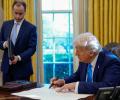
The stage may be set for a recalibrated US-Iran relationship, suggests Ambassador M K Bhadrakumar.
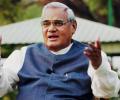
It was good fortune for India to have Atal Bihari Vajpayee lead the government at a crucial moment in our history. He avoided India meeting the fate of Iraq or Ukraine, asserts military historian Colonel Anil A Athale (retd).
Appreciating its 'responsible' behaviour, the United States has said it will not push India to sign the Non Proliferation Treaty and the Comprehensive Test Ban Treaty 'for quite some time,' but sought New Delhi's cooperation to strengthen the global non-proliferation regime.
Breaking the tradition of not naming countries, the first draft of the final document of the 2010 Nuclear-Non Proliferation Treaty Review conference has asked India, Pakistan and Israel to sign the NPT and the CTBT. "The conference calls upon India, Israel and Pakistan to accede to the treaty as non-nuclear weapon States, promptly and without conditions, thereby accepting an internationally legally binding commitment not to acquire nuclear weapons," it said.
Ahead of the Non Proliferation Treaty review conference, the United States on Friday said the Indo-US civil nuclear deal has not weakened the Nuclear Non-Proliferation Treaty as the pact comes with a number of 'transparency mechanisms.'
The government of the Democratic People's Republic of Korea also declared its total freedom from the binding force of the safeguards accord with the International Atomic Energy Agency
Maintaining its strident opposition to the historic Indo-US civilian nuclear deal, the Chinese state media has accused Washington of contradicting its obligations under the Non-Proliferation Treaty.

Declaring that they consider the avoidance of war between Nuclear-Weapon States and the reduction of strategic risks as their foremost responsibilities, the leaders of the five countries in a joint statement said, "we affirm that a nuclear war cannot be won and must never be fought."
Although the credit for acquiring the technological skill must be given to India's outstanding nuclear scientists, the decision to go nuclear was a political one that entailed clarity of vision, courage and resolve, points out Rup Narayan Das.
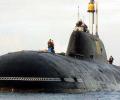
China on Tuesday angrily denounced the nuclear-powered submarine deal announced by the US, UK and Australia, saying the pact violates the Non-Proliferation Treaty (NPT) and the three countries are travelling "further down the dangerous and wrong path."
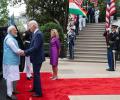
The change of heart in the US and India was propelled by the increased threat of China to both countries, explains Ambassador T P Sreenivasan.
India on Friday rejected China's contention that it must sign the Non-Proliferation Treaty to get membership of the Nuclear Suppliers Group.
India was on Wednesday unperturbed by Nuclear Suppliers Group's decision to strengthen guidelines on enrichment and reprocessing technology transfer, saying it expected its bilateral agreements on full implementation of nuclear deals to be fully honoured without any pre-conditions.
Russia on Friday assured that India would continue to enjoy the waiver it received in 2008 from the Nuclear Suppliers Group's export ban and Moscow wants New Delhi's full participation in the 45-nation grouping that regulates global atomic commerce. Russia's assurance came after India objected to the new guidelines adopted in June by the NSG on the export of nuclear enrichment and reprocessing equipment.
Australian Defence Minister Stephen Smith, who had pitched for reversing ruling Labor party's policy on uranium export to India, has ruled out similar treatment to Pakistan, citing its poor proliferation record.
Pakistan's High Commissioner to Australia, Abdul Malik Abdullah, said if Australia is willing to export uranium to India then it should sell it to Pakistan as well.
Neither the United States government nor its powerful business lobby is likely to embrace the Indian law, which imposes unprecedented liability on the suppliers for 80 years, says TP Sreenivasan
United States President Barack Obama on Wednesday virtually backed Australian Prime Minister Julia Gillard's plans to sell uranium to India saying it "seemed to be compatible with international law and the Non-Proliferation Treaty".
Stockpiles of the nations that are not recognised as nuclear weapon states under the Nuclear Non-Proliferation Treaty -- India, Pakistan, Israel and North Korea -- are minuscule in comparison with those of Russia and the United States.
China is all set to announce its intent to provide to Pakistan two nuclear-power reactors, according to a prominent American nuclear expert who said this would breach international protocol about the trade of nuclear equipment and material.

In an expected showdown, Iranian President Mahmoud Ahmadinejad and United States Secretary of State Hillary Clinton launched a verbal attack against each other at a Nuclear Non-Proliferation Treaty meeting at the United Nations on Monday.In his 35-minute speech at the NPT Review Conference, Ahmadinejad slammed Washington for bullying Tehran over its nuclear programme while not pushing the 'Zionist regime' (Israel) for getting rid of its nuclear weapons.
Alleging that Iran is evading its international responsibilities, the Obama Administration has accused Tehran of indulging in "rope-a-dope diplomacy".
The government on Friday said that the G-8 resolution -- on curbing the transfer of enrichment and reprocessing (ENR) technology to non-Nuclear non-Proliferation Treaty signatory countries -- was 'not a legally binding document' and hoped individual nations will implement civil nuclear agreements with India on bilateral basis. External Affairs Minister S M Krishna also allayed concerns over the End-User Monitoring Agreement (EUMA) with the United States.
Bracketing both India and Pakistan as its 'very special friends', the United States has said that it would not pressurise these countries to sign the nuclear non-proliferation treaty.
Germany on Monday backed India's bid to gain membership of the Nuclear Suppliers Group, applauding the country's 'excellent' non-proliferation track record.German Ambassador Thomas Mattusek told reporters that India not being a party to the Nuclear Non-Proliferation Treaty will not be an issue for his country's support to India's candidacy to the elite nuclear club, though it would like New Delhi to be a signatory to the NPT.
The reported affirmative reply of Prime Minister Manmohan Singh to Fareed Zakaria's question whether India would be willing to sign the NPT (Nuclear Non Proliferation Treaty) as a nuclear weapon state (NWS) has evoked some debate amongst the Indian security analyst community about the wisdom of such a move.
An international commission on disarmament has recognised that India will not sign Non Proliferation Treaty, but has disappointed it by clubbing it with Pakistan and Israel in terms of non-proliferation and disarmament obligations.
Visiting Australian Prime Minister Kevin Rudd has made it clear that he will not buckle on Australia''s refusal to sell uranium to India just hours ahead of a meeting with Indian Prime Minister Manmohan Singh.
In a major breakthrough in its quest for nuclear technology, India will launch talks with Japan from Monday to seal a civilian atomic cooperation pact that will pave the way for the sale of advanced technology by Japanese firms like Mitsubishi and Hitachi. Terming the development as 'very positive', sources said for Japan, the only country ever attacked with atomic weapons, the decision to go ahead with such a pact with a non-Nuclear Non-Proliferation Treaty signatory country
 © 2026 Rediff.com - Advertise with us - Disclaimer - Privacy Policy - Sitemap - Feedback - About us - Terms of use - Grievances