
>According to the latest RBI data, PPF receipts have already experienced a decline between April 2023 and February 2024. Other schemes like the Sukanya Samriddhi Account and National Savings Certificate are also witnessing reduced inflows.

Sitharaman does away with loans from National Small Savings Fund to Food Corporation of India.
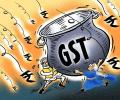
The CAG has pulled up the union government for adopting an erroneous process of devolution of IGST to states and short-transfer of cesses to reserve funds, which resulted in under-reporting of deficit figures for the 2017-18 and 2018-19 fiscals. The Integrated Goods and Services Tax (IGST), which is levied on inter-state sale of goods and services, is shared between the Centre and states in the 50:50 ratio. In its report on the union government accounts tabled in Parliament, the Comptroller and Auditor General of India (CAG) found that a sum of Rs 13,944 crore was left unapportioned and retained in the Consolidated Fund of India (CFI) in 2018-19, even though the amended IGST Act now provides for a process for ad-hoc apportionment of IGST.

Instead of conceding the demand for a cut in personal income-tax rates, Finance Minister Nirmala Sitharaman should phase out many exemptions in both personal and corporation taxes, suggests A K Bhattacharya.

The panel, to be headed by Reserve Bank of India Deputy Governor Shymala Gopinath, will review the structure of the National Small Savings Fund and give recommendations on making schemes more flexible and market-linked.

The impact of economic slump was visible in the Budget's fine print, as this step-by-step explanation show how the Budget math was worked out, reports Abhishek Waghmare.

The continuing fiscal stimulus is heavily tilted towards capex, to the extent that it chips away a part of revenue spending. Accounting for other areas of revenue expenditure, such as salaries, pensions, subsidies and defence (committed spend), the room to spend on welfare schemes, health and education will narrow in FY22.

NSSF collections are down by 68% over last year. Investors are preferring banks, mutual funds and insurance policies for investments over the National Small Savings Fund. In order to deploy the surplus, the NSSF plans to lend Rs 1,500 crore to India Infrastructure Finance Company Ltd at 9 per cent interest. To save the fund from collapsing, the finance ministry included 5-year Post Office Time Deposits and Senior Citizens' Saving Scheme under Section 80C for tax exemption.
National Small Savings Fund schemes are losing out to stock market, bank and insurance products.

India is expected to harvest 291.95 mt of foodgrain in 2019-20

To make possible discretionary spending including capex and that on welfare, the government decided to borrow more than planned in FY21 -- Rs 12.7 trillion.

Fitch Ratings on Thursday said the resurgence of COVID-19 infections may delay India's economic recovery, but won't derail it, as it kept the sovereign rating unchanged at 'BBB-' with a negative outlook. It projected a 12.8 per cent recovery in GDP in the fiscal year ending March 2022 (FY22), moderating to 5.8 per cent in FY23, from an estimated contraction of 7.5 per cent in 2020-21. Fitch had in June last year revised outlook for India to 'negative' from 'stable' on grounds that the coronavirus pandemic had significantly weakened the country's growth outlook and exposed the challenges associated with a high public debt burden.

Sitharaman's Budget missed deficit target for the third year in a row, pushing shortfall to 3.8 per cent of GDP in the current fiscal as compared to 3.3 per cent previously planned.
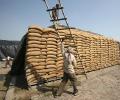
This is the highest in the past five years and almost 24 per cent more than last year.

Finance Minister Nirmala Sitharaman has brought down the budgetary allocation for the fertiliser subsidy for FY21 to Rs 71,309 crore, from the RE of Rs 79,998 crore for FY20, while increasing food subsidy to FCI through "ways and means advance" to Rs 50,000 crore for FY21, from Rs 36,000 crore in RE for FY20, and under the National Food Security Act (NFSA) to Rs 77,982 crore, from Rs 75,000 crore.

Interest rate on Public Provident Fund scheme was cut to 8.1%.

Overall, small savings have amassed Rs 1.17 trillion from April-September - 26 per cent more than the previous year. But in those six months, the economy lost 24 per cent in the first three months, and is slated to lose 10 per cent in the second quarter.

But it is disappointing to note that Sitharaman's third Union Budget continues to promote a few problematic ideas, observes A K Bhattacharya.

FPIs are currently capped at 5 per cent of the total outstanding government dated securities, and own 4.5 per cent

If the government cuts wasteful expenditure as it is trying now, the deficit would at most fall to 8 per cent, not less than that.

'The road ahead for the government's fiscal management will be full of many new challenges,' warns A K Bhattacharya.

Post office savings deposit, recurring deposit accounts and the senior citizen savings scheme account have shown the highest growth in the current financial year.

After making a larger-than-expected cut of 50 basis points on September 29, Rajan urged the federal government to do its bit to accelerate growth through structural reforms.

'If such inflows materialise, what will be the effect on the rupee's value -- and therefore on exports growth, the only sustainable path to recovery?', asks Mihir S Sharma.

Demonetisation is the biggest reason for the rise in preference for small savings.

Backloading the government's borrowing programme suggests the finance ministry's confidence in better revenue numbers, says A K Bhattacharya.

The Centre has to bear the maximum burden of borrowing NSSF loans to the tune of Rs 1 lakh crore.

The ripples from November 8 may be seen in next year's state budgets.

IDS-2 and raids to uncover black money stash keep receipts flowing

Government to pay disproportionately high interest for borrowings from savings, overturning a nearly two-decade-long process of reforms in the management of public debt.

Finance ministry maintains that all KYC requirements will be followed.
 © 2026 Rediff.com - Investor Information - Advertise with us - Disclaimer - Privacy Policy - Sitemap - Feedback - About us - Terms of use - Grievances