
Prime Minister Narendra Modi on Tuesday expressed hope that digital transactions will soon surpass cash as Unified Payments Interface (UPI) is increasingly becoming the most preferred payment mechanism in the country. Modi after the launch of the cross-border connectivity between the UPI and PayNow of Singapore said about 74 billion transactions amounting to more than Rs 126 trillion, which is approximately 2 trillion Singapore dolla, was done through UPI in 2022. "Many experts are estimating that very soon India's digital wallet transactions are going to overtake cash transactions," he said.

In the first such collaboration for India, the country's flagship payments platform, the Unified Payments Interface (UPI), and Singapore's PayNow payment system have launched a real-time cross-border payment linkage system. The linkage, which was launched by Prime Minister (PM) Narendra Modi and Singapore's PM Lee Hsien Loong on Tuesday, was kicked off by a live cross-border transaction between Reserve Bank of India Governor Shaktikanta Das and Monetary Authority of Singapore managing director Ravi Menon, using mobile phones.

RCom is looking at listing Flag Telecom through a Singapore business trust, Global Telecommunications Infrastructure Trust on the Singapore stock exchange.

Ujjivan Small Finance Bank's initial public offering attracted heavy investor demand on the final day of bidding on Wednesday as the issue was subscribed a whopping 126.36 times.

Insurance behemoth LIC on Tuesday said it has garnered a little over Rs 5,627 crore from anchor investors led primarily by domestic institutions ahead of its mega initial public offering (IPO). Anchor Investors' (AIs) portion (5,92,96,853 equity shares) was subscribed at Rs 949 per equity share, the insurer said in an early morning filing to exchanges. Out of the allocation of about 5.9 crore shares to AIs, 4.2 crore shares (71.12 per cent) were allocated to 15 domestic mutual funds through 99 schemes, the filing said.

Ambani is in good company. The likes of ultra-rich individuals like hedge fund billionaire Ray Dalio and co-founder of Google Sergey Brin have chosen Singapore to establish their family offices. So have British inventor James Dyson, famous for his bladeless fans and hair dryers and vacuum cleaners, and Zhang Yong, founder of China's Haidilao hotpot restaurant chain, reports Lee Kah Whye.

Rajan, 57, who was RBI governor for three years until September 2016, is currently working as a professor at the prestigious University of Chicago.

Reliance Capital on Wednesday said it has got approval from the Indian market regulator Sebi and the Monetary Authority of Singapore (MAS) for Rs 1,450-crore (Rs 14.5 billion) stake sale in its mutual fund business unit to Japan's Nippon Life.

The company said the capital infusion will help it continue investments in future roll-outs to build large network capacity and create content and technology partnerships

In the first major international exchange business initiative by an Indian entity, a new commodity and currency bourse, Singapore Mercantile Exchange (SMX) on Tuesday commenced trading here with derivatives contracts like gold, crude oil and Euro-US dollar.

Located in the banking hub of Singapore's central business district, the branch office is the start of ICICI's retail operations in the country under a 25-branch qualified Full Banking licence given by the Monetary Authority of Singapore in April, Kochhar said.

Put plans on hold after HK caps expansion, Singapore orders stricter asset norms.

Under the CECA, signed between India and Singapore in June 2005, Singapore has committed to award three qualified full bank (QFB) licences to three Indian banks while India had agreed to give three Singaporean banks free access to the Indian banking
India has questioned Singapore's decision to not to grant qualifying full banking status to the State Bank of India. The two countries have asked their monetary authorities to set up a committee to look into the matter.

The board of Bharti Airtel approved the rights issue to raise up to Rs 25,000 crore through the issuance of fully paid up shares at a price of Rs 220 per share and to raise an additional Rs 7,000 crore via the foreign currency perpetual bond issue.

Move comes after the country's monetary authority tightened credit norms

'Allocate some parts of one's surplus income towards cryptocurrencies, considering the immense growth potential of this emerging asset class.'
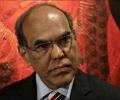
In his new role, Subbarao will take part in various activities at NUS Business School, the Institute of South Asian Studies and the Monetary Authority of Singapore.

The main issue has been that of a higher Asset Management Ratio as has been prescribed by the Monetary Authority of Singapore for qualifying full banks from India.
 © 2026 Rediff.com - Advertise with us - Disclaimer - Privacy Policy - Sitemap - Feedback - About us - Terms of use - Grievances