
rediffGURU Ulhas Joshi answers your personal finance and mutual fund queries.

Emerging business theme-based funds basically invest into mid and small-cap stocks, which normally have the potential to grow faster.

If the index is unable to sustain above 24,500 levels, technically it can then slip to its 200-DMA placed at 23,365 levels.

'Consider 40% to 50% in equities, 10% in gold as a hedge, and the remaining 30% to 40% split between multi-asset funds and hybrid funds.'
Unlike the first quarter of FY08 when Indian IT small- and mid-caps were hit hard due to a nearly 7 per cent appreciation in the rupee against the dollar, the July-September period was relatively kind to these firms. It spared them to some extent, since the rupee appreciated around 1.5 per cent over the period. However, the rupee rose around 12 per cent against the dollar over the last 12 months.

Don't let panic ruin your wealth. Avoiding these mistakes can save you from HUGE losses, says Ramalingam Kalirajan

'Investors looking at the next 6-12 months can be certain that the Fed will maintain its easing cycle, and we expect the overall environment to be conducive for fixed income investments for portfolio diversification.'

rediffGURU Ulhas Joshi answers your mutual fund queries.

'Choose an equity allocation that will allow you to remain invested even if the market falls by 50 to 60 per cent.'

'The markets will correct, and they are bound to correct. The boom will turn into bust.' 'When this bust happens, people would lose like they have lost in the past.' 'Whatever you have made possibly in the last couple of years, you may lose in a couple of weeks. That's very much possible.'

Five stocks - Havells, NCC, Suzlon, Blue Star and Crompton Greaves look most attractive after the recent course correction.

Imagine transforming a modest Rs 10,000 monthly investment into a steady Rs 1 lakh monthly income in your retirement years. This is the power of compounding -- a strategy that rewards you for starting early and staying consistent with your investments, says Ramalingam Kalirajan.

With India overtaking China in terms of weightage in the Morgan Stanley emerging markets IMI, Indian equities could see inflows of about $4.5 billion (Rs 37,000 crore), according to estimates. This week, Morgan Stanley announced that India has overtaken China in the MSCI Emerging Markets Investable Market Index (MSCI EM IMI). The weight of India in MSCI EM IMI stood at 22.27 per cent compared to 21.58 per cent of China.

Retail investors have become a force to reckon with in the last 10 years with their ownership of Indian equities rising 800 basis points, or 8 per cent, to 23.4 per cent during this period, suggests a recent note from Morgan Stanley. This number, Morgan Stanley said, is set to rise in the next few years as Indian households are still underinvested in equities. India's demographics, policy framework, investor education and modest positive real rates, it said, will fuel the 'equity cult' in India.

Analysts say other than the niche focus, these firms are also reaping the benefit of deals becoming smaller.

Polycab India, Power Finance Corporation, Shriram Finance, and Union Bank of India appear poised to transition from the mid-cap to the large-cap category within the domestic mutual fund industry. Their market capitalisation (m-cap) now ranks among the top 100, which is the threshold for the large-cap universe defined by the Securities and Exchange Board of India.

These 10 stocks represent the best mix of value and growth, offering relatively low price-to-earnings and price-to-book ratios, a high return on equity, and sufficiently high potential from current levels.

rediffGURU Dev Ashish answers your personal finance and mutual fund queries.

Ask rediffGURU and PF and MF expert Janak Patel your mutual fund and personal finance-related questions.

'From a risk-return perspective, large-cap funds may generate lower-than-historical average returns in 2024, whereas mid-, and small-cap funds hardly have any upside left.'

rediffGURU Vivek Lala answers your income tax and personal finance queries.

Investor wealth eroded by Rs 4.46 lakh crore in a single day on Friday with the benchmark BSE Sensex tanking more than 1 per cent in line with global stocks rout. The 30-share BSE Sensex plunged 885.60 points or 1.08 per cent to close at 80,981.95 with 25 of its components declining and five ending with gains. During the day, it nosedived 998.64 points or 1.21 per cent to hit an intra-day low of 80,868.91.

BSE Mid-cap index ended at a record closing high of 10499.86 and CNX Mid-cap index ended at a record closing high of 12672.85 levels.

Active equity mutual fund schemes have improved their showing across key categories over the past three months vis-a-vis their benchmarks.

rediffGURU Vivek Lala answers your income tax and personal finance queries.

Analysts are expecting pharmaceutical companies to post sales growth of 10-11 per cent in the second quarter this financial year while the Ebitda (earnings before interest, tax, depreciation, and amortisation) margins are anticipated to improve by about 110 basis points. Ebitda improvement will be led by lower input costs because prices of active pharmaceutical ingredients (APIs) are 5-15 per cent lower year-on-year (Y-o-Y). Axis Capital said sales growth would be around 10 per cent, of which growth in the India market would be 11 per cent or so.

The benchmark indices are set to end their five-month gaining streak, but the market breadth continues to hold strong So far this month, stocks gaining have outnumbered those declining, a sign that the bulls still have the upper hand, even as the pullback in the S&P BSE Sensex and the National Stock Exchange Nifty indicates otherwise. On the BSE, 2,126 stocks have advanced and 1,955 have declined in August, translating into an advance/decline ratio (ADR) of 1.1.
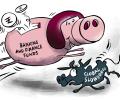
Companies in the banking, finance sector and insurance (BFSI) sector have underperformed on the bourses despite leading the earnings growth charts in the post-pandemic period. This has created a dichotomy between their earnings and share prices. BFSI companies have never been less expensive than the rest of the equity market.

Infrastructure stocks are once again gaining traction.

rediffGURU and financial planning expert Colonel Sanjeev Govila (retd) answers your personal finance-related questions.

The BSE mid-cap and small-cap stocks have outperformed the benchmark Sensex in 2023-24 with about 62 per cent returns, reflecting buoyant investors' sentiment amid robust macroeconomic conditions in the country and impressive quarterly earnings reported by various firms. As per an analysis, the BSE mid-cap gauge jumped 15,013.95 points or 62.38 per cent in the 2023-24 fiscal, while the small-cap index climbed 16,068.99 points or 59.60 per cent. In comparison, the 30-share BSE Sensex raked in a gain of 14,659.83 points or 24.85 per cent during the fiscal under review.

'As the markets are expected to remain jittery in the near term, we advise investors to use this opportunity to enter quality largecaps from a long-term perspective.'

Stocks of small- and mid-cap companies continued to gain ground in July, notwithstanding analysts sounding caution on these two market segments given the sharp run thus far in calendar year 2023 (CY23). Sanjeev Prasad, co-head of Kotak Institutional Equities, in a note co-authored with Anindya Bhowmik and Sunita Baldawa in June-end, had cautioned against the sharp run in small- and mid-caps. "We do not see any particular reason for the excitement in small- and mid-cap stocks.

The last four years, the best for corporate profits in a long time, have not been as impressive for corporate capital expenditure. The combined net profits of India's top listed companies excluding banks, financial services, and insurance (BFSI) increased at a compound annual growth rate (CAGR) of 32.4 per cent since FY20, a sharp jump from the 7.4 per cent in corporate earnings between FY14 and FY19.

rediffGURU Ramalingam Kalirajan answers your personal finance queries.
 © 2026 Rediff.com - Investor Information - Advertise with us - Disclaimer - Privacy Policy - Sitemap - Feedback - About us - Terms of use - Grievances