
India could save $1 billion in crude oil imports annually if the country switches 10 per cent of its diesel usage in the transport sector to liquefied natural gas.

Iranian gas, through a pipeline via Pakistan, will cost $2.40-2.49 per million British thermal unit at the Indian border, according to estimates by international consultants working on the 2775-km Iran-India pipeline project.
ONGC Chairman and Managing Director R S Sharma on July 30 wrote to Petroleum Secretary M S Srinivasan seeking immediate hike in price of gas it sells under regulated regime as it was incurring Rs 700 crore (Rs 7 billion) loss on the business.
Gail India Ltd will import spot LNG cargo from Algeria at $9.28 er million British thermal unit.

Lower crude oil costs and higher marketing margins are expected to raise the fortunes of oil marketing companies (OMCs) in the first quarter (Q1) of 2023-24 (FY24), while city gas distribution (CGD) companies could also benefit from lower spot prices of liquefied natural gas (LNG). However, in a break from the past, growth trends are expected to diverge for various segments within the broad energy sector. Analysts expect the earnings from gas production to go down for upstream national oil and gas companies such as Oil and Natural Gas Corporation (ONGC) and Oil India (OIL) due to the introduction of the new domestic gas pricing regime on April 1. After showing steep losses over the first half of 2022-23 (FY23), the marketing margins of OMCs have steadily recovered in four months.
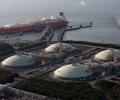
Around 15 years ago, when Reliance Industries (RIL) struck natural gas in the Krishna-Godavari (KG) basin off the east coast, the government made plans to supply that fuel cheaply to scores of generators that sprang up in India triggered by the discovery. Most of the plants, which account for 6 per cent of India's total generation capacity, operate sparsely after the KG-D6 area first failed to meet production targets, and then finally shut shop. Affordable domestic gas was why those thermal plants came up and the rate of the fuel today is why those generators hardly operate. Record liquefied natural gas (LNG) rates may yet again unravel India's ambitions to expand use of gas in industries, households and vehicles. Rates, while volatile, may stay strong this decade as developed nations with higher purchasing power embrace gas as the transition fuel.
Notwithstanding the windfall tax placing a cap on profits, oil and gas producers like Oil India (OIL) and Oil and Natural Gas Corporation (ONGC) have done well in the October-December quarter (third quarter, or Q3) of 2022-23 (FY23). ONGC faces the drag of poor results from its subsidiary Hindustan Petroleum Corporation, and in comparative terms, OIL is better off. Standalone net sales in Q3FY23 stood at Rs 5,900 crore - up 57 per cent year-on-year (YoY), up 2 per cent quarter-on-quarter (QoQ).

The price would increase from $4.2/mbtu to $10/mbtu if Rangarajan formula is accepted.

Based on the panel's formula, the base price of domestic natural gas comes to around $7.4 per million British thermal unit (mBtu), but the pricing formula proposed by RIL, officials say, translates the price into $13-14 an mBtu.
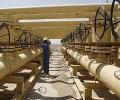
The approval is required to put through gas sales agreements with customers, which in turn are required to finalise Gas Transportation Agreements with transmission companies.

After Moily took over as oil minister, the central government agreed to link prices with global indices.

A bench headed by Chief Justice P Sathasivam sought response from the Centre and RIL on a PIL filed by Communist Party of India Member of Parliament Gurudas Dasgupta who alleged that no due diligence was done by the government while increasing the price of natural gas.

The petroleum ministry has said Reliance Industries Ltd (RIL) is not right in seeking an out-of-turn rise in the price of natural gas produced from the KG-D6 fields and asserted the $4.205 per million British thermal unit (mBtu) rate will prevail unless pricing formula is changed.
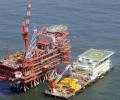
RIL estimates output from KG-D6 could reach up to 60 mscmd in the next five years, when all satellite fields are brought into production.
In a major relief to Mukesh Ambani-led Reliance Industries Ltd, the Bombay High Court Friday allowed the sale of gas from the Krishna-Godavari basin at $4.20 per million British thermal unit (mBtu) and reserved final judgment on a case brought by Anil Ambani-run Reliance Natural Resources Ltd.
Mittal said his steel plants were getting gas at no less than $6 per million British thermal unit (mBtu), much lower than the $4.33 per mBtu price proposed by RIL.
ONGC has been making an annual loss of about Rs 700 crore (Rs 7 billion) on sale of gas at administered prices and hoped the government will soon decide on hiking the fuel price. the present price of Rs 3.2 per cubic meters that ONGC gets for gas produced from fields given to it on nomination basis, was not sustainable. Price of about 80% of gas produced by ONGC is regulated by the Govt. PetroMin had recommended 16% increase in price of gas produced by ONGC and Oil India.
Indications emerged on Friday on the possibility of India and Iran reviving an LNG deal struck last year, with Tehran offering a new price and New Delhi saying it was willing to raise its offer slightly.
Tehran is seeking at least 7.2 dollars per mBtu price for gas it wants to sell to India and Pakistan through the over 7 billion dollar pipeline while New Delhi is willing to pay no more than 4.2 dollars per mBtu for gas delivered at its border.
Iran has changed its pricing formulae for liquefied natural gas sale to India and is demanding 28 cents more per million British thermal unit (mBtu).
Iran has sought a 20 per cent increase in price for the additional 2.5 million tonnes per annum of liquefied natural gas that India wants to buy, over and above the five million tonnes contracted earlier this week.
He added every dollar rise in the gas price will result in Rs 4,000 crore of revenue and Rs 2,300 crore in profit after tax.
A close examination of the government's decision-making process shows there were four specific reasons that influenced the Union Cabinet's Wednesday move to defer a decision on gas prices by three months, to September 30.

In the 38-page report, across 10 chapters, RIL explained how it entered the exploration and production business; the history of the New Exploration and Licensing Policy and the introduction of production-sharing contracts.
Locally produced gas in India will now cost at least 8 per cent less.

Mukesh Ambani's Reliance Industries (RIL) might be denied a higher gas price from its D1 and D3 fields until the arbitration process with the government is over and a third-party expert report on the fall in output at the KG-D6 block is out.
The government recently announced a new formula for determining the price of natural gas, lowering it from $8.4 suggested by the C Rangarajan committee.
RIL has proposed to charge the government- fixed rate for natural gas on a gross calorific value (GCV) basis, instead of net calorific value (NCV).

A bench headed by Chief Justice P Sathasivam sought response from CBI on the petition filed by Civil society members including former Cabinet Secretary T S R Subramanian and ex-Naval chief Admiral L Ramdas seeking probe by the agency in the alleged 'collusion between RIL and the political establishment'.
A swift recovery in oil demand in India is not only helping the stability of the global market, it is giving huge fiscal headroom to the government in terms of additional excise duty.

RIL declined to comment on this or related allegations, saying the entire issue was in court.

Anil Ambani's Reliance Natural Resources continued its attack on the government for allegedly favouring brother Mukesh Ambani's Reliance Industries Ltd on the sale price of gas from the Krishna Godavari D6 basin. At $4.2 per million British thermal unit (mBtu), the price fixed, there is a premium of more than 100 per cent over the gas available through the administered pricing mechanism, it said.
With the Mukesh Ambani-promoted Reliance Industries Ltd (RIL) planning to approach the Supreme Court, challenging a High Court order for selling gas at $2.34 per million British thermal unit (mBtu) to Reliance Natural Resources Ltd (RNRL), the chances of an agreement between the Ambani brothers by July 15 appear remote.
Anil Ambani's Reliance Natural Resources Ltd is laying claim (through a family agreement prior to the group's split) to gas from estranged brother Mukesh Ambani's Reliance Industries Ltd at a fixed price of $2.34 per mBtu
A price of $4.20 per million British thermal units is not viable for smaller gas discoveries, say industry experts.
The move apparently has been triggered by the drastic fall in international crude oil prices which have dived from $147 a barrel in August 2008 to below $40 now. In the old formula, taking crude price at $60 per barrel, the cost of gas at Iran-Pakistan border translated into $4.93 per mBtu. But according to the new formula, gas price will shoot up to $5.9 per mBtu although crude prices have crashed below $40 a barrel.
The crux of the ongoing court case between Reliance Industries (RIL) and Reliance Natural Resources (RNRL) on Monday was pricing of the gas produced from the Krishna-Godavari (KG) basin.

ONGC's chairman and managing director Sudhir Vasudeva tells Business Standard that any price for natural gas that is more than $4.2 a unit is good for the company.
Mukesh Ambani-promoted Reliance Industries will lose around $1 billion (Rs 4,300 crore) a year if it sells gas to the Anil Ambani's Reliance Natural Resources at the agreed price of $2.34 per million British thermal unit
"The letter approving a price of $4.20 per million British thermal unit (mBtu) for first five years of production from KG-D6 was issued by the Petroleum Ministry on Thursday," a source familiar with the development said.
 © 2026 Rediff.com - Investor Information - Advertise with us - Disclaimer - Privacy Policy - Sitemap - Feedback - About us - Terms of use - Grievances