
Russia and China have a broad consensus today on almost all core issues related to global strategic stability, which is unprecedented in modern history, observes Ambassador M K Bhadrakumar.

Pakistan will not cooperate with the US in Afghanistan unless and until the latter accepts its central role in the search for a settlement and accommodates its 'legitimate interests'. This is the crux of the matter, says MK Bhadrakumar.

Regional States will be worried that the US's nascent engagement with the Taliban behind the fig leaf of humanitarian aid enables the return of US intelligence personnel to Afghanistan, observes Ambassador M K Bhadrakumar.
Bhadrakumar feels that the "despite the dust and heat in domestic politics", the government has done remarkably well in the foreign policy sphere and signs of "new thinking" have appeared. "Which is why the new foreign secretary will prove to be a great asset to the government," he said.

Richard Holbrooke, who passed away on Monday, was probably inching toward his complete lifetime achievement -- as the architect of peace in Afghanistan and in South Asia, says M K Bhadrakumar.
Pious pre-summit homilies cannot hide the ugly truth that cooperation in energy security is going at snail's pace despite it being a strategic area for India. The high hopes raised 3 years ago during the visit by Vladimir Putin to Delhi remain unfulfilled, says M K Bhadrakumar.
Big-power rivalries in the Central Asian region have catapulted Pakistan into a key role in the US's regional strategy more than at any time, says M K Bhadrakumar.

The alacrity with which regional States responded to Delhi's invite signals that expectations are high regarding an Indian role in the efforts to stabilise the situation in Afghanistan, observes Ambassador M K Bhadrakumar.
The Afghan endgame is moving into a crucial phase. Much will depend on regional politics involving Pakistan, Iran, India and China. How far the US's 'divide-and-rule' strategy succeeds remains to be seen, says M K Bhadrakumar.
As Afghanistan President Hamid Karzai begins his two-day visit to India on Tuesday, policymakers face the challenge to get the Afghan plot straight, says former diplomat M K Bhadrakumar

'The big power struggle in faraway Europe erupted at a most critical juncture when India has been increasingly sceptical about American policies and statesmanship,' argues Ambassador M K Bhadrakumar.
Indian foreign policy is listlessly meandering. At times, it stands still lost in thoughts and then it dashes forward -- and the next thing you know, it begins dashing backward. The pantomime seems to be happening with no greater logic than that it creates the illusion of a flurry of activity -- and our PM feels good and dynamic, says M K Bhadrakumar.
In a clutch of ice-cold words Dr Singh conveyed a great deal outright rejecting any third party mediation and disabusing any Pakistani notions to the effect that India was coming under US pressure over the Kashmir issue.
The US is in desperate need to conjure up an ideology-driven relationship with India, to enable it to boost its arms exports to the Indian market, says M K Bhadrakumar.
The Headley case highlights that the Indian government proved incapable of assessing the geopolitical dimensions of the US-led war in Afghanistan, while Pakistan has shrewdly exploited the fallacies in India's foreign policy orientation to navigate itself to an unprecedented geopolitical positioning, writes M K Bhadrakumar.
While the United States is unlikely to launch an attack on Pakistan, the US military build-up on the Pak-Afghanistan border is the opening salvo to unfurl a "containment strategy" toward Pakistan, says M K Bhadrakumar
The "uncommitted" Malayali voter today has hardly any political choice available. Even if he were to choose the Congress-led UDF in the polls on April 13, he would be acutely conscious that five years hence he would have no choice but to revert to the communist-led LDF to run the successor government, writes M K Bhadrakumar
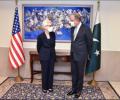
Russia and China are tight-fisted and Iran is broke and none of them has the political will or capacity to bankroll the Afghan economy, which only the US can, points out Ambassador M K Bhadrakumar.

The Taliban knows that Washington holds the key, points out Ambassador M K Bhadrakumar.
Ustad Abdul Rab Rasul Sayyaf, Afghan president Hamid Karzai's first choice as the speaker of the new Afghan parliament, is at once the perfect bridge the latter needs to reach out extensively in the Islamic world and Pakistan, says former diplomat MK Bhadrakumar, possibly the first and last India to have met Sayyaf in his native village

This visit has ended on a vastly different note in comparison with Modi's previous visits. Call it a rebuke, call it a censure, call it a distancing from Modi, the sharp message would have gone home, observes Ambassador M K Bhadrakumar.
In a fashion, his political life may yet be only beginning. Seared by the anguish of the past week's hellish experience, he may henceforth see things and India's political culture in a new, mature perspective. His 'homecoming' may have become complete.

'The Obama administration must show the sagacity to cooperate with Karzai's strategy,' says M K Bhadrakumar.
M K Bhadrakmar, the former diplomat and strategic thinker, reviews the first day of President Obama's visit to India.

'Frankly, India has no role to play.' 'This is a showdown between the US and NATO on one hand and Russia on the other.' 'That said, the outcome of this titanic struggle in Central Europe will remould the world order and affect India profoundly,' argues Ambassador M K Bhadrakumar.
With the agreement over processing of spent nuclear fuel, a major stumbling block for the 'operationalisation' of the Indo-US nuclear deal has been removed
M K Bhadrakumar, who is in Kerala covering the election, offers his take on how the importance of politics is receding for the average Malayali.

American analysts and their camp followers in India are talking absolute rubbish when they try to establish that India is facing a Hobson's choice in regard of Donbass, called upon to take sides between Russia and the West, asserts Ambassador M K Bhadrakumar.
M K Bhadrakumar says helping Pakistan with flood relief may help America win some hearts and minds in that country.

US Secretary of State Antony Blinken was asked by US Congressmen if the US had explore the possibility of northwest India for counter terrorism capabilities in Afghanistan. Blinken's remarks on India assume great importance, observes Ambassador M K Bhadrakumar

It is entirely conceivable that Modi began realising at some point that it will be a liability for India if he is seen as Trump's fellow traveller, observes Ambassador M K Bhadrakumar.
India's options are few. Can it drop its insistence on taking the 26/11 file to its bitter end? No elected government in New Delhi can adopt a policy of 'kiss-and-make-up' on the 26/11 file, given the public mood in the country regarding the horrendous nature of the crime that the ISI perpetrated.
China's profile as the South Asia's leading interlocutor highlights India's inability to lead its own sub-region. This is the stark message that the Indian establishment needs to cull from the Thimpu SAARC summit.
Some ministers have a different point of view from the current conventional wisdom in the Congress party and the UPA government.
'The overall India-US relationship is entering a mature phase where the two countries can have different perceptions or specific interests with regard to regional or global issues and can still talk about an enduring economic partnership to mutual benefit.'
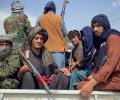
The US is not in a forgiving mood for being humiliated in such a manner by an insurgent force and made to look 'loser' internationally, predicts Ambassador M K Bhadrakumar.

The flawed Indian policy toward Afghanistan is missing the woods for the trees. The Modi government doesn't have a 'big picture', observes Ambassador M K Bhadrakumar, who played a stellar role in beginning India's systemic dealings in Afghanistan in 1994.

A confrontation with the Taliban in Kabul in this fading light of a twilight zone would have been sheer madness, observes Ambassador M K Bhadrakumar.

'There is little or no evidence that the return to representative rule in Pakistan last year means the supremacy of civilian government. The so-called permanent establishment remains in place -- the military, top echelons of bureaucracy and the intelligence agencies. The army continues to be in the driving seat with regard to foreign and defence policy, internal security and nuclear policy.'
M K Bhadrakumar on what the US and India should do to stabilise Afghanistan and rein in rogue elements in Pakistan.
 © 2026 Rediff.com - Advertise with us - Disclaimer - Privacy Policy - Sitemap - Feedback - About us - Terms of use - Grievances