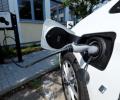
While traditional automakers in India are reeling under a global shortage of semiconductors, the country's electric vehicle (EV) makers, too, are now facing a shortage of lithium-ion batteries, a key raw material. The soaring prices of metals like lithium, nickel and cobalt, which are the primary constituents of the cell, as well as supply chain bottlenecks, are also pushing up the cost of batteries. Battery manufacturers say that prices have been increasing every quarter since the beginning of 2021.

'Policy-sensitive sectors will wait and watch, but policy-agnostic areas will continue based on normal consumption demand.'
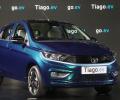
Tata Motors, the market leader in electric four-wheeler space, has sought incentives for its Tiago EV under the government's production-linked incentive (PLI) scheme, group chief financial officer P B Balaji said on Tuesday. The Mumbai-headquartered firm has applied for all variants of the Tiago, which recently hit a sales milestone of 10,000 units. "The Automotive Research Association of India certification is done.

This is a good opportunity for long-term investors to pick quality small and midcap stocks at reasonable valuations.

You increase the production, only then it is possible to reduce cost, Gadkari said.
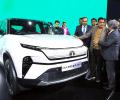
'I'm very much against petrol and diesel....'' 'I travel in an electric car.' 'I have had a really good experience with it.'
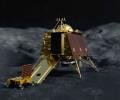
A number of private companies have contributed to the development of ISRO's Chandrayaan-3 spacecraft which successfully landed near the south pole of the Moon on Wednesday evening.
'I have personally been very keen on investing in lithium ion battery technology for some time.'

Prime Minister Narendra Modi on Wednesday said the world looks at India as an important pillar of stability, a trusted friend, an engine of growth in the global economy, a technology hub for finding solutions and a powerhouse of talented youth. He also said that in the rapidly changing world order, India is moving forward as 'vishwa mitra' (friend of the world). Speaking at the inauguration of the 10th edition of the Vibrant Gujarat Global Summit, which saw participation of state hea

Vader is the first electric bike in India to offer 7-inch Android display.
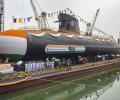
The status of the current submarine force level is alarming and we need to address the threat perceptions expeditiously. Critical decisions pertaining to national security cannot be delayed any further due to the rapidly changing maritime threat perceptions and growing strategic importance of the Indian Ocean region, asserts Commodore Venugopal Menon (retd).
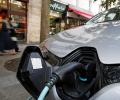
Road Transport Minister Nitin Gadkari on Tuesday said rapid strides in technology and green fuel will reduce the cost of electric automobiles, bringing them at par with petrol-run vehicles in the next two years. Replying in the Lok Sabha on the Demands for Grants for Road Transport and Highways Ministry, 2022-23, Gadkari emphasised the need to shift to cost-effective indigenous fuel and hoped that this fuel will be a reality soon, bringing the pollution levels down and improving the overall situation in Delhi.

'We are going to have hybrid cars, which, as far as I know, none of our competition is working on, and this includes ethanol.'

Nearly a decade ago, the first fully electric vehicle (EV) caught fire on the road in the US. It was a model from Tesla, the world's most admired EV maker. A metal fragment punctured the underbelly of the vehicle, penetrating its battery pack, leading to a fire. Indian lawmakers and automakers have had nine years to study the incident (in fact, three Tesla Model Ss caught fire in two months in 2013) but seem to have learnt little.

The government is considering the option of inviting fresh applications to bid for the fourth slot which fell vacant after one of the initial candidates who qualified, Hyundai Global Motors, exited from the production-linked incentive (PLI) scheme for advanced chemistry cell battery storage with a capacity of 20 GwH. Earlier, stakeholders had expected that the vacant slot would be offered to waitlisted players ranked on their technical and financial offer. A final decision will be taken soon.

There will be two variants on sale -- namely the F77 and the F77 Recon, priced at Rs 3.8 lakh and Rs 4.55 lakh (ex-showroom) respectively.

From the seas to the stars, this partnership will now be deepened by the defining role of technology, the statement said.

Billionaire Mukesh Ambani's Reliance Industries Ltd on Friday announced the buyout of British battery maker Faradion Ltd for an enterprise value of 100 million, as the oil-to-retail conglomerate continued with the acquisition of end-to-end technology for its multi-billion-dollar clean energy portfolio. Reliance New Energy Solar Ltd (RNESL), a unit of the nation's most valuable company, signed definitive agreements to acquire 100 per cent shareholding in Faradion for an enterprise value of 100 million and will invest an additional 25 million as growth capital to accelerate the commercial roll-out, the company said in a statement. Based out of Sheffield and Oxford in the UK and with its patented sodium-ion battery technology, Faradion is one of the leading global battery technology companies.
10 non-bank and non-finance stocks from the BSE500 Index universe that offer an optimal blend of low valuation, reasonably robust revenue and earnings growth in recent quarters, a strong balance sheet, and most importantly, positive cash flow from their operations.

E-vehicles may face pollution hurdle with hazardous batteries. One lithium-ion battery has a potential to poison the whole water aquifer of Delhi.

Railways is testing waters for locomotives to run on lithium-ion batteries, the most common ones used in electric vehicles.
India's climate change goals are turning combustible. On the one hand, a protracted dispute between the government and manufacturers over subsidies threatens to slow the pace of electric vehicle (EV) sales. On the other hand, repeated assertions by different arms of the government over banning sales of new fossil fuel-fired vehicles have queered the pitch for energy investments. Before we address the issue of the recommended diesel vehicle ban in the recent report on energy transition, issued months before the next round of global climate talks begin in Dubai in November, let's look at what's at stake.

With just a month left in this financial year, electric two-wheeler sales, so far, are at just 62 per cent of the ambitious target of 1 million units set for 2022-23 by the NITI Aayog. According to VAHAN data, compiled by the Society of Manufacturers of Electric Vehicles (SMEV), 620,006 units of electric two-wheelers were sold across the country in FY23 until February 21. Though the industry may miss the 1-million target, sales in FY23 are already up 146 per cent from 249,621 units sold in FY22.
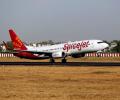
Aviation regulator DGCA has temporarily suspended SpiceJet's licence for the transportation of 'dangerous goods' for alleged violations, according to sources. The suspension is for 30 days, and during this period, SpiceJet will not be allowed to carry dangerous goods, including lithium-ion batteries, on its domestic as well as international flights, the sources told PTI on Friday. When contacted, a SpiceJet spokesperson did not directly mention the suspension.
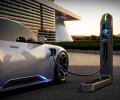
At Prestige Polygon Towers in Chennai's Teynampet, hectic preparations are on for a mega global investors' meet under the aegis of Guidance Tamil Nadu (the state investment promotion agency) scheduled for January 2024. Asked about the key focus areas of the meet, the agency's managing director and chief executive officer, V Vishnu, said the state was betting big on electric mobility. This is no surprise, given that the state has signed electric vehicle (EV)-related memorandums of understanding (MoUs) with several companies in the recent past that may bring in investments worth around Rs 33,000 crore with the potential to create over 43,000 job opportunities.

The Union Budget on Wednesday outlined several initiatives to drive India's technology agenda and boost digital infrastructure, including new centres of excellence for artificial intelligence, National Data Governance Policy, and Entity DigiLocker.

'In terms of semiconductors, challenges do remain in the pan industry, but I think we are much better than where we were a year or so back.'

German luxury car maker Audi on Thursday launched three all-electric SUVs under its e-tron range with prices starting from Rs 99.99 lakh kicking off its electrification journey in the country. The three all-electric SUVs -- e-tron 50, e-tron 55 and e-tron Sportback 55 -- are priced at Rs 99.99 lakh, Rs 1.16 crore and Rs 1.18 crore respectively (all prices ex-showroom), Audi India said in a statement. Commenting on the launch of the e-tron brand in India, Audi India Head Balbir Singh Dhillon said, "we are launching not one, but three electric SUVs that begin our electrification journey." The three electric SUVs are "the perfect confluence of luxury, zero emissions, performance and everyday usability", he added.
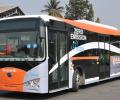
In view of cost, these vehicles will justify deployment only as public buses, taxis, three-wheelers

Only a few thousand chargers dot the Indian landscape, some in working condition, others not, with some held hostage to the power supply vagaries of local utilities, reports S Dinakar.

Niti Aayog CEO Amitabh Kant on Tuesday said it is difficult to carry out tough reforms in India and emphasised that more reforms are needed to make the country competitive in the global environment. Addressing a virtual event organised by Swarajya magazine, Kant said for the first time, the Centre has carried out hard reforms across sectors, including mining, coal, labour, agriculture, and the next wave of reforms must be pushed by the states.
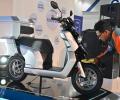
as the FAME II deadline of March 31, 2024, nears, EV manufacturers are worried about their investments and future plans.

Ola Electric on Monday said it will foray into the electric car segment with plans to launch its first model by 2024. The company, which struggled with deliveries for its electric scooters after it announced entry into the segment exactly a year ago, has set an ambitious target of selling 10 lakh electric cars by 2026-2027. In a press conference, Ola founder and CEO Bhavish Aggarwal said Ola Electric aims to provide a range of electric two-wheelers to electric cars which are priced in the range of Rs 1 lakh to Rs 50 lakh.

Tamil Nadu secured investments worth Rs 1.44 trillion on Monday by signing of memoranda of understanding (MoU) with 60 companies, laying of foundation stones and inauguration of new projects.

Finance Minister Nirmala Sitharaman on Wednesday raised the personal income tax rebate limit, doled out sops on small savings and announced one of the biggest hikes in capital spending in the past decade as she did a tight rope walk in the Budget between staying fiscally prudent and meeting public expectations in the year before general elections.

The discovery of a material that maintains a rechargeable sulphur cathode helps to overcome a primary hurdle to building a lithium-sulphur (Li-S) battery.

Researchers have developed a new architecture for lithium-ion battery anodes that could enable charging of portable electronics in 10 minutes, instead of hours.

When mounted on a vehicle, the scooter is charged automatically using electricity produced while driving, ensuring that the user can complete their journey seamlessly, using the e-scooter to reach their final destination after parking the vehicle.

Every week, we bring you fascinating videos, chosen by you, through your likes.
India's traditional companies are now moving full scale into the renewable and alternative energy space that had been dominated by smaller players over the past decade. Companies such as government-owned NTPC and the Adani and the Tata groups restructured their businesses well in time to become major players in the green space. At the same time, other conventional companies, such as Larsen & Toubro and Reliance Industries Ltd (RIL), which have a presence both in the energy sector as well as myriad other activities - construction, technology and retailing - are tying up with new-age companies to hitch a ride to a greener path.
