
A bomb explosion at the Idinthakarai coastal village in Tirunelveli district in Tamil Nadu has killed six people, including three children, who were all aged below five. The blast site is close to Kudankulam Nuclear Power Plant.
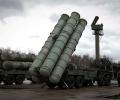
If India signs the deal, it would be the second customer of the prized missile system after China which had struck a $3 billion contract last year.
India will complete the process of putting its 14 civilian nuclear facilities under IAEA safeguards by the year end as part of a commitment made under the Indo-US nuclear deal.
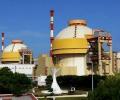
Nuclear Power Corporation of India Limited on Wednesday dismissed reports about a blast or steam pipe leak at the Kudankulam Nuclear Power Plant, saying there was only "an incident of hot water spillage" in which six persons were injured.

Modi said Kudankulum 1, an Indo-Russian project, was an important addition to the continuing efforts to scale up production of clean energy in India.
Left parties on Wednesday warned the government that it would commit an "illegal act" if it tried to dilute the Civil Nuclear Liability Act or signed any agreement for supply of nuclear reactors during the upcoming United States visit of Prime Minister Manmohan Singh.
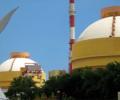
Legal hitches appear to have cropped up in the plans to set up two new reactors in the Kudankulam Nuclear Power Project and a commercial agreement on it is unlikely to be signed at the Annual Summit between Prime Minister Manmohan Singh and Russian President Vladimir Putin in Moscow on Monday.

The Kudankulam Nuclear Power Plant will attain criticality by mid-night on Saturday, Atomic Energy Commission Chairman S K Sinha announced in Tirunelveli.
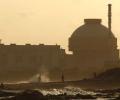
The Indian Nuclear Energy Pool, meant to insure risks from nuclear reactors, may take longer to be set up. While the idea of forming a pool was mooted earlier this year, it has reached a deadlock owing to differences among the stakeholders on certain clauses.

Several nuclear power projects held up for the lack of such an insurance pool can now be expected to move forward.
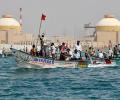
Mahatma Gandhi said that an eye for an eye only ends up making the whole world blind. A Ganesh Nadar/Rediff.com travelled to Idinthakarai, the epicentre of protests against the Kudankulam Nuclear Power Plant, where two factions of people chose to settle scores by hurling country bombs at each other.

Russia is a strong and reliable friend of India and both countries have a "truly strategic" partnership, PM Modi on Thursday told President Vladimir Putin.

In a candid chat with A Ganesh Nadar, S P Udaykuamr's wife Meera speaks about Idinthakarai's struggle, the sacrifices made by her and her two sons and more.

Kanika Datta explains why the Modi sarkar is gunning for non-profit organisations

During his two day visit, Modi is expected to seal a raft of major deals in defence, nuclear energy and hydrocarbons sectors to further cement their 'special and privileged strategic ties'.

Rediff.com's Sheela Bhatt, who is accompanying Prime Minister Manmohan Singh on his trips to Russia and China, notes that Moscow and New Delhi work together professionally and via a shared common approach on crucial issues.
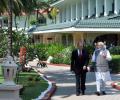
Big ticket defence deals including purchase of missile systems, frigates and joint production of helicopters were sealed on Saturday.
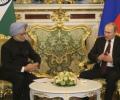
In a clear attempt to allay Russia's apprehensions, Prime Minister Manmohan Singh on Monday said it will remain an "indispensable" partner for India's defence needs even as he underlined that the bilateral ties should adapt to changing times to address challenges.

'Not a single person I spoke to there believes that the Kundalkulam plant is safe.'
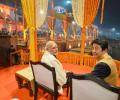
'Modi and Abe are working seriously for India-Japan bonhomie to grow stronger.' 'It is a win-win situation for both countries and the future look promising,' says Rajaram Panda, the Indian Council for Cultural Relations India Chair Visiting Professor at Reitaku University, Japan.

The two countries also asked all nations to stop cross-border movement of terrorists and asserted that a decisive collective response from the international community without 'double standards and selectivity' was required to combat the threat of terrorism.
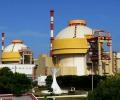
'Decisions on nuclear power have so far been taken by a small select group, primarily interested in profiteering from their actions, stating 'secrecy' as necessary from the national security point.' 'This argument is false, because we are dealing with the 'civilian' nuclear power sector, which is open even to the IAEA,' says Dr A Gopalakrishnan, former chairman of the Atomic Energy Regulatory Board.
 © 2026 Rediff.com - Advertise with us - Disclaimer - Privacy Policy - Sitemap - Feedback - About us - Terms of use - Grievances