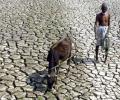
These three states sought a combined financial assistance of Rs 11,186 crore

Sanjiv Mehta, chairman of the country's largest consumer goods company, HUL, believes that the second wave of the Covid-19 pandemic between April and June this year has been a mere pause in India's consumption story, and that it will not change the country's overall growth trajectory. India is poised for growth, especially in the fast-moving consumer goods (FMCG) sector, Mehta told shareholders at the company's annual general meeting on Tuesday. The signs of recovery are becoming evident with many states lifting lockdown restrictions in recent weeks.

Uttar Pradesh, Bihar, Jharkhand, Odisha and Gujarat, have been left out, despite a strong start to the monsoon in June

India exports about 1.5 mt of onion every year.

Spiralling prices pinched the pocket of consumer as edible oil, fuel and many other commodities turned dearer this year amid pandemic-induced disruptions but the inflationary pressure is anticipated to ease, though marginally, in the coming months. As consumers, at retail as well as wholesale levels, are willy-nilly learning to live with the new normal of curbs to contain the spread of coronavirus infections, experts are of the view that elevated inflation is likely to stay longer. After dealing with the devastating blows from the second COVID wave, especially during the April-June period, the economy is well on the revival path but the emergence of Omicron might unsettle the recovery trajectory in the short term.
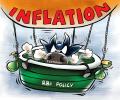
Currently, the retail inflation is well below the RBI's comfort level. The government has asked the central bank to keep inflation in the range of 4 per cent.

A favourable monsoon and government support to the rural economy are among the reasons that agrochemical companies, including makers of pesticides and fertilisers, have done well.

With social distancing in customer's mind coupled with the government's push to further normalise business conditions and banks becoming more considerate to finance vehicles, entry level passenger vehicles saw good demand.
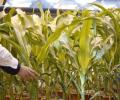
Low rain coupled with the fact that maize prices in the open market have surged from around Rs 15-16 a kg to almost Rs 25 this year have forced farmers to turn to this crop.

In Delhi, the wholesale price is now Rs 48-52 a kg; the retail one is Rs 80 a kg.

Much of the rural recovery story is based on the premise of agriculture doing well. Even if it clocks a growth of 2.5-3 per cent this year, it is still just around 15 per cent of the overall GDP. The non-farm sector, which constitutes a bigger portion of the overall rural economy, is now hampered by disruptions and lockdowns.

Bhupesh Baghel said about his father that he respected his father as a son, but as a chief minister, none of his mistakes that will disturb public order can be ignored.

For July-September, it pegged CPI-based retail inflation at 4.2 per cent which it saw firming up to 4.8 per cent in the second half of the current fiscal.
'Usually, urban wage rates are 50 per cent higher than rural wage rates. But, this could be narrowing very rapidly now,' points out Mahesh Vyas, CEO, Centre for Monitoring Indian Economy.
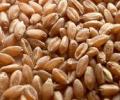
This year's kharif output may be higher than last year but it will be short of 2007 or 2008 levels.

In the context of RBI's view that the real interest rate, defined as the repo rate less "look forward" CPI, should be around 150-200 basis points.

The NITI Aayog, in a concept note floated a few months back, had suggested three models of procurement but the Centre, at least for the time being, has decided to rely on existing PSS schemes along with giving states the option of choosing Bhawantar Bhugtan for oilseeds.

Agriculture activity, according to recent channel checks by Prabhudas Lilladher, is expected to continue at a strong pace in FY22.

10 stocks which are most popular with brokerages right now and are expected to deliver maximum upside over the next 12 months.
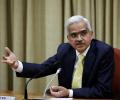
The Reserve Bank remains laser-focused to bring back retail inflation to 4 per cent over a period of time in a non-disruptive manner, Governor Shaktikanta Das stressed while voting for status quo in interest rates, as per minutes of the October policy meeting released on Friday. The central bank has been mandated by the government to ensure the Consumer Price Index (CPI) based inflation is at 4 per cent, with a band of 2 per cent on either side. The retail inflation, which was above 6 per cent during May and June, has started moving down and stood at 4.35 per cent in September.

NITI Aayog has been working on an action plan to relieve rural distress and energise the agricultural sector

The Bharatiya Janata Party-led state government is acquiring groundnut at Rs 4,500 per quintal; the market price is Rs 3,500 per quintal
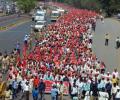
In the coming four months from August, agitating farmers will hold 400 meetings across the country to highlight farmers' issues and protest against government claims, reports Sanjeeb Mukherjee.

Under Pradhan Mantri Kisan Samman Nidhi (PM-KISAN) scheme, the Centre provides an annual financial benefit of Rs 6,000 to eligible beneficiary farmers in three equal four-monthly installments of Rs 2,000 each.
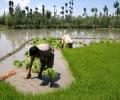
The final agriculture GDP numbers for 2016-17 are expected to be revised up, as rabi production is looking really good.
If the quantity purchased from anywhere in the country exceeds 25,000 tonnes, the central government will also have to be informed in writing.

Skymet is credited with correctly predicting the 2009 drought.

Prime Minister Modi has certainly pulled back, and his political capital -- dependent as it is on an image that he knows best and never retreats -- may have taken a bit of a beating. But, equally, it is hard to say that the protesters have 'won', argues Mihir S Sharma.

Owing to erratic monsoons this year, the kharif grain output is projected to fall 18 per cent to a seven-year low of 96.63 million tonnes against last year's 117.70 million tonnes.

The Reserve Bank on Friday said the agriculture growth will be muted this fiscal on account of the impact of poor monsoon on kharif crops.
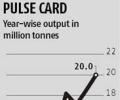
The India Pulses and Grains Association estimates production of kharif pulses at seven mt this year.

The India meteorological department has stated that day temperatures are likely to be above normal by 0.5 degree Celsius, reports Sanjeeb Mukherjee.
Farmers have either dropped or delayed sowing of summer crops due to poor rains.

While the likelihood of these states going the Lanka or Greece way may be an alarming assessment, the financial situation of some states such as Punjab and West Bengal is indeed quite weak.

The summer and rainy weather is favourable for locusts and they move from one place to another during this time, travelling 150 km in a day.

Indicators show green shoots in the economy with electricity and fuel consumption, inter and intra-state movement of goods, PMI data and retail financial transactions witnessing a pick-up, she said.

The recent improvement in consumer sentiment is almost entirely a rural India story. Much of the corporate sector reposes faith in rural India to fuel its growth, observes Mahesh Vyas.

However, the growth, driven largely by a bumper rabi harvest and facilitated by relaxation in lockdown, may not have resulted in a big rise in income for a section of farmers.

Among the key concerns of the Street is market share losses in growth segments, led by higher competitive pressures.

Till August 21, 246 districts were declared as drought affected, out of the 600-plus districts in the country.
 © 2026 Rediff.com - Advertise with us - Disclaimer - Privacy Policy - Sitemap - Feedback - About us - Terms of use - Grievances