
With the cooling down of heatwaves as the monsoon spreads across the country, power demand has fallen by 12.5 per cent from the start of this month till Monday. Peak power demand of the country had touched a record of 210 Gw last week, mostly due to rising temperatures and opening up of the economy. Compared with the beginning of this month, almost all states have seen a fall in power demand. Punjab, however, is an exception where the power demand on Monday was 17 per cent higher than on June 1.
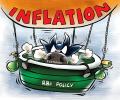
The RBI on Friday retained inflation forecast for FY23 at 6.7 per cent amid uncertain price trajectory on "geopolitical shocks" and on hope that inflationary pressures would ease with pick-up in kharif sowing and supply chain improvements. In its previous monetary policy review in June, it had projected retail inflation for 2022-23 at 6.7 per cent, higher from 5.7 per cent forecast in April. The six-member Monetary Policy Committee (MPC) unanimously decided to raise the benchmark repo rate by a steep 50 basis points to 5.40 per cent with immediate effect to tame inflation while supporting growth.

The country's unemployment rate in July fell to 6.80 per cent, the lowest level in the last six months, amid rising agriculture activities during monsoon, according to Centre for Monitoring Indian Economy (CMIE) data. The unemployment rate dropped to 6.80 per cent in July from 7.80 per cent in June, the CMIE data said. Rural unemployment declined 6.14 per cent to 272.1 million last month from 265.2 million or 8.03 per cent in June, it said.

Untimely rains during March have caused damage to rabi crops and may result in lower yields, a report said on Wednesday. Between March 1 and 21, cumulative rains have been 20 per cent more than normal, and in the past four days, it was 3-4 times more than usual, according to a report by Crisil Market Intelligence and Analytics. On March 21, the rain volume in central India was 1,600 per cent more than normal, the report said, adding that unfortunately, this ongoing harvest window for rabi crops has been lashed by an untimely torrent.

Less-than-expected rainfall and a poor spatial distribution, experts say, can rekindle fears of a rise in food and fuel inflation that can have an impact on the RBI's monetary policy. The fear of less than optimal rainfall due to El Nino this year, analysts believe, is the biggest short-term risk for the markets, which they said has not been fully priced in yet by them. Monsoon set over Kerala on June 08, a week later than its scheduled date.
Gross value added in agriculture and allied activities clocked a healthy growth rate of 4.5 per cent at constant prices in the second quarter of FY22, up from 3 per cent during the same period last fiscal year and 3.5 per cent in Q2 of 2019-20. In the first quarter of FY22, gross value added in the sector was also 4.5 per cent. Growth in current prices was also a healthy 7.9 per cent in July-September 2021-22, up from 7.3 per cent in the same quarter last fiscal year. It was slightly less than the 8.7 per cent of the second quarter of 2019-20.
Increase in kharif sowing area, good monsoon, rural cash flows and base effect among factors that have driven volumes.

The Reserve Bank of India on Friday raised the benchmark lending rate by 50 basis points to 5.40 per cent to tame inflation.
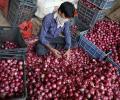
He said the onion farmers need to get a good price for the crop and the affected farmers get compensation.
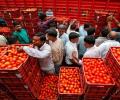
All India average retail tomato price, which has shot up by 63 per cent to Rs 67 per kg over the last year due to unseasonal rains, are likely to soften from December with the arrival of fresh crop from northern states, the government said on Friday. In the case of onions, retail prices have substantially subsided below to the level that prevailed in 2020 and also 2019, it said. "Tomato arrivals from north Indian states will start from the beginning of December itself, which will add to availability and lead to fall in prices.

Several experts are of the view that inflationary pressure, including that in food items, may build from October with economic activity gathering steam. However, the price movement in three key items of tomato, onions and potatoes, commonly known as TOP, may give some solace in the months to come. Traders and market watchers said the price movement in all the three will remain within the band sans any unusual spikes.
The Reserve Bank of India (RBI) will maintain the policy repo rate at 6.5 per cent during its upcoming June 8 announcement, considering the easing of retail inflation in April and the potential for further decline, indicating the effectiveness of previous policy rate actions, anticipate experts. Headed by Reserve Bank Governor Shaktikanta Das, a meeting of the six-member Monetary Policy Committee (MPC) is scheduled for June 6-8. The decision of the 43rd meeting of the MPC would be announced on Thursday, June 8.

Enthused by higher than expected GDP numbers in the fourth quarter of 2022-23, Chief Economic Adviser (CEA) V Anantha Nageswaran on Wednesday said India's economic growth may exceed the initial estimate of 6.5 per cent in the current fiscal and the country can look for another year of solid economic performance.
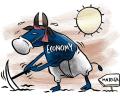
However, demand was still much higher compared to the previous years, underlining the scheme's vital role in providing employment to the rural poor, a vast majority of whom are migrants.

The south-west monsoon on Tuesday started withdrawing from parts of south-west Rajasthan and adjoining Kutch in Gujarat, with at least eight states, including rice bowl states of Uttar Pradesh and Bihar reporting deficient rains. It was for the first time since 2016 that the monsoon started withdrawing in the third week of September. "Southwest monsoon has withdrawn from parts of southwest Rajasthan & adjoining Kutch today, against its normal date of withdrawal from southwest Rajasthan of September 17," the India Meteorological Department (IMD) tweeted.
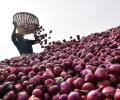
The model or average price for a kg of onion was Rs 6 on Monday -- the lowest in this late kharif and rabi harvesting season, so far. While poorer quality kharif onions traded at Rs 3 a kg, the price of export quality was Rs 9 a kg.

The southwest monsoon is set to make its exit in style, bringing rains to the parched parts of Uttar Pradesh and Bihar, as weather forecasters have picked up signs of formation of a cyclonic circulation over Bay of Bengal. Addressing a press conference in New Delhi, India Meteorological Department (IMD) director general Mrutyunjay Mohapatra on Thursday junked last week's forecast of early withdrawal of southwest monsoon and announced the extended stay of the seasonal showers. "Even though we expected early withdrawal of the southwest monsoon, a cyclonic circulation over west-central and adjoining northwest Bay of Bengal will shift the monsoon trough southwards around September 7.

In the national capital, onion prices were ruling at around Rs 40 per kilogram.
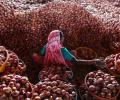
Last week, the Union Cabinet decided to import 1.2 lakh tonnes of onions to improve the domestic supply and control prices, which touched Rs 100 per kg earlier this month.

Riding high on the hopes of a normal monsoon, the agriculture ministry aims to increase foodgrain production by 6.35 million tonnes to a record 298.3 million tonnes in the 2020-21 crop year. The foodgrain output in the 2019-20 crop year (July-June) is estimated at an all-time high 291.95 million tonnes, as per the second advance estimates released by the ministry in February.
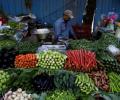
Retail inflation fell to a 15-month low of 5.66 per cent in March, mainly due to a decline in food prices, government data showed on Wednesday. The inflation figure in March is within the RBI's comfort zone as it is below 6 per cent. The retail inflation based on Consumer Price Index (CPI) was 6.44 per cent in February 2023 and 6.95 per cent in the year-ago period.
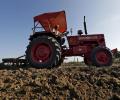
This rise was spurred by record kharif sowing - after a good rabi season - that ensured high disposable incomes in rural India.

Between June 1 and July 28, about 32 per cent of the 685 districts in the country did not receive adequate rainfall.
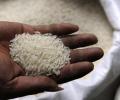
India has defended its decision to ban export of wheat and rice at a WTO meeting even as some member countries have flagged concerns over the country's stand, an official said. At a meeting last week in Geneva, Senegal, the US and the European Union raised questions over this decision, stating it could have adverse implications on global markets. In May, India restricted export of wheat to enhance domestic availability.
Maruti Suzuki says it has sold at least one car in 418,000 villages.

Reserve Bank of India (RBI) on Wednesday upped inflation projection for the current fiscal to 6.7 per cent from 5.7 per cent forecast in April. RBI Governor Shaktikanta Das said the upside risk to inflation persists and the recent spike in tomato prices would fuel food inflation. Also, high global crude oil prices would add to the upside pressure on inflation. The upward revision in inflation projection comes as domestic retail inflation has remained above RBI's comfort level of 6 per cent for four months in a row, mainly due to the Russia-Ukraine war which has impacted the prices of commodities across the globe.

'The Fed rate will peak in the range of 5.1-5.3 per cent during the second quarter of CY23 and will most likely stay there for a while before rate cuts start in CY24.'

The slowdown in sowing is mainly because of the delayed onset of the southwest monsoon and its slow progress in June.

According to state officials, the project envisages lifting of 17.40 thousand million cubic feet of water from river Thunga to Bhadra reservoir and 29.90 TMC from Bhadra reservoir.
'If you see the composition of items which are causing this spike in prices, most of them have little to do with the kharif harvest, except for pulses and vegetables to some extent.' 'I don't know on what basis the government is claiming that food prices will moderate in the weeks to come.'

Karnataka, Andhra Pradesh, Tamil Nadu, Rajasthan, Maharashtra, Bihar, Uttar Pradesh, Madhya Pradesh, and Gujarat account for 85 per cent of India's maize production.

'An eerie similarity with 2019 inflation trajectory could now mean that the RBI and market inflation estimates could go awry.'
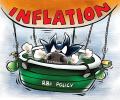
The Consumer Price Index (CPI)-based inflation is now projected to be at 5.3 per cent for 2021-22 with risks evenly balanced. In its August policy, the central bank had estimated inflation to be at 5.7 per cent due to supply side constraints, high crude oil and raw materials cost.

The met department said that rainfall in August is projected to be within the normal range at 97% of LPA. In August and September, India receives around 43 mm of rainfall.
Retail inflation softened to 6.71 per cent in July due to moderation in food prices but remained above the Reserve Bank's comfort level of 6 per cent for the seventh consecutive month. With retail inflation continuing to remain high despite a fall in prices of vegetables and edible oils, among other commodities in July, the Reserve Bank of India (RBI) might go for another rate hike in September. The Consumer Price Index (CPI) based retail inflation was at 7.01 per cent in June and 5.59 per cent in July 2021. It was above 7 per cent from April to June this fiscal.
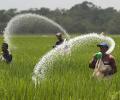
India's fertiliser subsidy bill is likely to shoot up by 55 per cent to record Rs 2.5 lakh crore this fiscal as the government will provide additional funds to make up for the spike in cost from higher import price, top sources said on Thursday. The government will ensure that there is no shortage of fertilisers in the country during the kharif (summer-sown) and rabi (winter-sown) season and it is already in talks with major global producers to import key soil nutrients, they added. According to the sources, Union Chemicals and Fertilisers Minister Mansukh Mandaviya is likely to visit many countries, including Saudi Arabia, Oman and Morocco, soon to secure imports on both short and long term basis.
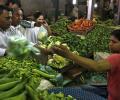
Retail inflation dropped marginally to 7.01 per cent in June mainly due to slight easing in prices of vegetables and pulses, though it still remained above the Reserve Bank's comfort level for the sixth month in a row. The consumer price index (CPI) based inflation stood at 7.04 per cent in the preceding month of May and 6.26 per cent in June 2021. Inflation in the food basket in June 2022 was 7.75 per cent, compared to 7.97 per cent in the previous month, as per the National Statistical Office (NSO) data released on Tuesday.

The southwest monsoon might finally start withdrawing from parts of North-West India over the next three days, signaling the end of its four-month journey over the country that started in June, the India Meteorological Department (IMD) said. However, though the retreat might begin from next week, the rains might not descend quickly, as the met department predicted fresh spells of rains in Vidarbha, Chhattisgarh and east MP on September 21-22 and over Odisha, Coastal areas north Andhra Pradesh and Gangetic West Bengal on September 19-21. "Due to anti-cyclonic flows over northwest India at lower tropospheric levels, dry weather is very likely over west Rajasthan, Punjab, Haryana, Chandigarh and Delhi during the next five days. "Hence conditions are becoming favourable for the withdrawal of Southwest Monsoon from parts of northwest India during next three days," the IMD said.
The Reserve Bank of India on Friday raised the retail inflation forecast for 2021-22 to 5.7 per cent due to supply side constraints, high crude oil and raw materials cost. The RBI in June had pegged the retail inflation estimate at 5.1 per cent for the current financial year. The RBI has the mandate to keep inflation in a band of 2-4 per cent, with a tolerance level of 2 per cent on either side.
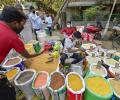
The impact of fiscal measures announced by the government to contain inflation will be seen in the next few months because of the base effect, reports Indivjal Dhasmana.
 © 2026 Rediff.com - Advertise with us - Disclaimer - Privacy Policy - Sitemap - Feedback - About us - Terms of use - Grievances