
At the pre-Budget meeting at Niti Aayog, Modi called for a focussed effort from all stakeholders in order to achieve the target of $5 trillion economy. The participants urged the government to focus on credit expansion, exports growth, governance of PSBs, increasing consumption and job creation.

Observing that India's worsening COVID-19 situation and the strict measures to contain it have hit the economy hard, the rating agency said productive capacity has been severely disrupted since the start of the pandemic.

The President in his address to the joint sitting of Parliament unveiled the policies and priorities of the BJP - led NDA government which assumed power last month after elections to the 16th Lok Sabha.

The government has created a comprehensive budget with sharp focus on sustaining economic activity and investment but more clarity is needed on areas like taxation framework for adopting remote working on a long-term basis, IT body Nasscom said on Monday. The industry association noted that the IT/ITeS (Information Technology-enabled Services) industry has been a key driver of growth and jobs in 2020 and there is an opportunity to significantly accelerate it further. "For the IT sector, one of the biggest needs ahead of us is the development of future business models, with hybrid working becoming a reality. "We look forward for the government to provide clarity on providing a framework in direct taxes and indirect taxes for the industry to adopt WFH/remote working on a long-term basis," Nasscom said in a statement.
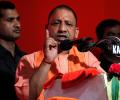
Chairing a review meeting of Agra division, the chief minister made it clear that his government 'always nurtured nationalist ideology and anything which smacks of subservient mentality will be done away with', the UP government said in a statement.

India's macroeconomic situation is improving fast and the country's GDP growth will turn positive in the third and fourth quarters of the current financial year, eminent economist Ashima Goyal said on Sunday. Goyal in an interview to PTI said the management of the COVID-19 pandemic and gradual unlocks announced by the government have helped in avoiding multiple COVID-19 peaks. The growth estimates by different agencies are being continuously revised, she said.
There were a lot of expectations from Narendra Modi government's maiden Budget. How did it fare?

About 13 million first time car/two-wheeler buyers are entering the market every year. If employment creation is such a big issue, where are these people coming from, asks Mahesh Nandurkar.
The party promised to contain inflation, pursue tax reforms and promote foreign investments.

Addressing the Congress Working Committee meeting, she said thousands of young men and women, especially students have realised the "grave harm" that implementation of the new citizenship law will cause.

Goyal also announced hiking of tax free gratuity to Rs 30 lakh from existing Rs 20 lakh for employees having service of more than five years.

Reflecting a loss of "growth momentum", manufacturing activities in the country slowed down to a six-month low in March amid softer increases in new orders, production and employment, according to a survey.

To help revive the economy battered by COVID-19, Finance Minister Nirmala Sitharaman on Monday announced a slew of measures, including Rs 1.1 lakh crore credit guarantee scheme for improving health infrastructure, and enhancing the limit under the ECLGS by 50 per cent to Rs 4.5 lakh crore for the MSME sector facing liquidity crunch. Sharing the details of stimulus package, the finance minister said this comprises eight relief measures and other eight measures to support the economic growth. She announced Rs 1.1 lakh crore loan guarantee scheme for COVID-affected sectors, including health sector, which includes guarantee cover for expansion or for new projects. Besides, she said, additional Rs 1.5 lakh crore limit enhancement done for Emergency Credit Line Guarantee Scheme (ECLGS) scheme.

In signs of sluggishness in the labour market, hiring activities declined in May as employers remained cautious tracking macro economic conditions.

Prime Minister Narendra Modi on Friday said production linked incentive (PLI) scheme, which is aimed at boosting domestic manufacturing and exports, is expected to increase the country's production by $520 billion in the next five years. Addressing a webinar on PLI scheme, organised by Department of Industry and International Trade (DPIIT) and NITI Aayog, through video conference, Modi said the government is continuously carrying out reforms to boost domestic manufacturing. In this year's Budget, about Rs 2 lakh crore was earmarked for the PLI scheme for the next five years and "there is an expectation that the scheme would result in increasing the production by about $520 billion in the next five years", he said. He added that there is also an expectation that the current workforce in the sectors, which will avail the benefits of the PLI scheme, will be doubled and job creation will also increase.

New risks have been identified, which include risk of non-compliance, business investment risk and legal regulatory risk.
Leading social networking site LinkedIn had examined the data of over 259 million members' profiles to determine the top 10 most popular job titles that were non existent in 2008.

The new rules are aimed at providing a strong impetus to the industry and positioning India as one of the most competitive IT jurisdictions in the world.
Concerned with the continuous downward revision, the EPFO has since last month begun counting people quitting their previous jobs and joining a new one as an addition to the net payroll.

Sector-wise, IT and BFSI sectors are expected to witness the maximum number of job creation, followed by manufacturing, pharma and ITES.

Growth under NDA has been reasonable, inflation, exports and job creation are problem areas

43 months after Modi's election promise that his government would create 10 million jobs, the reality does not paint a pretty picture, warns Shyamal Majumdar.

A glance back at some important events that occurred in 2018.
India should be given credit for helping America recover from the economic crisis, says S Jaishankar, India's new Ambassador to the US.

He did not specify which executive actions Trump will repeal.

'Mr Modi has inherited a system that taxes businessmen and fritters the money away over ministries.'

In televised remarks after Finance Minister Nirmala Sitharaman presented the budget, Modi said it has many provisions for the agriculture sector, including for making loans easier for farmers.

According to the report by WEF and Deloitte Touche Tohmatsu, the manufacturing sector not only adds value to the overall economic growth but also helps in creating more jobs than any other sector.

'They want (the ownership and management of PSU banks) to pass into the hands of a private sector entity.' 'Ownership of these banks will go from the public sector to private sector.'
Falling economic growth, fewer job opportunities call for a smart response to handle your finances well. Here's how you can make a small beginning.

The proposed campus will come up on around 125 acres, which the company will acquire from airport authorities, and would house as many as 3,000 employees.

India and the 27-nation European Union are negotiating Broad based Trade and Investment Agreement since June 2007, but a breakthrough has not yet been achieved due to strong differences on several of the issues.

The earlier forecast expected to see 654 million working Indians overall by the fiscal year ending 2022.

The pandemic has brutally highlighted the inadequacy of India's administrative systems. And, the government has demonstrated its culpable inability to speed up vaccination in a timely manner, says Jaimini Bhagwati.
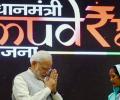
After taking benefit of the scheme, jobs increased by around 11 mn in establishments that took loans.
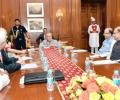
Government will lay greater emphasis on social sectors, finance minister said.

They are in desperate need of attracting individuals with the right skills and talent.

The decision was taken during the eighth meeting of the India-Sri Lanka Joint Commission in New Delhi on Tuesday. The meeting was co-chaired by External Affairs Minister Salman Khurshid and his Sri Lankan counterpart Prof. GL Peiris.

However, the growth during the next financial year would be higher at 8.1 per cent in case of a second wave of the coronavirus and bit slower at 7.9 per cent if the virus recedes and remains under control.
Enthused by improving global economic scenario and a renewed wave of reforms back in India, IT giant Infosys says it is bullish over better growth prospects of IT sector in 2013 and expects greater job creation this year.
 © 2026 Rediff.com - Investor Information - Advertise with us - Disclaimer - Privacy Policy - Sitemap - Feedback - About us - Terms of use - Grievances