
Despite a steady collection rate, the government faces a steep Budget target of Rs 6.1 trillion for CGST for 2019-20.

Accounting for the first Advance Estimates for 2017-18, an additional planned borrowing of Rs 200 billion, the fiscal deficit could come in at 3.35 per cent of GDP.

GST collections in March touched a record high of over Rs 1.23 lakh crore, a 27 per cent growth over the year-ago period, the Finance Ministry said on Thursday. "GST revenues crossed above Rs 1 lakh crore mark at a stretch for the last six months and a steep increasing trend over this period are clear indicators of rapid economic recovery post pandemic," the ministry said. Closer monitoring against fake-billing, deep data analytics using data from multiple sources including GST, income tax and customs IT systems and effective tax administration have also contributed to the steady increase in tax revenue over last few months, it added.

For fiscal 2019-20, the GST collection target has been budgeted at Rs 13.71 lakh crore.
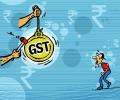
The broad trends of GST collections will make you wonder if indeed the biggest indirect tax reform in the country has led to a real improvement in revenues, notes A K Bhattacharya.
For 2019-20, the government proposes to collect Rs 6.10 lakh crore from CGST and Rs 1.01 lakh crore as compensation cess.

The data primarily pertains to activities in March, which had only a few days under the Covid-19 lockdown. For April , hence, CGST collections could be much lower, fear analysts.
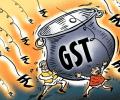
One of the grey areas is whether the anti-profiteering provisions can provide for a comparison of tax rates between the pre-GST and post-GST eras, says Niraj Bagri.
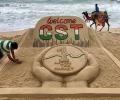
Mop up grows 10% y-o-y at Rs 1.05 trillion, almost equal to levels in February before a nationwide lockdown to contain the coronavirus pandemic

'From the tiniest to mid-level organisations and even some at the lower end of the large-scale ones would say that computerisation and the extensive documentation and regulatory requirements for GST have made the compliance process worse in many cases.'

Only after its recommendations will the central GST, integrated GST and state GST Bills be taken up

To meet the yearly target, each of the next five months has to yield Rs 1.107 trillion GST collections.
The shortfall in the Centre's GST collections has raised concerns over it meeting the fiscal deficit target of 3.3 per cent of GDP, reports Ishan Bakshi.
The mop-up could have been much higher, but tax on imports fell 2 per cent y-o-y.

Currently, the five-year FTP aims to raise total exports to $900 billion but targets may be reduced

Is the curated and limited data put out by the central government sufficient enough to pass a judgement on the trend in GST collections, particularly that of the Centre?
Only 69 per cent of the assessees filed returns

The recent surgical strikes in Pakistan-occupied Kashmir are expected to grab limelight during the month-long session. Some parties have alleged that the government is trying to politicise it.
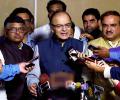
The Centre is likely to introduce the Central GST and integrated GST bills in late November or early December in the ongoing session in the form of money Bills.

It is possible that the Centre has now become wiser and has decided to follow an allocation system which gives it more from Integrated GST and helps boost its revenues, says A K Bhattacharya.

The panel might also decide on a new chairman.

K M Mani was appointed the chairman of the panel in March this year.

The Bills are primarily aimed at helping the MSME sector and small traders, Finance Minister Piyush Goyal said while introducing these in the Lok Sabha
The revenue collection in the same month a year ago stood at Rs 94,442 crore.

Businesses need to get on board in 15 days, ahead of indirect tax roll-out
Tax experts said historically in July and August indirect tax collections remain subdued and pick up with the onset of the festive season post Ganesh Chaturthi.

States should have enough time. We still do not know the rules. There are a lot of operational difficulties, says Jammu and Kashmir Finance Minister Haseeb Drabu.
Since its rollout 13 months ago, the new indirect tax has yielded Rs 1 trillion only in in April 2018

The GST bill's draft says tax would be levied on Maximum Retail Price
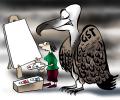
Experts said if the slowdown, and subsequent weakness in GST mobilisation, continued, it would curtail the Centre's resources to a considerable extent in the current financial year.
The total revenue earned by central government and state governments after regular settlement in December was Rs 43,851 crore for CGST and Rs 46,252 crore for SGST.

The revised structure will help to keep airfares down, when airlines already face a triple challenge of rising crude oil prices, rupee depreciation and constrained airport capacity.
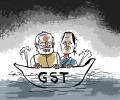
The collections stood at Rs 98,202 crore in the month, against Rs 1.02 trillion in July. The figures indicate continuation of economic slow down which was reflected in the gross domestic product (GDP) growth which plummeted to a 25-quarter low of 5 per cent in the first quarter of 2019-20, experts said.
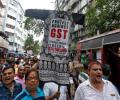
After 17 tumultuous years, a nationwide Goods and Services Tax (GST) will rollout from midnight of June 30, overhauling India's convoluted indirect taxation system and unifying the $2 trillion economy with 1.3 billion people into a single market.
The passage of the bill will pave the way for setting up of a GST council that will decide the tax rate, cess and surcharges.

The consensus was reached after the Centre agreed to the demand of states to go in for horizontal split

References to the repealed laws for service tax, purchase tax, etc, continue in the SEZ laws.
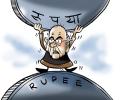
For the first eight months of the current financial year, the figure stood at Rs 7.17 trillion.

States are apprehensive of losing their rights to raise revenue during emergencies.

A corpus of Rs 20,000-30,000 crore is under consideration, to narrow the input tax credit cycle and facilitate their working capital requirements.
 © 2026 Rediff.com - Advertise with us - Disclaimer - Privacy Policy - Sitemap - Feedback - About us - Terms of use - Grievances