
India has commissioned its new indigenously-built nuclear-powered ballistic missile submarine INS Aridaman into service, further strengthening the naval component of its nuclear triad. Defence Minister Rajnath Singh also highlighted the Indian Navy's role in securing maritime trade routes.
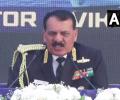
India is strengthening the naval component of its nuclear triad with Navy Chief Admiral Dinesh K Tripathi on Tuesday saying that the third indigenous nuclear-powered submarine 'Aridaman' will be commissioned soon and that his force is focusing on boosting its overall combat prowess.

In 2025, India launched Operation Sindoor, a multi-domain combat mission against Pakistan in response to cross-border terrorism. The operation involved precision strikes, military retaliation, and diplomatic measures, marking a significant shift in India's security policy.

In a major step towards completing its nuclear triad, India has activated the atomic reactor on-board the indigenous nuclear submarine INS Arihant, paving the way for its operational deployment by the Indian Navy.

Dhanteras, the prime minister said, has become even more special.

India's second nuclear-powered ballistic missile submarine was commissioned into the Navy on Thursday in the presence of Defence Minister Rajnath Singh who said this will further strengthen the country's nuclear triad and enhance nuclear deterrence.

With this new induction, the country has the capability to launch nukes from land, air and sea.

With this India joins the select group of countries which have a nuclear triad -- capable of delivering nuclear weapons by aircraft, ballistic missiles and submarine launched missiles.

Pakistan on Monday termed the induction of an indigenously-built nuclear-powered submarine by India as a 'destabilising step' and said it was capable of defending itself in the face of all such regional challenges. "The government of Pakistan is fully aware of this issue and is prepared to counter it at all levels. Pakistan's defence is fully prepared to face this challenge," Defence Minister Chaudhry Ahmed Mukhtar told reporters.

With the indigenous nuclear submarine INS Arihant set to be launched for sea trials in few weeks, India will soon complete its nuclear triad giving it the capability to respond to nuclear strikes from sea, land and air-based systems.
With the launch of the first indigenous aircraft today, India will join a club of nations like the United States, Russia, China, the United Kingdom and France that possess nuclear-powered submarines

Adm R K Dhowan is also likely to take a closer look at the submarine building assembly line at the Naval Dockyard co-located with the Eastern Naval Command, on his maiden visit to a field command since taking over, reports RS Chauhan.

India's first indigenous nuclear-powered submarine is a considerable achievement -- and should have an impact on security strategy
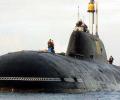
India's nuclear-powered submarine INS Arihant on Friday carried out a successful launch of a submarine-launched ballistic missile (SLBM) in the Bay of Bengal with a 'very high accuracy', the defence ministry said.

The Indian troops guarding the nearly 3,500-km Line of Actual Control (LAC) maintained an assertive approach in sync with the broader national security doctrine and procured a variety of military platforms and weapons to enhance their combat capabilities.

Moving towards completing its nuclear triad, India will activate the atomic reactor on-board the indigenous nuclear submarine INS Arihant in the "next two to three weeks" paving way for its operational deployment by the Navy soon.
Arihant, the first submarine under the Advanced Technology Vessel (ATV) programme, was launched for sea trials on July 26 this year at a naval yard in Visakhapatnam by Prime Minister Manmohan Singh's wife Gurcharan Kaur.
The Indian Navy is all set to join the global elite club on Sunday when Prime Minister Manmohan Singh formally launches the indigenously-built nuclear-powered submarine INS Arihant at the naval dockyard of the Eastern Naval Command in Visakhapatnam.Prime Minister will arrive at the ENC's airbase INS Dega in Visakhapatnam by a special Indian Air Force plane along with his wife at 11 am and drive straight to the naval dockyard to commission INS Arihant into the sea.

Veteran atomic scientist and former chairman of Atomic Energy Commission Dr Sekhar Basu succumbed to Covid-19 early on Thursday at a private hospital in Koklata, a health department official said. He breathed his last just three days after turning 68.

Hydrography (underwater geography) prevents the Indian Navy for opting for an all-conventional, or all-nuclear submarine fleet.

In yet another accident involving the Navy, one civilian worker was killed and two were injured in an accident at the under-construction nuclear submarine at the shipbuilding centre of Eastern Naval Command in Visakhapatnam on Saturday night.
"Arihant is steadily progressing towards its operationalisation and we hope to commence sea trials in the coming months. Given our unequivocal no-first-use commitment -- a retaliatory strike capability that is credible and invulnerable is an imperative. The Indian Navy is poised to complete the triad and our maritime and nuclear doctrines will then be aligned to ensure that our nuclear insurance comes from the sea," Navy chief Admiral Nirmal Verma said
India's indigenous nuclear-powered submarine INS Arihant will be ready for deterrent patrols in two years from now, completing the nation's capability to deliver strategic weapons from land, air and undersea.
Launch of the indigenously built nuclear-powered submarine has been planned for July 26 to coincide with Vijay Diwas. A host of Navy and defence officials are expected to grace the occasion.

C2C DB Systems is tightly integrated into India's warship production eco-system.
A democracy can only thrive when there is real unity based on common identity. India is still more than 85 percent Hindu and unless there is renaissance in Hindu society and peace between Hindus and Muslims, India cannot exploit its creative and intellectual strengths.
'India has so far spent Rs 30,000 crores on the ATV, with virtually no side benefits. This equals the entire budget of the National Rural Employment Guarantee Act last year, which generated 45 million person days of employment.'
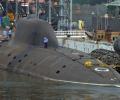
The INS Chakra III will be ideal for 'sea denial' missions, in which the submarine denies the enemy the use of the sea.
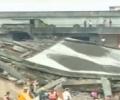
A two-storeyed building housing a garment factory had collapsed in Kalher village near the powerloom town in the wee hours killing one worker on the spot and injuring 24 others, they said.

For the navy, which is making do with just 14 conventional submarines against a requirement of 24, the INS Khanderi delay extends a dangerous operational void.
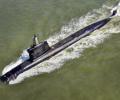
There were 35 defects that still remained to be resolved. Of these, 29 could not have been resolved during the monsoon since they required testing in absolutely calm seas. Nor is the Khanderi being commissioned with a full complement of its primary weapon, the torpedo.

'India must close the missile technology gap with both China and Pakistan as early as possible, or else the credibility of India's nuclear deterrence will remain suspect,' says Brigadier Gurmeet Kanwal (retd).
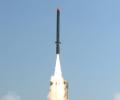
'So far, Pakistan leads India in subsonic cruise missile development, having tested and operationally deployed the Babur cruise missile that has a range of 700 km, significantly less than the Nirbhay's.'

The strategic illiteracy on display in the arguments put forth on the Rafale deal before the Supreme Court is breathtaking, argues Colonel Anil A Athale (retd).

The Agni-V can reach beyond Tibet to high-value targets in the Chinese heartland, even its northern-most provinces.

'It was deliberate,' the Russians allege.

'With Pakistan's 'first use doctrine' threatening the use of nuclear weapons early in a war with India, the S-400 will shield vulnerable targets like Delhi and Mumbai, complicating Pakistan's targeting calculations.'

Naval divers on Friday found bodies of three naval personnel from ill-fated submarine INS Sindhurakshak, which exploded and sank at the Mumbai dockyard early Wednesday.

The Indian Navy on Thursday released the names of the 18 crewmen who were present in INS Sindhurakshak, the submarine that exploded on Wednesday.

Indian Navy Chief Admiral R K Dhowan enumerated a three-pronged strategy to counter the country's minified submarine fleet.
 © 2026 Rediff.com - Advertise with us - Disclaimer - Privacy Policy - Sitemap - Feedback - About us - Terms of use - Grievances