
He, however, said sometimes such people spread wrong news or information about China on purpose.

India described Pakistan's allegations of stealing water as "preposterous and completely unwarranted". Pakistan has alleged that India is stealing its share of river waters and waging a water war, saying it is "scrupulously" providing Pakistan its share of water in line with the 1960 Indus Waters Treaty.
Indian High Commissioner Sharat Sabharwal said on Saturday that reduced flow of river waters into Pakistan are not the result of any "violation of Indus Waters Treaty by India or any action on our part to divert such flows or to use more than our assigned share of water from Western Rivers".

Pakistan has raised objections to the design of India's Kiru hydroelectric plant, a mega 624 MW project over the Chenab river in Jammu and Kashmir, but New Delhi asserts that the project is fully compliant with the Indus Water Treaty, according to officials.

Pakistan Prime Minister Nawaz Sharif has said that the Indus Water Treaty was a mutually agreed arrangement between his country and India brokered by the World Bank and no one country can unilaterally separate itself from the treaty.

'In the last 55 years India and Pakistan have gone to wars, but nobody spoke about scrapping the Indus Waters Treaty.'

Out of India's total merchandise trade of $641 billion in 2015-16, Pakistan accounted for a meagre $2.67 billion
Water flowing into Pakistan from the Sutlej, Ravi and Beas can be stopped only if three dam projects on this side of the border are completed.
Secretary of Pakistan's ministry of water resources Khawaja Shumail said: "We have neither concern nor objection if India diverts water of eastern rivers and supplies it to its people or uses it for other purposes, as the IWT allows it to do so."
India is set to participate in the meeting of the Permanent Indus Commission, scheduled to be held in Lahore in March.

'What Modisaab will accomplish by tampering with the treaty is providing ammunition to ultra-nationalist right wing elements within Pakistan who see India as an existential threat.'
Kamal Majidulla, special assistant to the prime minister on water issues, claimed that the neutral expert's verdict of 2007 on the Baglihar project was a "travesty of justice" and an "inversion of the Indus Waters Treaty" that allocated three Western rivers to Pakistan.
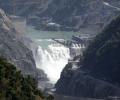
Pakistan has raised objections to four power projects being built by India on the Chenab river on the ground that they allegedly violate the Indus Waters Treaty.

In his letter, Qureshi also accused the Indian government of using 'water as a weapon'.
Emboldened by the international court of justice's interim ruling on the Kishenganga project, Pakistan now plans to take the Nimoo-Bazgo hydropower project being built by India on the Indus river to the world court, according to media reports.

The 70-year-old real estate tycoon had last month described tensions between India and Pakistan as a "very, very hot tinderbox" and offered to be "the mediator or arbitrator" if it was necessary and if the two countries wanted him to, following which the Foreign Office had welcomed such an offer.
Pakistan Foreign Secretary Salman Bashir has once again raked up the Kashmir issue, and said peace and stability in South Asia is not possible unless the long pending disputes between India and Pakistan are resolved.During a meeting with foreign diplomats in Islamabad, Bashir said India should also come forward to resolve water issues with Pakistan in accordance with the Indus Waters Treaty, and added that Islamabad is committed towards resuming a sustained engagement.
With India and Pakistan set for a battle in an international court to settle their dispute over the Jammu and Kashmir-based Kishenganga hydel project, the Indian government has earmarked Rs 30 crore to take care of the legal expenses.
During the meeting, Pakistan was expected to highlight concerns about the three Indian hydro projects being built on the rivers flowing to Pakistan.
Pakistan has decided to approach the International Court of Arbitration to halt the construction of the Kishanganga hydropower project by India, on the ground that it violates the Indus Waters Treaty of 1960, and has formed a team of legal experts to fight the case.Professor Kaiyan Homi Kaikobad, an international legal expert of Pakistani origin, will lead the team at the International Court of Arbitration.
Assistant Secretary of State for South Asian Affairs Robert Blake said Pakistan had frequently raised the controversial and contentious water issue with India during his recent trip to Islamabad, but added that the US had no intention of intervening in the bilateral issue.
'The dialogue process is just too inadequate to meet the challenges from Pakistan,' says former R&AW chief A K Verma.
Pakistan has decided to approach the World Bank to request the appointment of a neutral expert to resolve a dispute with India over the Kishanganga hydroelectric project if bilateral efforts fail to settle the matter, according to a media report.
Rejecting recent allegations by Pakistan of non-adherence to the Indus Water Treaty, India on Tuesday said it was yet another move to raise an 'anti-India' bogey to create 'popular resonance' to cover-up their internal domestic water woes and asked Islamabad to do better water management.
Pakistan has been opposing the construction of the Kishanganga hydropower project on Ganga river in Kashmir, which is called Neelum upon entering Pakistan. Pakistan has said that the diversion of the waters of the Neelum is not allowed under the 1960 Indus Waters Treaty, and that it will face a 27 per cent water deficit when the project gets completed.

Jaitely's statement comes amidst the escalating tension between Indian and Pakistan.
The US may need to develop a closer relationship with Pakistan to deal with Pakistani state-sponsored terrorism, but it should take India into confidence, writes K Subrahmanyam.
Pakistan today pressed India to release its share of river waters under the Indus treaty as it has documentary evidence that its due share of water had been "stolen" from the Chenab river.
Pakistan had earlier moved the World Bank for appointment of neutral experts but India has insisted on solving the issue bilaterally.
According to the provisions of the treaty, the decision of Professor Lafitte on all matters within his competence is final and binding.
Water Resources Minister Saifuddin Soz emphasised that river Jhelum, on which the project is proposed to be built, is a 'symbol of our civilisation' and cannot lose the right of navigation on it.
Gadkari said the water of these 'Eastern rivers' will be diverted and supplied to Jammu and Kashmir and Punjab.
"The design of the project is strictly according to the Indo-Pak water treaty and will not become hurdle in the peace process," Union Water Resources Minister Priya Ranjan Dasmunshi explained.
Officials from the Permanent Indus Water Commissions of both countries had earlier met to resolve differences over the Baglihar project but failed.
Islamabad says the height of the project is in violation of the Indus Waters Treaty.
Umer Ayub Khan signs a petition to the World Bank raising a dispute over the Baglihar hydropower project under the Indus Waters Treaty. His grandfather and Nehru had signed the treaty.
Islamabad should purchase water from India to save 50 million people in southern Punjab, the MPs said.
Pakistan claims the project violates the 1960 Indus Water Treaty.
 © 2026 Rediff.com - Advertise with us - Disclaimer - Privacy Policy - Sitemap - Feedback - About us - Terms of use - Grievances