
India is back on the diplomatic table pushing oil producing countries to raise production in a bid to cool down runaway oil prices. Brent crude oil prices traded above $90 a barrel, on Thursday, for the first time since 2014. Brent is the most popular marker for crude oil trade. It is used as a benchmark for two-thirds of the world's internationally traded crude oil.
At present, India has 56,999 fuel outlets. Of those, only 6,276 are owned by private companies

Bankers claim they have received good response to the roadshows held abroad for Coal India, IndianOil and PowerGrid.
.jpg)
Three PSUs, three private firms join bid to acquire 40% stake in Haldia Petrochem.

The ministry of petroleum and natural gas is evaluating a threshold at which the subsidy on liquefied petroleum gas (LPG or cooking gas) will be reinstated. According to a senior government official in the know, a survey is currently being conducted to determine the price at which maximum consumers will keep buying domestic cylinders. One of the options also being considered is to limit any subsidy disbursal only to Pradhan Mantri Ujjwala Yojana (PMUY) beneficiaries.
Earlier in the day, Jet Airways faced operational disruptions across major airports when IOC refused to refuel its planes without clearing the outstanding amount.
The divestment of Bharat Petroleum Corporation (BPCL) may hit a fuel price hurdle, according to officials dealing with the matter. They pointed out that the inconspicuous administered price regime could hamper the prospects for potential buyers of BPCL. A senior oil ministry official said public-sector oil-marketing companies (OMCs) take a hit when they sell petrol, diesel, and liquefied petroleum gas (LPG), three of the most popular petroleum products in the country.
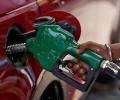
The ministry of petroleum and natural gas has granted seven authorisations to companies for selling automobile (auto) fuels in the country. These new approvals are under the relaxed guidelines for authorisation to market transportation fuels that were revised in 2019. This is expected to make the competition more intense in India's petroleum retail business. According to a top oil ministry official, a fresh marketing authorisation has been granted to Reliance Industries (RIL) under these norms. This is being done since RIL's existing retail marketing authorisation has been transferred to its subsidiary Reliance BP Mobility

Government-controlled oil-marketing companies (OMCs) have held back petrol and diesel price revisions for a week and are expected to continue doing so, ostensibly owing to political reasons. It appears that the Centre has informally conveyed to the three major OMCs to not revise fuel prices for the time being, two people in the government said. This informal directive follows the talks between the Centre and states on cutting taxes and bringing the auto fuels under the good service tax regime not fetching the desired results, so far.
IOC protests, says have invested in these facilities over a period of time.
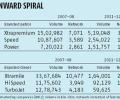
Oil marketing companies decrease distribution & production of fuel brands after huge drop in demand.
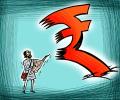
For first time in 8 yrs, stake sale proceeds could exceed Budget Estimates. ONGC's acquisition of HPCL alone could get the exchequer more than Rs 30,000 crore.
IOC has asked consumers to book LPG refill through IVRS or SMSes so that refills reach genuine users.
Oil marketing companies IndianOil, Bharat Petroleum and Hindustan Petroleum together blocked nearly 2.9 million LPG connections belonging to customers having more than one connection across states.
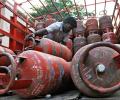
Given that the target was to reach 80.34 million families under PMUY - within three months starting April 1 - the government should have distributed at least 241.02 million cylinders by the end of June. It actually ended up distributing only 119.7 million cylinders.
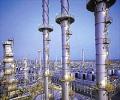
BPCL plans to save Rs 500-800 cr, while HPCL eyes 10% reduction in total costs.

The Houston-based company is selling up to 50 per cent of its oil-sand reserves in Alberta. There are some producing assets and some exploration assets on offer.
In a marginal relief to consumers, IndianOil, the biggest oil marketing company, has cut petrol prices by Rs 0.56 per litre with effect from midnight today.

IOC urged the government to cut excise duty by Rs 8 (the current revenue loss) to Rs 6.78 per litre. It also demanded a cut in state-level taxes.
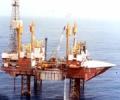
These firms are expected to incur an under-recovery of over Rs 121,000 crore (Rs 1,210 billion) during this financial year, compared to Rs 78,000 crore (Rs 780 billion) in 2010-11.

The post fell vacant after incumbent Prasad Dasgupta took early retirement. Dasgupta's five-year term was to come to an end on August 31 and he was eligible for a two-year extension till he attained superannuation at the age of 65 in 2012.
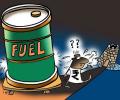
A swift recovery in oil demand in India is not only helping the stability of the global market, it is giving huge fiscal headroom to the government in terms of additional excise duty.
Aiming to raise Rs 40,000 crore (Rs 100 billion) from disinvestment, the government on Wednesday said it will sell its stake in 10 more PSUs, including IndianOil, MMTC, Coal India Ltd, SAIL, RINL and Shipping Corporation, in the current financial year.
The company, which has successfully commissioned the 'open access' fuel storage system for the first time in the country at Bangalore International Airport, has submitted its expression of interest for the projects. Currently, IOC, HPCL and BPCL are providing fuel storage services at Mumbai and Delhi airports.
The previous highest divestment proceeds for the first half of a year was around Rs 21,000 crore in 2016-17.
Analysts said the higher capex by PSUs, along with government spending, could trigger a capex revival for the corporate sector by the second half of FY17

The NSE Nifty ended 55.75 points, or 0.57 per cent, higher at 9,912.80 after moving between 9,925.75 and 9,882.

Amid a spate of government proposals at its door, the Election Commission has asked all Union government departments to route their proposals through the Cabinet Secretariat.
State-run oil companies on Wednesday raised prices of aviation turbine fuel, or ATF, for the third time in a month, this time by about 6.7 per cent, in step with international rates, which are firming up.
The petroleum ministry has sought additional oil bonds worth about Rs 13,000 crore (Rs 130 billion) to cover the revenue loss on fuel sale in the fourth quarter of the current fiscal.
The jet fuel rate will go up by Rs 104 per kilolitre in Delhi to Rs 32,303, an IOC official said. The increase comes on the back of a 1.8 per cent hike in rates on May 16. On May 1, state-run oil firms marginally reduced the price by one per cent, which had brought the rates in Delhi down to Rs 31,614.51 per kl. In Mumbai, home to the nation's busiest airport, the rate will go up from Rs 33,138 per kl to Rs 33,261 per kl.
IndianOil XTRAREWARDS is the first on-line reward programme for customer's paying cash
India captain Rahul Dravid won the toss and elected to bat against Sri Lanka in the opening game of the IndianOil Cup tri-series tournament
 © 2026 Rediff.com - Advertise with us - Disclaimer - Privacy Policy - Sitemap - Feedback - About us - Terms of use - Grievances