
A graphical representation of the Indian economy.

In its latest interim Economic Assessment report released today, OECD said a moderate expansion is under way in most major advanced and emerging economies.

'They have since only tried to improve systems. Also, with regulatory guidance from time to time, we are in a position to assess a situation and react in time.'

India's economy is estimated to contract by 9.6 per cent in the fiscal year 2020-21, reflecting a sharp drop in household spending and private investment, and the growth is expected to recover to 5.4 per cent in 2021, the World Bank said on Tuesday. In its Global Economic Prospects report, the World Bank said that the informal sector, which accounts for four-fifths of employment, has been subject to severe income losses during the COVID-19 pandemic.
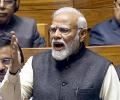
Why did Modi single out the Congress and its leaders for the most pugnacious verbal assault while sparing other regional adversaries? If he is trying to get some parties to break the Opposition ranks, it means that the BJP's present bravado is for effect. Nilanjan Mukhopadhyay, author of Narendra Modi: The Man, The Times, begins a new column for Rediff.com.

Global disinflation has finally caught up with India's high-cost economy.

Even if no statistical jugglery is afoot, only to warn that the 'noise' in the numbers should be eliminated in order to hear the underlying music, without distortion, warns T N Ninan.

India, the world's third-largest energy consumer, will see its energy needs doubling by the end of this decade as it witnesses an unprecedented explosion of economic growth, the nation's richest man Mukesh Ambani said on Saturday. Speaking at the convocation of Pandit Deendayal Energy University (PDEU), Ambani, who heads the nation's most valuable company Reliance Industries Ltd, said the Indian economy will become a $40 trillion economy by 2047 from the current $3.5 trillion. "And to fuel this growth, the country will need enormous amounts of energy - clean, green energy that won't choke mother nature for the sake of human progress," he said.

There has been a distinct trend change in the micro-indicators like rising auto sales and consumer confidence index in the last 20 quarters, Chandrasekaran stated.

While Manmohan Singh had to deal with high oil prices, inflation and trade deficit, Narendra Modi is lucky as major threats have receded, says T N Ninan.
.jpg)
The toxic brew of fiscal populism, crony capitalism and bad economic management has ensured the collapse of economic growth, industrial stagnation, stubbornly high consumer inflation, declining savings and investment, shrinking employment opportunities, and a dangerously vulnerable external financing situation.

Despite multiple headwinds at the start of 2023, the Indian markets delivered a strong performance, posting 19-20 per cent growth for the year. Even as new records were set, investor sentiment remains strong going into 2024, given the lower inflation, expectations of steady to lower interest rates, higher economic growth, and strong inflows. However, the overriding concern for most brokerages is valuations.

'We should not underestimate the power of Hindutva.'

tailwinds of a remarkable year and handsome investor returns, Indian equities are set for an eventful journey in 2024, with a slew of local and global cues -- varying from interest rates to Lok Sabha polls to geopolitical happenings. Analysts are of the view that the bull run in the domestic equity market will continue, and over the next 3-6 months, the benchmark indices -- Sensex and Nifty -- could climb up to 7 per cent. In 2023, the 30-share BSE Sensex jumped 11,399.52 points or 18.73 per cent, and the NSE Nifty climbed 3,626.1 points or 20 per cent.

In a memorable year for the equity market, Dalal Street investors added a whopping Rs 81.90 lakh crore to their wealth in 2023 as a raft of positive factors powered a stellar rally in stocks. Experts said India's strong macroeconomic fundamentals, political stability owing to the BJP's success in recent elections in three significant states, optimistic corporate earnings outlook, signals from the US Federal Reserve about three prospective rate cuts next year and heavy retail investors participation played a major role in fuelling the stock market rally in 2023. In the year 2023, the 30-share BSE Sensex jumped 11,399.52 points or 18.73 per cent.
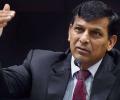
Indian economy, dubbed the fastest growing major economy in the world, is faced with the single most important pressure point of job creation, says former RBI Governor Raghuram G Ranjan as he makes a strong case for improvement of human capital through skill development. Talking about the book 'Breaking the mould: Reimagining India's economic future', written jointly by him and Rohit Lamba, assistant professor of economics at Pennsylvania State University, Rajan said one of the greatest strength of India is its human capital of 1.4 billion and the question is "how do you make it strong?" The nation needs to create jobs at every level going along the path of development, said Rajan, presently Katherine Dusak Miller Distinguished Service Professor of Finance at Chicago Booth, USA.

'In Eastern Ladakh the Chinese attempted salami slicing.' 'Our response has been superb. Our military has responded magnificently.'

Indian economy is doing well and the performance of domestic stock markets is not as bad as that of other nations.

She said that earlier governments used to sell dreams to people while the present regime is fulfilling the dreams.

The finance minister's assertion that industry should not expect any spectacular announcements in the 2024 interim Budget suggest that the electoral imperatives of more tax concessions or higher expenditure on welfarist programmes could be far less pronounced than they were before the 2019 interim Budget, expects A K Bhattacharya.

For long-term financial security, millennials must not only provide social security for their young families but also ensure that their financial burdens are not passed down to their families, says Casparus Kromhout.

At present there is virtually no dialog between votaries of different various versions of economic democracy.

In a dazzling resurgence, foreign investors have graced the Indian equity markets with an influx of nearly Rs 1.5 lakh crore in 2023, fuelled by optimism over the country's resilient economic fundamentals amid shadows of a gloomy global scenario. Experts believe that the positive trend may continue in 2024. This follows Indian equities witnessing the worst-ever net outflow of Rs 1.21 lakh crore by FPIs in 2022 on aggressive rate hikes by the central banks globally after net inflows for three consecutive years.
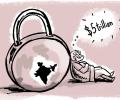
India decisively withstood global headwinds in 2023 and is likely to remain as the world's fastest-growing major economy on the back of growing demand, moderate inflation, stable interest rate regime and robust foreign exchange reserves. Despite widespread pessimism witnessed among the developed nations and the worsening geopolitical situation, India recorded a gross domestic product (GDP) expansion of 6.1 per cent in the March quarter. The growth moved up to 7.8 per cent in the June quarter and was 7.6 per cent in the September quarter. For the first six months of this fiscal, the growth was 7.7 per cent.

Government's focus on infrastructure is the biggest positive for the Indian economy, followed by the improvement in tax collections and good consumption recovery.

Titan, IndusInd Bank, Axis Bank, State Bank of India, Power Grid, NTPC and Tata Motors were among the among the major gainers. Mahindra & Mahindra, Larsen & Toubro, Nestle, JSW Steel, Infosys and Tata Consultancy Services, Tech Mahindra and Maruti were the major laggards.

Surplus in March, the last month of a financial year, has helped the government reduce fiscal deficit in the last few years.

Extreme poverty in India declined by 38 million in 2021 to 167.49 million after a surge in the two preceding years, but remained above the 2018 level, the latest World Bank data shows. While for most countries poverty rose in 2020, when the Covid-19 pandemic hit the global economy, the data shows poverty shot up in India a year earlier in 2019 to 176.09 million from 151.79 million in 2018, the lowest pre-pandemic count. India's poverty rate at 11.9 per cent in 2021 also remained higher than the 2018 level of 11.09 per cent, though easing from 14.72 per cent in 2020.

Smaller stocks have emerged as Dalal Street's favourites in 2023 that has turned out to be a "great year" for equities, rewarding investors with big gains, driven by optimism over the country's macroeconomic fundamentals and heavy retail investors participation. Experts said equity markets are experiencing a prolonged bull run and it is during this time that the midcap and smallcap segments tend to outshine their larger counterparts. Till December 22 this year, the BSE smallcap gauge has jumped 13,074.96 points or 45.20 per cent while the midcap index has surged 10,568.18 points or 41.74 per cent.

With economic activity buoyed by expectations from the new elected government of "Prime Minister Narendra Modi, India is benefiting from a 'Modi dividend'," the Bank said in its twice-a-year South Asia Economic Focus report on Monday.

Have the markets already played out their dynamics before the economy has even properly taken off? Are we now destined for a period of mediocre returns despite a strong economy? asks Akash Prakash.

'Focus on 19,400/64,900 as the key resistance levels for the Nifty/Sensex.'

'The succesfully conduct of the global event would have filled the Indians with pride'

'What you need is a credible Opposition, a credible platform to persuade people to believe that it can replace this government.'

GDP growth seen at 8.1-8.5% in 2015-16

JSW Steel (3.37 per cent), Tata Steel (3.33 per cent), Maruti (3.24 per cent), Power Grid (3.07 per cent), IndusInd Bank (2.95 per cent), Bajaj Finance (2.12 per cent) and Tech Mahindra (2.22 per cent) were among major gainers. On the other hand, Ultratech Cement, Sun Pharma, Nestle and L&T were the losers.

Global funds, according to Christopher Wood, global head of equity strategy at Jefferies, are now beginning to pay more attention to India with the market now offering 30 companies with a market capitalisation over $25 billion.

Indian economy is set for a 'goldilocks' period -- used to describe a timeframe of high growth and low inflation -- while it can become Asia's fastest growing economy in 2016, Japanese financial major Nomura said.

Large and small businesses alike have delivered low-key performances.

The state's joblessness is three times higher than the national average of 7.8 per cent.
 © 2026 Rediff.com - Advertise with us - Disclaimer - Privacy Policy - Sitemap - Feedback - About us - Terms of use - Grievances