
Indian economy is gathering momentum in the second quarter, though inflation would continue to average above the central bank's comfort zone of 6 per cent, said an article in the RBI's monthly bulletin released on Thursday. The consumer price index (CPI) based retail inflation shot up significantly to 7.44 per cent in July, from 4.87 per cent in the preceding month, mainly due to soaring prices of tomato, vegetables and other food items. In his address to the nation on the Independence Day, Prime Minister Narendra Modi vowed to take more steps to contain price rise.

Lower income groups earning less than Rs 100,000 a year are yet to recover as are those earning between Rs 100,000 and Rs 200,000.

Bihar has fertile grounds for caste to emerge as an electoral issue.

The five warmest years in Indian weather history have occurred in the past 14 years -- the others being 2009, 2017 and 2010, in order of intensity.

Questions will be raised over why those changes take place and whether non-economic factors are at play, says A K Bhattacharya.

Government announcements for the building of new roads, railways, and other capital expenditure (capex) projects may have hit an all-time low, according to numbers for the December quarter.

S&P Global Ratings on Monday raised India's growth forecast for the current financial year to 6.4 per cent, from 6 per cent, saying that robust domestic momentum has offset headwinds from high food inflation and weak exports. The US-based rating agency, however, has cut growth estimates for the next fiscal (2024-25) to 6.4 per cent, as it expects growth to slow in the second half (October-March) of the current fiscal, on higher base impact and subdued global growth.

Manufacturing's share in the profit pool of companies had declined before the pandemic.

Bangladesh was the largest source of foreign tourists, accounting for 21.4 per cent of all arrivals.

Fitch Ratings on Thursday retained India's growth forecast for the current fiscal at 6.3 per cent citing economic resilience despite tighter monetary policy and exports weakness, but upped year-end inflation projection on El Nino threat. The Indian economy grew 7.8 per cent in the April-June quarter of current fiscal on strong services sector activity and robust demand. "The Indian economy continues to show resilience despite tighter monetary policy and weakness in exports, with growth outpacing other countries in the region," Fitch said, while projecting 6.3 per cent growth for current fiscal (April-March), and 6.5 per cent for next fiscal.

Stating that the worst is over for the Indian economy, financial major Citigroup on Friday said the country is likely to clock a growth rate of 5.4 per cent in 2012-2013 fiscal year.

'If India can only grow at 5%, why bother spending time on the country?' asks Akash Prakash.
In spite of a zero growth in agriculture sector, the Indian economy grew at an impressive 5.8 per cent in the second quarter of 2002-03 compared to 5.3 per cent in the same period last year.

'One is happy. The moment one starts criticising the BJP, ED, IT and CBI comes to one's house.'

The Indian economy grew by 8.9 per cent in the first quarter (April-June)of this fiscal, up by 0.4 per cent compared to the same period last year.
RBI governor and new FM could hog all the limelight.

Many things could play spoilsport for the Indian economy.

If oil prices stay at their new level of $72 or drop further, India will be in the happy position next year of enjoying a surplus on the trade account.

Indian economy is expected to improve marginally in the current financial year with its GDP at market price projected to expand by 3.4 per cent from 3.3 per cent in the previous fiscal, think tank OECD said.

Asia's richest man, Mukesh Ambani, signed off an address to employees last week by assuring them that 2024 would be better than 2023 for both Reliance Industries and India. Ambani isn't an exception. Promoters and their representatives from several other conglomerates have expressed similar optimism.

The challenge isn't in selling -- it's easy to sell when the market peaks. The real challenge is in buying back.

Prime Minister Narendra Modi on Thursday suggested the G20 trade ministers to work collectively to ensure equitable competition between large and small sellers as there are challenges in the fast growing cross-border e-commerce. In a video message at the G20 Trade and Investment Minister's meeting here, he also emphasised on the need to address the problems faced by consumers in fair price discovery and grievance handling mechanisms. "Digitising processes and use of e-commerce have the potential to enhance market access. "I am glad that your group is working on the 'High Level Principles for the Digitalization of Trade Documents'. These principles can help countries in implementing cross-border electronic trade measures, and reduce compliance burdens.
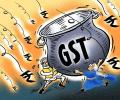
GST collections jumped 15 per cent to nearly Rs 1.68 lakh crore in November, the finance ministry said on Friday. Goods and Services Tax (GST) mop-up was over Rs 1.45 lakh crore in November 2022.

India's growth projection released by the latest World Economic Outlook remains unchanged from its previous WEO (World Economic Outlook) update of July this summer but is a three-percentage point in 2021 and 1.6 percentage point drop from its April projections. According to the latest WEO update, released ahead of the annual meeting of the IMF and the World Bank, the world is expected to grow at 5.9 per cent in 2021 and 4.9 per cent in 2022.

The RBI on Thursday said banks' gross NPA ratio has fallen to a sever-year low of 5 per cent and the banking system remains sound and well-capitalised. In the 26th issue of the Financial Stability Report (FSR), the RBI also said the global economy is facing formidable headwinds with recessionary risks looming large. The interplay of multiple shocks has resulted in tightened financial conditions and heightened volatility in financial markets, it pointed out.

There hasn't been any dramatic moment in the first act (the Budget) but nobody would complain. It's par for the course as long as the figures don't change in the main Budget, which will be presented after general elections.

If we persist in talk and little action, I think we will slip. I fear the consequences of sustained slow growth. We need strong, sustained, clever action today, Rajan said.

As the adjournment of Parliament for an indefinite period with the Rajya Sabha also adjourning sine die kickstarts the final countdown for the general elections, Modi said the last five years were a period of "reform, perform and transform" with the country moving towards "big changes" at a fast pace.

Fresh formal job creation cooled for the second consecutive month to decline to a six-month low in September, signalling a downturn in the labour markets this financial year. The number of new monthly subscribers under the Employees' Provident Fund (EPF) declined by 6.45 per cent to 891,583 in September from 953,092 in August, shows the latest payroll data released by the Employees' Provident Fund Organisation (EPFO). Besides, the net payroll additions -- calculated by taking into account the number of new subscribers, the number of exits, and the return of old subscribers -- increased by 14.9 per cent to 1.72 million in September from 1.49 million in August.

India on Friday made a strong pitch for a sovereign rating upgrade with Moody's and also questioned the parameters based on which the US-based agency accords ratings, sources said on Friday. Ahead of its annual review of the sovereign rating, Moody's Investors Service representatives met Indian government officials during which the officials highlighted the reforms and strong fundamentals of the Indian economy. A higher rating for India would mean the nation is less riskier, translating into lower interest rates on borrowings.

In her first address to a joint sitting of the two Houses in the new Parliament building in which she touched on varied issues ranging from insurgency to inflation, Murmu said a country can progress at a fast pace only when it defeats the challenges of the past and puts maximum energy into building the future.

'We all work hard and save money, and later spent it in hospitals!'

Mihir S Sharma outlines why this year's Union Budget does not respond to the needs of India's economy, or attempt to frame the economy's future.

The Indian economy is likely to post better than anticipated growth in the second quarter (July-September) owing to robust urban consumption and expansion in services, a Business Standard analysis of high-frequency indicators showed. While gross domestic product growth in the September quarter is expected to come below the 7.8 per cent print in the June quarter due to a favourable base fading, analysts say the print will be much closer to 7 per cent than the 6.5 per cent anticipated earlier. While the Reserve Bank of India (RBI) had estimated 6.5 per cent growth for July-September, last month Governor Shaktikanta Das said the growth figure would surprise on the upside.

'The US investors are very enthusiastic about India and policy changes'.

Most of India's oil supplies are expected to stay safe because of the country's good relations with both Russia and Iran. That would take care of over a third of India's supplies.

South and South-West Asia could witness an economic growth of 5.3 per cent in 2015, which will be a four-year high.

Replying to the no-confidence motion, Prime Minister Narendra Modi asserted on Thursday that the opposition's move is auspicious for his government as he expressed confidence that the Bharatiya Janata Party and its allies will break old records to retain power at the Centre in the 2024 Lok Sabha polls.
The first of a 4-part article on how the Indian economy functions, and the problems it faces.

'They will continue to keep pricking at places where both of us are sensitive and keep the LAC alive.'
 © 2026 Rediff.com - Advertise with us - Disclaimer - Privacy Policy - Sitemap - Feedback - About us - Terms of use - Grievances