
'OMCs are incurring losses of Rs 1,000 crore per day due to the West Asia crisis.'

Even if there is an early agreement on a cessation of hostilities in West Asia, the price shock will not go away easily, points out A K Bhattacharya.

A joint study by IBM and IndiaAI, a MeiTY initiative, indicates that Artificial Intelligence (AI) has the potential to contribute over USD 500 billion to India's economy by 2030. The report highlights the need for improved AI literacy, infrastructure, and data quality to fully realise this potential.

'When we start describing somebody as an enemy that is the start of politics and emotion after which no business can take place.' 'We need to get out of this, allow Indian businessmen to do business with China.'

Despite a sharp increase in import duties on gold and silver to 15 per cent, the precious metals are trading at significant discounts in the domestic market, with gold seeing discounts of up to $200 an ounce and silver up to $6 an ounce.

'Once the market decides it wants to go up, it goes up -- no amount of bad news can really hold it back.'

'Even last year, when India bought gold, the physical quantity was much less than the previous years.'

A prolonged supply shock can transmit to lower incomes, and dampen confidence and sentiment, warns Aditi Nayar, chief economist, head-research and outreach, ICRA.

The rupee weakened to a record low against the US dollar due to Gulf tensions, rising oil prices, and foreign capital outflows.

India has managed high government debt-to-GDP, a slowing domestic revenue engine, lower household savings and a more hostile geopolitical environment separately in the past. But together, they threaten to undo the growth narrative on which today's optimism rests, warns Debashis Basu.

'Even if the war ends tomorrow, which is unlikely, and we go back to the pre-war status quo, the world will still need some time to get over the sudden shock of oil price increases.'

Kanwal Rekhi is a peaceful techie who ardently believes in competitive market economics and democracy, despite the trauma his family suffered during Partition and his narrow escape from violent mobs in 1984.
Uncertainties stemming from the West Asia crisis and its potential impact on inflation and economic growth were key factors in the Reserve Bank of India's Monetary Policy Committee (MPC) decision to maintain the status quo on interest rates, according to the recently released MPC meeting minutes.

Foreign investors have aggressively sold off Indian equities, withdrawing over 48,213 crore in the first 10 days of April, following a record 1.17 lakh crore outflow in March, driven by escalating geopolitical tensions in West Asia, rising crude oil prices, and global inflation concerns.

'Markets never fully lose hope. But an important shift could come if the Strait remains closed -- moving from high prices to no prices.'

India, the world's fourth largest economy, is set to maintain the 'goldilocks' phase with tailwinds of good growth, low inflation and robust banking performance as well as reform initiatives poised to sustain the economic pace witnessed during 2025.

A poor monsoon could drag overall economic growth and compound the impact of the West Asia conflict on the Indian economy.

Aviation stocks experienced a significant surge following the announcement of a two-week ceasefire between the US and Iran, which led to a sharp decline in crude oil prices. This development has positively impacted stock markets and the broader economic outlook for India.

'Mark Mobius's life was dedicated to investing.'

S Mahendra Dev, chairman of the Economic Advisory Council to the Prime Minister, expressed confidence that the rupee would stabilise around the 92-93 level against the US dollar, despite geopolitical tensions, and that foreign investment flows would return.

India's foreign exchange reserves decreased by USD 10.288 billion to USD 688.058 billion during the week ending March 27, according to the Reserve Bank of India (RBI). This decline follows a previous decrease and comes after the reserves reached an all-time high in February.
Moody's Ratings on Tuesday said tax cuts in the current fiscal has dented India's revenue growth, leaving less scope for fiscal policy support for the economy.

A foreign brokerage warns that sustained crude oil prices above USD 100 per barrel could push India's inflation above the RBI's tolerance level, potentially triggering interest rate hikes.
The World Bank has affirmed India's strong position to withstand the current global energy shock, citing high foreign exchange reserves, fiscal space, and low inflation as key buffers supporting continued growth despite international headwinds.

India's new manufacturing project announcements more than halved in the fourth quarter of FY26, falling 60 per cent sequentially and 78 per cent year-on-year to approximately 1.7 trillion, driven by global uncertainties, geopolitical conflicts in West Asia, and existing unutilised manufacturing capacity.

A new report suggests that prolonged conflict in the Middle East could significantly impact India's GDP growth and inflation.

The Reserve Bank of India (RBI) Governor Sanjay Malhotra is now confronting the classic growth-inflation tradeoff, a situation exacerbated by the West Asia war, which threatens to end the 'goldilocks period' of low inflation and robust growth.

West Asia conflict triggers sharp sell-off in Indian markets, with realty, banking and auto stocks leading losses amid energy shock fears.

India's foreign exchange reserves decreased by USD 7.052 billion to USD 709.759 billion in the week ending March 13, according to the Reserve Bank of India (RBI). This decline follows a previous drop and comes after reserves reached an all-time high in February.

The cost of the war is being counted not in the corridors of power in Washington or Tehran, but in Firozabad's darkened furnace rooms, Howrah's idle casting sheds, and a barbershop in Kochi where the wait is suddenly, inexplicably, an hour long, notes Prem Panicker in his must read blog on the Iran War.

'The West Asia or the Gulf crisis has shown that what we develop as national infrastructure when things are not as bad as they could be, we forget to plan for adversities.'

Finance Minister Nirmala Sitharaman stated that it is premature to comment on the tariff changes announced by the United States, adding that the commerce ministry is currently reviewing the situation.

The Indian rupee weakened against the US dollar due to a strengthening dollar, high crude oil prices, and foreign fund outflows amid geopolitical uncertainties.

In the present hyper-connected world, there are many domestic and global factors that affect financial markets. Of them, the most powerful and often least predictable are geopolitical events, which often boil down to one diplomatic headline.

Amidst escalating tensions in West Asia, India voices strong concerns over the safety of its nationals and the potential disruption to energy supplies, urging dialogue and diplomacy for a swift resolution.

Foreign investors pulled out Rs 21,000 crore (around $2.3 billion) from Indian equities over the last four trading sessions amid deteriorating global risk sentiment triggered by the West Asia crisis.

India's digital economy is projected to constitute nearly 20 per cent of the nation's GDP by 2030, fuelled by a growth rate twice as fast as the overall economy, according to a senior government official.

India's foreign exchange reserves have surged to an all-time high, reaching USD 728.494 billion, according to the Reserve Bank of India. This increase is attributed to a rise in foreign currency assets and gold reserves.

'We are profoundly energy-dependent on the Gulf. That dependency must now be redirected towards the United States, because we require American permission to procure oil.' 'We additionally require Iranian permission to acquire oil from that source. So India now has to seek two separate permissions merely to secure its energy supply.' 'Should we be compelled to source from America, or from Venezuela -- which is, in effect, American-controlled supply -- that will inevitably carry a price premium, an elevated shipping cost, and a considerably extended delivery timeline, given the distances involved.'
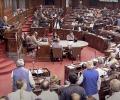
Opposition MPs in the Rajya Sabha criticised the Modi government's economic policies, citing the LPG crisis, lack of energy security, and concerns over the Economic Stabilisation Fund.
 © 2026 Rediff.com - Advertise with us - Disclaimer - Privacy Policy - Sitemap - Feedback - About us - Terms of use - Grievances