'Unfortunately, India and Pakistan could learn a 'lesson' from this conflict that will make them more likely to use these weapons against each other in the future.' 'Rounds of missile and drone attacks could be more routine features of their hostility, just like artillery fire has become a familiar fact of life along the Line of Control.'
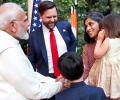
Prime Minister Narendra Modi and US Vice President JD Vance have expressed satisfaction with the progress made in negotiations for a bilateral trade agreement. The two leaders met in New Delhi and discussed a range of bilateral issues, including cooperation in energy, defense, strategic technologies, and other areas. They also exchanged views on regional and global issues of mutual interest.
The China threat continues to resonate in the strategic partnership between India and the USA, points out Rup Narayan Das.
'The strategic direction of the relationship will not be affected. But the perception has been affected.'
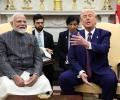
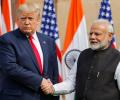
US President Donald Trump and Indian Prime Minister Narendra Modi met in Washington D.C. to discuss a range of issues including trade, defense, and energy. The two leaders announced plans to finalize "wonderful trade deals" for both countries, and Trump emphasized the need for India to purchase US oil and gas. Modi congratulated Trump on his second term and highlighted the importance of working together to further strengthen the India-US relationship. The meeting also addressed the ongoing conflict in Ukraine, with Modi reiterating India's commitment to peace.

Jimmy Carter, the 39th president of the United States, was the third American leader to visit India during which a village in Haryana was named Carterpuri in his honour.

'A less tense US-China relationship would make Beijing less likely to provoke India -- including on the border -- in retaliation for its close defence ties with the US.'

Official sources said Modi also congratulated Trump on the performance of his Republican Party in the US Congressional elections, as both leaders affirmed that they would work together for world peace.
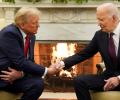
'As far as skilled immigration is concerned, the US needs Indian skills and Indian talent, and there are no two opinions about it even among US companies.'

Besides colourful costumes, ethnic jewellery and the mandatory dandiyas, there's one more thing that is becoming de rigueur every Navratri.

To begin with, the consulate in Bengaluru will not offer visa services.
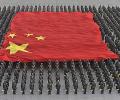
The sudden proximity between India and US has, in the eyes of many, sidelined China. This is not the case, argues Colonel Anil A Athale (retd).

'The border deal offers a hedge for India against Trump's unpredictability when it comes to his approach to competition with China.'
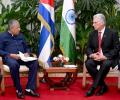
The warmth and respect for India were evident wherever I went and noticed how most Latin Americans have Indian gurus either directly or online and yoga was very much in vogue, observes Ambassador T P Sreenivasan.

The India-United States relationship is set to expand under the Donald Trump administration, but there could be some unease on issues like imports, tariffs and immigration, strategic affairs experts said after the Republican leader won the fiercely contested presidential election.

Jaishankar said, "The immediate part which awaits us is what we call the de-escalation, which is the build-up of forces along the Line of Actual Control."

As Donald Trump registered a historic comeback in the US presidential election, many former Indian diplomats on Wednesday concurred that the India-US ties will "continue to grow" from strength to strength, even as some of them cautioned that Trump is "highly unpredictable" and New Delhi will have to "wait and watch" to see what position he adopts going forward.

The Biden administration's failure in stopping two major wars and several minor ones was seen as a major disaster by many Americans and the world at large, observes Ambassador T P Sreenivasan.
'Whether I am optimistic or pessimistic is not the issue; I am just going by the evidence available.' 'The Indian economy and financial sector are now well-placed and very resilient in dealing with any kind of spillover coming from the external world.'

Over the years, India has enjoyed bipartisan support in the US and this asset must be kept intact and nurtured through across the board political and civil society engagement, suggests former foreign secretary Shyam Saran.
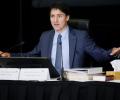
It seems that the West is sending a signal to India that it can return to old hostilities unless India toes their line on Russia. It is no surprise that India is being compared with Putin's Russia in terms of targeting 'dissidents' as the West calls these Khalistani terrorists, asserts Colonel Anil A Athale (retd).

The EAM when asked about his view of the world at present, said it would be "very grim forecast, for the next five years".

New Delhi has reached out to Moscow while waiting for a new president in Washington. New Delhi knows well that in international relations, there are no permanent friends or foes, only permanent national interests, points out Dr Rup Narayan Das.
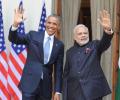
The greatest challenge before India is how to strike a fine balance of its relationship between its neighbour and strategic rival China, and the US.

Ron Somers, founder and CEO of India First Group and the former President of leading business advocacy group US-India Business Council said that when Lok Sabha election results are declared on June 4, "I believe that Narendra Modi will win Parliament by the largest majority ever recorded in the country's history.

Although India-US relations have strengthened significantly in recent years, partly because of the security situation in the region, the Indian policy establishment would have to be prepared to protect India's interests in a world that could get more unpredictable.

The scaling up of the India-US strategic partnership to the level of non-NATO ally with defence deals, sharing and transfer of defence technology, interoperability, joint collaboration and joint production of defence equipment has exacerbated Moscow's anxiety, notes Rup Narayan Das.

A group of eminent Indian Americans in Silicon Valley has held a special meeting with senior officials of the Department of Justice, Federal Bureau of Investigation and police and told that the United States soil is being used for terrorist activities against India.

Although the credit for acquiring the technological skill must be given to India's outstanding nuclear scientists, the decision to go nuclear was a political one that entailed clarity of vision, courage and resolve, points out Rup Narayan Das.

Minister for External Affairs Salman Khurshid speaks about the importance of the fourth edition of the India-US Strategic Dialogue, which he co-chaired with United States Secretary of State John Kerry in New Delhi

K Alan Kronstadt, an expert in South Asian affairs at the US Congressional Research Service, speak to Sheela Bhatt on why India-US bilateral relations are getting cold.

The Indian position on the Russia-Ukraine war and the unconditional treaty between China and Russia appear to have caused some ripples in India-US relations and led to a reappraisal of India's usefulness to the US in the eventuality of a conflict with China, notes Ambassador T P Sreenivasan.

"I have come to India as a friend," he said addressing a select gathering here at Delhi's historic Purana Qila.
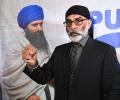
The Indian envoy said that India was "absolutely" and "decidedly" not involved in the homicide, terming it a "motivated and absurd allegation."

'The allegations of government involvement in targeted assassinations abroad are likely to help, not hurt, the ruling party.' 'True or false, they convey a sense of muscularity and, in some quarters, are celebrated as a harbinger of 'great power' status.'
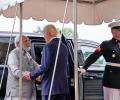
Foreign policy is always a work in progress and ups and downs are built into foreign policy process. What is permanent is national interest. Hopefully, this year, which will also witness general elections in the country, will also clear clouds in the foreign policy horizon, observes Rup Narayan Das.
'Never before have I seen a diplomatic crisis in US-Indian relations, or for that matter a crisis involving India and any other country, driven by bureaucratic trade unionism, where the political leadership was simply missing in action.' Dr Ashley J Tellis, one of the foremost strategic experts on US-India relations, accesses the fallout of the diplomatic spat provoked by Devyani Khobragade's arrest.

While Modi has spent fewer days abroad than his predecessor (270 days versus Dr Singh's 306), he has travelled more extensively and actively than any other Indian PM.

'US officials must grapple with the possibility that one of its closest partners attempted an extrajudicial killing on its soil.' 'This is not something that friends typically do to friends.'

'You ain't seen anything yet,' EAM Jaishankar says about the India-US relationship.
 © 2026 Rediff.com - Advertise with us - Disclaimer - Privacy Policy - Sitemap - Feedback - About us - Terms of use - Grievances