
The World Bank on Thursday projected Indian economy to grow at 8.7 per cent this year but estimated that the high growth would moderate in 2008 due to tighter financial and fiscal conditions.

Omkeshwar Singh, head, Rank MF, a mutual fund investment platform, answers your queries.

The gross domestic product growth rate during April-June 2009 at 6.1 per cent was higher than 5.8 per cent in the previous quarter, though it witnessed a decline when compared to 7.8 per cent economic expansion recorded during the corresponding period of the last fiscal. The government and Reserve Bank of India have been maintaining that the Indian economy will grow by six per cent growth with upward bias.

"It is a matter of pride for us that India's vaccination programme has been science-born, science-driven and science-based," Modi said.

'We expect the bull run to continue until economic growth continues.'

Bajaj Finance was the top gainer in the Sensex pack, surging around 5 per cent, followed by Bajaj Finserv, HDFC, Tech Mahindra, HDFC Bank, UltraTech Cement and Tata Steel. On the other hand, HUL, Nestle India, ICICI Bank, Axis Bank, SBI, TCS and ITC were among the laggards.

S&P Global Ratings on Thursday said the Indian economy is projected to grow at 11 per cent in the current fiscal, but flagged the "substantial" impact of broader lockdowns on the economy. In its report on Asia-Pacific Financial Institutions, S&P said the control of COVID-19 remains a key risk for the economy. New infections have spiked in recent weeks and the country is in the middle of a second pandemic wave.

In the Sensex pack, HDFC, ONGC, Bharti Airtel, Titan, Asian Paints, Mahindra and Mahindra and TCS were the prominent gainers. On the other hand, ICICI Bank, IndusInd Bank, NTPC, UltraTech Cement, Tech Mahindra and SBI were among the major laggards. On the other hand, HCL Tech, Tech Mahindra, HUL, Bharti Airtel and ICICI Bank were trading in the red.

In a rare face off, captains of the auto industry have hit out at the government for not walking the talk. At an industry event in the capital on Wednesday, R C Bhargava, chairman of India's largest carmaker Maruti Suzuki, and Venu Srinivasan, chairman of TVS Motor, questioned the government's intent to support the auto sector. Revenue secretary Tarun Bajaj sat in the audience listening, before his turn came to counter them.
Global rating agency Moody's on Tuesday warned that India's over 8 per cent economic growth may not be sustainable, saying it may average to 6.5 per cent in the coming years.

India is looking at near close to double-digit growth this year and the country will be one of the fastest-growing economies, Finance Minister Nirmala Sitharaman has said. The minister also emphasised that she expects the economic growth next year to be in the range of 7.5-8.5 per cent, which will be sustained for the next decade.

The tax portal problem is a goof-up by both sides, and making Infosys the only villain in the story is quite unfair, argues Shyamal Majumdar.
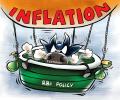
'While intensification of fuel prices and broad-based domestic cost pass-through pressures is a downside risk, core inflation is expected to strengthen further as demand recovers to pre-Covid levels,' the ministry said on Friday.

S&P Global Ratings on Wednesday said the second wave of COVID infections poses downside risks to India's GDP and heightens the possibility of business disruptions. The second wave brings in uncertainty and a drawn-out COVID outbreak will impede India's recovery, it said.

Fitch expected economic activity to contract by 5 per cent in FY21 due to the strict lockdown measures imposed since March 25, before rebounding by 9.5 per cent in FY22.
India is expected to log about 4.8 per cent economic growth in 2002-03, making it one of the world's fastest expanding economies, economists said on Friday.\n\n

The company is planning to invest Rs 1,100 crore in the new mobile phone manufacturing facility.

The agency had earlier said that the economy would grow at the rate of 5.8 per cent. In a teleconference, S&P said the revision was occasioned because of the positive policy responses by the country and improving global conditions, despite the deficient rains and lurking swine flu.
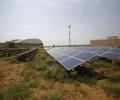
Billionaire Gautam Adani's Group on Wednesday announced the acquisition of SoftBank Group Corp's renewable power business in India for a deal value of $3.5 billion (approximately Rs 25,500 crore), to become the world's largest solar company. In a statement, Adani Green Energy Ltd, the renewable energy unit of the port-to-energy conglomerate, said it has inked share purchase agreements to buy 100 per cent of SB Energy India from SoftBank and Bharti Group. Without giving deal details, the statement said the transaction values SB Energy India at an enterprise valuation of approximately $3.5 billion, it stated. The transaction marks the largest acquisition in the renewable energy sector in India.

'At this moment, investors should look for relative value within sectors and clear visibility (third-wave-or-not) on earnings delivery.'

S&P Global Ratings on Monday said systemic risk in Indian banks is likely to remain high in the wake of the second wave of COVID-19 and high proportion of weak loans. S&P estimates the weak loans in banks at 11-12 per cent of gross loans.

Close-ended equity funds, launched with fanfare three years ago, have disappointed investors with their dull returns. The data from Value Research shows 10 out of 17 close-ended schemes maturing before July have seen one-year returns between 34 and 40 per cent. In comparison, the Sensex Total Return Index (TRI) has rallied 46 per cent over the past one year.

Gujarat reported 2,165 cases, Maharashtra 1,188, Uttar Pradesh 663, Madhya Pradesh 590, Haryana 339 and Andhra Pradesh 248 cases.

'This encourages escapism through the politics and economics of nationalism, made worse by tribalism or nativism, the package accompanied inevitably by the erosion of institutional bulwarks and therefore State capture by powerful businessmen,' notes T N Ninan.
The Indian economy will grow by 6.9 per cent in 2011-12 against 8.4 per cent in the last financial year according to government estimates.

India's economy is unlikely to see double-digit growth and may grow between 8 per cent and 9 per cent this fiscal year (2021-22, or FY22), against the estimated 11.5 per cent, according to leading economists and rating agencies. The downward revision of growth projections to as low as 10 per cent is mostly on account of stringency in restrictions by states, relatively slow vaccination pace, and the possibility of a third wave of the pandemic. However, they say the impact will not be as severe as the first wave, and expect the first quarter to see positive growth.

India's economy is estimated to contract by 9.6 per cent in the fiscal year 2020-21, reflecting a sharp drop in household spending and private investment, and the growth is expected to recover to 5.4 per cent in 2021, the World Bank said on Tuesday. In its Global Economic Prospects report, the World Bank said that the informal sector, which accounts for four-fifths of employment, has been subject to severe income losses during the COVID-19 pandemic.

According to experts, major stocks are in the process of correcting to their support levels ahead of the Union Budget.

Amid oxygen shortage and a faltering health system in the country, India is seeing over 300,000 cases daily.

Inflation targeting has worked well and the government must stay with it, and the framework is going to work well in the period ahead also, former RBI Governor D Subbarao said on Thursday. He also said low inflation contributes to sustainable growth. Addressing the 'Times Network India Economic Conclave' virtually, Subbarao said the government's proposal to privatise some public sector units is not akin to selling family silver but it is a route for putting India on a sustainable growth path.

The labour participation rate tells us how many of the working age population are willing to be employed. If this proportion keeps falling as it evidently is, it does not bode well for India's growth story. It renders all stories of a revival in the economy as a myth, warns Mahesh Vyas.

India has just 28 Olympic medals to its credit since making a debut back in 1900.

The Indian economy will suffer lasting damage from the coronavirus crisis and after an initial strong rebound in FY22 (fiscal year ending March 2022) growth will slow to around 6.5 per cent a year over FY23-FY26, Fitch Ratings said on Thursday. "A combination of supply-side scarring and demand-side constraints - such as the weak state of the financial sector - will keep the level of GDP well below its pre-pandemic path," it said in commentary on the Indian economy. Fitch said India's coronavirus-induced recession has been among the most severe in the world, amid a stringent lockdown and limited direct fiscal support.

The proposed amendments to the Consumer Protection (E-Commerce) Rules, 2020, that are envisioned to protect consumer interests, may further compound the impact of multiplicity of regulations on the e-commerce sector, the Indo-American Chamber of Commerce (IACC) had told the ministry of consumer affairs. IACC, the apex bilateral chamber for Indo-US business, had told the government that the proposed amendments would increase compliance liabilities that risk severely impairing the growth of the sector.

Bank of America (BofA) Securities expects India to be the third-largest economy in the world by 2031. The economic rise could become a reality by 2028, but the Covid pandemic delayed the pace, BofA Securities economists Indranil Sen Gupta and Aastha Gudwani wrote in a report.

A combination of demonetisation, a poorly and hurriedly implemented GST, and more recently the "botched up" lockdown of the economy to control the spread of Covid has brought the economy to its knees.

Omkeshwar Singh, Head, Rank MF, a mutual fund investment platform, answers your queries.

Here's the full text of President's Ram Nath Kovind's address to the joint sitting of both houses of Parliament on the first of Budget Session 2022.
 © 2026 Rediff.com - Investor Information - Advertise with us - Disclaimer - Privacy Policy - Sitemap - Feedback - About us - Terms of use - Grievances