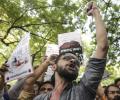
The Supreme Court has denied bail to Umar Khalid in the 2020 Delhi riots conspiracy case, citing a prima facie case against him under the UAPA. Other activists were granted bail. Khalid's father expressed disappointment, while a friend shared Khalid's reaction.
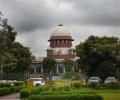
The Supreme Court denied bail to activists Umar Khalid and Sharjeel Imam in the 2020 Delhi riots conspiracy case, citing prosecution material suggesting their involvement in planning and strategic direction. The court granted bail to other activists but emphasized the seriousness of the allegations against Khalid and Imam.
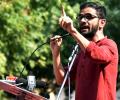
Activist Umar Khalid seeks bail in the UAPA case related to the 2020 Delhi riots, claiming lack of evidence and denying conspiracy charges. Other activists also argue for bail, citing delays and insufficient evidence.
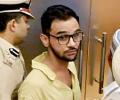
The Supreme Court has refused to grant bail to activists Umar Khalid and Sharjeel Imam in the 2020 Delhi riots conspiracy matter, citing a prima facie case against them under the UAPA. However, bail was granted to other activists in the same case.
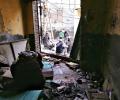
The Supreme Court has directed lawyers for the accused in the February 2020 Delhi riots to restrict their oral arguments to 15 minutes, emphasizing the need for a time schedule. The court also addressed bail pleas from activists like Sharjeel Imam and Umar Khalid, while the Delhi Police maintained the riots were a pre-planned attack.
Activist Umar Khalid has appealed to the Supreme Court against the Delhi High Court's decision to deny him bail in a case under the Unlawful Activities (Prevention) Act (UAPA) related to the alleged conspiracy behind the February 2020 Delhi riots.

The Delhi police vehemently opposed the bail pleas of activists Umar Khalid, Sharjeel Imam and others in the February 2020 riots case, saying it had become a trend now for doctors and engineers to engage in anti-national activities. The police cited inflammatory speeches and violent protests as reasons for opposing bail.

The Supreme Court on Friday adjourned to September 22 the hearing on bail pleas of activists Umar Khalid, Sharjeel Imam, Gulfisha Fatima and Meeran Haider in the Unlawful Activities (Prevention) Act (UAPA) case related to the alleged conspiracy behind the February 2020 riots in Delhi.
Delhi Police strongly opposes bail pleas of activists Umar Khalid, Sharjeel Imam, and others in the February 2020 riots case, claiming it was a pre-planned attack on the nation's sovereignty and an attempt to divide society on communal lines.
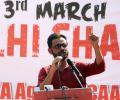
The Supreme Court on Monday sought the Delhi police's response on the bail pleas of activists Umar Khalid, Sharjeel Imam, Gulfisha Fatima and Meeran Haider in the UAPA case related to the alleged conspiracy behind the February 2020 riots in Delhi.
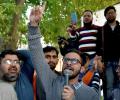
The prosecution had opposed the bail pleas saying it was not a case of spontaneous riots but a case where riots were "planned well in advance" with a "sinister motive" and "well-thought-out conspiracy".

Activist Sharjeel Imam has moved the Supreme Court challenging a Delhi High Court order denying him bail in a case linked to the 2020 Delhi riots. The High Court had denied bail to several individuals, emphasizing that conspiratorial violence under the guise of protests cannot be allowed.

The court granted her bail on the ground of parity as co-accused Jawaharlal Nehru University students and Pinjra Tod members Devangana Kalita and Natasha Narwal have already been granted the relief in the case.

'This process is the punishment.' 'Once the trial starts, they know this fairy tale case will fall on its face. So they don't want to begin the trial.'
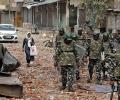
'We wish Gulfisha gets bail before Eid, but whatever happens will be Allah's wish.'
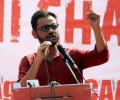
On Monday, another accused Meeran Haider also applied to the restoration of inmate daily phone call facilities.
In this conspiracy, firearms, petrol bombs, acid bottles and stones were collected at numerous homes, police claimed.

'You realised there was a struggle outside and now your struggle is to survive, live in prison, to retain your feelings, your humanity, and collectively continue doing inside what you were doing outside.'

'There are many people languishing in jail under these draconian laws, where it takes them 10 years, 15 years, to finally be acquitted.' 'And, who is going to account for those years?' 'The home ministry's statistics says that between 2016 and 2019, the conviction rate (under UAPA) is only 2 per cent and the use of UAPA has increased by more than 70 per cent.' 'There are many people languishing in jail under these draconian laws, where it takes them 10 years, 15 years, to finally be acquitted.'
'Who is going to account for those years?'
'The home ministry's statistics says that between 2016 and 2019, the conviction rate (under UAPA) is only 2 per cent and the use of UAPA has increased by more than 70 per cent.' 'The government statistics itself is so revealing what the purpose of this law (UAPA) is.'
 © 2026 Rediff.com - Investor Information - Advertise with us - Disclaimer - Privacy Policy - Sitemap - Feedback - About us - Terms of use - Grievances