
The story of Bihar's educational reform is a lesson for all reforms done halfway.

India has 54 institutions in the QS World University Rankings, making it the 4th most represented country after the US (192), the UK (90) and China (72).

'India is a very strategic geography. The business is growing over 37-38 per cent year-on-year.'

A parliamentary panel has criticized the Indian government for withholding funds from states that have not agreed to implement the PM SHRI schools scheme, calling the reasoning behind the decision "not factual or justified." The panel has recommended the immediate release of pending funds to states like Kerala, Tamil Nadu, and West Bengal, which have been significantly impacted by the delays.

'Why has Maharashtra slipped up over the past couple of decades?' 'Not only is this question critical for residents of the state, but given that it accounts for 14% of India's GDP, a faster-growing Maharashtra implies a faster-growing India as well, point out Shishir Gupta and Rishita Sachdeva.

Haryana has done well in terms of economic growth over the last couple of decades. For it to continue to lead the growth ladder, the new government has to work hard on multiple dimensions, recommend Shishir Gupta and Rishita Sachdeva.

The coveted QS rankings indicate that India is slowly but steadily overtaking other nations in the field of education.

The 38.5 million enrolled for higher education in 2019-2020 outnumbered Canada's entire population of 38.2 million.

Prime Minister Narendra Modi on Friday said the government will soon take a decision on revising the minimum age of marriage for girls after it receives the report from the committee set up for the purpose.

These initiatives are expected to increase Gross Enrolment Ratio in higher education from 24.5 (2015-16) to 30 (2020).

Any narrative against the Dravidian model may impact the BJP's prospects in Tamil Nadu. This may explain why the BJP in Tamil Nadu is placing more emphasis on corruption allegations against the DMK, even as the party focuses nationally on the Sanatana controversy.

Additional investment of $190 billion has to be made in the next eight years.

One is to increase the intake capacities in the existing universities and colleges and the second, to increase the number of colleges and universities. But the real focus will be on increasing the enrolment of disadvantaged sections, like the Scheduled Castes, Scheduled Tribes, minorities and even the poor

The Saveetha Institute of Medical and Technical Sciences. The Indian School of Mines, Dhanbad. Vinay Umarji explains why these two universities have made India proud.

It was women who unambiguously bore the brunt of the lockdown joblessness, says Kanika Datta.

India is also short of about a thousand colleges.

The second-year BSc (Honours) in Mathematics student had returned from Delhi in March this year after those staying in the hostel were asked to go home by the college authorities in view of the COVID-19 pandemic.

21st century may have witnessed expansion of higher educational institutions, but who can afford it? Sushree Panigrahi & Jeet Singh look at the numbers.
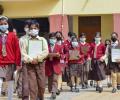
"The policy draft has been approved. The ministry has been renamed as education ministry," a senior HRD ministry official said. The existing NEP was framed in 1986 and revised in 1992. A new education policy was part of the Bharatiya Janata Party's manifesto ahead of the 2014 general election.
Dr Talat Ahmad, vice chancellor of Jamia Milia Islamia suggests important reforms in the Indian education system.
 © 2026 Rediff.com - Advertise with us - Disclaimer - Privacy Policy - Sitemap - Feedback - About us - Terms of use - Grievances