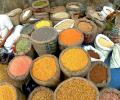
After climbing to the highest level in more than five years to 4.7 million tonnes in FY24, India might import fewer quantities of pulses this financial year at 4-4.5 mt on the back of good monsoon and higher domestic production, Bimal Kothari, chairman of India Pulses and Grains Association (IPGA), said in New Delhi on Friday. Kothari was addressing reporters on the sidelines of a seminar on pulses titled "Bharat Dalhan-2024".

As India looks to mend its Covid-battered economy, one thing that will grab the attention of all concerned is the path that both wholesale and retail inflation will follow. Even the Reserve Bank of India in its latest policy statement said, "Going forward, the inflation trajectory is likely to be shaped by uncertainties impinging on the upside and the downside.
The government on Monday exempted importers of pulses from stock limits, and also relaxed the norms for millers and wholesalers, in view of softening of prices of the key pulses in the country. Now, the stock limits will be applicable only on tur, urad, gram and masoor for a period up to October 31, it said. However, these entities will continue to declare their stocks on the web portal of the Department of Consumer Affairs, it added. A revised order in this regard has been notified.
On a day when several mandis across the country are closed in protest against the recent Centre's decision to impose stringent stock-holding limit on pulses, the government clarified that limits have been defined as retail prices are still higher than last year though there is some moderation in the last few weeks. It said the same logic also holds true for edible oils, the import duties on which was slashed few days back and curbs lifted on import of refined oils. The decision on edible oil and pulses have caused massive resentment among the trading community as it came just ahead of the kharif sowing season, when prices were off their peaks due to multiple steps announced previously. Sources said trading activity in some of the major mandis dealing in pulses such as Sholapur, Amravati and Latur in Maharashtra, Indore and Dewas in Madhya Pradesh along with Kanpur in Uttar Pradesh was impacted as traders went on a flash strike in protest against the decision to impose stock limits.

Prices of essential commodities, including foodgrains, have surged 8-10 per cent in just three days, because of deficient rains and on concerns that the farm output this kharif season would be hit badly.

Nilesh Veera, director of APMC said, complained that availability of workers is a big problem. They have asked the government to provide enough sanitizers, masks, etc, for worker safety, to call them back. There has been no reply.
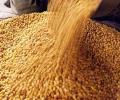
Chana is majorly imported from Australia and Tanzania and it attracts an import duty of 60 per cent. A section of the traders is demanding a reduction in import duty to around 35-40 per cent to tide over any shortage of the commodity as the new crop will start hitting the market only around mid-February.

Scenario is precarious for urad with almost half the crop damaged in major growing states, tur quota of 400,000 tonnes already exhausted.

Gujarat has already relaxed norms for stock holding limits.
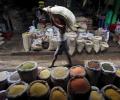
According to government data, the prices have still not crossed the MSPs in some mandis.
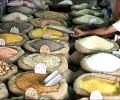
The Centre has taken several measures such as creating a buffer stock of 40,000 tonnes and sale of imported pulses at cheaper rates to give relief to the common man.

The RBI said recently that the upsurge in inflation in April was led by food and commodity prices.
Prices moved up sharply in recent months.

Now, government is also contracting imports.
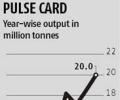
The India Pulses and Grains Association estimates production of kharif pulses at seven mt this year.

Plans to enhance buffer stock to 500,000 tonnes; Gujarat exempts importers from stock limit
 © 2026 Rediff.com - Investor Information - Advertise with us - Disclaimer - Privacy Policy - Sitemap - Feedback - About us - Terms of use - Grievances