
The finance minister's assertion that industry should not expect any spectacular announcements in the 2024 interim Budget suggest that the electoral imperatives of more tax concessions or higher expenditure on welfarist programmes could be far less pronounced than they were before the 2019 interim Budget, expects A K Bhattacharya.

The bulk of the incremental profits will come from oil & gas and automobile sectors.

Citing faster-than-expected recovery, rising consumer confidence and the resultant spending spike, Swiss brokerage UBS Securities has revised upwards its growth forecast for the current fiscal to 9.5 per cent from 8.9 per cent in September. The brokerage also sees the economy clipping at 7.7 per cent in FY23 but moderating to 6 per cent in FY24, as it expects the benefit of the low-interest rate regime to end by the end of FY23, and it sees the central bank hiking policy rates by 50 bps in the second half of the next fiscal. The Reserve Bank also forecasts 9.5 per cent GDP growth this fiscal while the average projection ranges from 8.5 to 10 per cent.

Hospitality players want the government to accord infrastructure status to hotels to make investments on new properties more attractive rather than categorising them as luxury or even 'sin goods' in the upcoming Union Budget considering the sector's potential to play a key role in India's growth. They also want the government to consider incentives in the form of tax breaks or subsidies for adopting sustainable and eco-friendly practices, while asserting that the upcoming budget must accelerate the tourism agenda saying it is an opportunity to make Indian hospitality the emerging engine for GDP growth and employment generation.

From connectivity woes to infrastructure advancements and the startup boom, there is a gulf between claims and reality in India's economic landscape, points out Devangshu Datta.

Finance Minister Nirmala Sitharaman on Thursday announced a Rs 11.11 lakh crore spending on infrastructure and vowed to continue reforms as she resisted resorting to populist measures in Modi government's last Budget before general elections, instead choosing to stay on the path of cutting deficit while bolstering measures for focus groups.

'With continued focus on votes, upcoming by-polls and purchasing politicians, the political hierarchy has little time for national defence.' 'They would do well to heed a veteran scholar, who says, "There will be war with China in the next few years. The next full scale war will have the involvement of Pakistan and terror elements, insurgents and intelligence assets operating inside India",' warns Lieutenant General Prakash Katoch (retd).

Moody's Investors Service on Wednesday said the outlook for global banks for 2024 is negative as central banks' tighter monetary policies have resulted in lower GDP growth. It said Indian banks' profitability will increase further on lower provisioning expenses and robust growth in higher-yielding retail segments. "Our outlook for global banks for 2024 is negative as central banks' tighter monetary policies have resulted in lower GDP growth.

In the volatile international situation where 'nativism' is on the rise and immigrant communities are being targeted, the Leader of the Opposition's statement is like adding fuel to fire. If the Indian diaspora numbering 4 crores is threatened it will constitute a grave threat to national security, warns Colonel Anil A Athale (retd).

He argued that if inflation is low, stable and moving towards the 4 per cent target, why has the RBI not revised downward the bank rate fixed in June 2023?
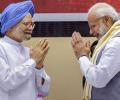
In a scathing attack on Prime Minister Narendra Modi, former prime minister Manmohan Singh on Thursday accused him of lowering the dignity of public discourse and the gravity of the office of the PM by giving "hateful speeches" during the poll campaign.

The Reserve Bank on Wednesday approved a Rs 2.11 lakh crore dividend payout to the central government for 2023-24, more than double the amount it paid for the previous 2022-23 financial year. The decision was taken at the 608th meeting of the Central Board of Directors of the Reserve Bank of India held under the chairmanship of Governor Shaktikanta Das.
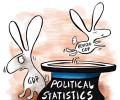
The GDP growth is estimated to come at the "deceptively high" level of 20 per cent for the April-June 2021 quarter but is far below the same in the pre-COVID times, rating agency Icra said on Wednesday. Icra said the low base of the last year, when the GDP had contracted by close to 24 per cent, "conceals" the impact of the second wave of COVID-19 infections. Economic activity is boosted by robust government capital expenditure, merchandise exports and demand from the farm sector, it said, estimating the GDP to grow by 20 per cent and the gross value added (GVA) will register a growth of 17 per cent for the June quarter.

The ongoing fourth quarter earnings season, global factors and macroeconomic data would guide the trends in the equity markets this week, analysts said. Markets would also take cues from trading activity of foreign investors, rupee-dollar trend and movement of global oil benchmark Brent crude. "Domestically, the next batch of Q4 earnings reports will drive stock-specific movements, Hero MotoCorp, Larsen & Toubro, BPCL, State Bank of India, Eicher Motors and Tata Motors are some of the big names in the list and the next phase of voting," said Pravesh Gour, senior technical analyst, Swastika Investmart Ltd.

'We expect the bull-market phase to still persist, but now led by large-caps which offer better valuation and benefit from FII inflows.'
'We expect continued pressure on midcaps, but any sharp correction looks unlikely from here on.'

Despite the wobble in the markets over the past few weeks, Indian equities remain expensive as measured by several yardsticks. India's market capitalisation-to-GDP ratio, for instance, has touched a multi-year high. The ratio is currently at 116 per cent, based on the FY22E gross domestic product (GDP) number, above its long-term average of 79 per cent.
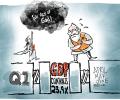
Dominic Xavier wonders whether the steep decline in GDP numbers should be considered as an act of God too.

'We have been threatened. We have felt violated.' 'Everything is in danger if you don't give safe spaces to women.'

Domestic institutional investors pumped Rs 2.3 trillion into equities during H1 CY24. Of this, mutual funds contributed 80%.

The total allocation to the defence sector is 12.9 per cent of the total budget of the government of India for the financial year 2024-25.

Thanks to a booming market, India now has more than 300 family offices, up from 45 in 2018, according to a PwC report. The number is expected to grow rapidly, with promoters establishing more businesses in Tier-II and Tier-III cities. Family businesses play a crucial role in India's booming economy, spanning manufacturing, retail, real estate, healthcare, and finance.

Larsen & Toubro, Axis Bank, Reliance Industries, UltraTech Cement, Mahindra & Mahindra, IndusInd Bank, ICICI Bank and Tata Steel were the other big gainers. Sun Pharma, HCL Technologies, Asian Paints, Nestle and Infosys were the laggards.

By taking the mutual fund route, investors can take exposure to gilts with small amounts. Over a decade or more, returns from these funds tend to be sound.

Indian GDP will grow at 8.5 per cent in 2021-22, and the rate will accelerate further to 9.8 per cent in 2022-23, a foreign brokerage said on Tuesday. The GDP had contracted by 7.3 per cent in the pandemic-hit FY21, and is widely expected to grow at a faster pace due to the base effect in 2021-22. The Reserve Bank of India (RBI) expects a 9.5 per cent growth in 2021-22, and the same to slow down to 7.8 per cent as things normalise.
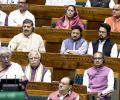
Finance Minister Nirmala Sitharaman on Tuesday announced income tax relief for the middle class, a Rs 2 lakh crore outlay for job creation schemes over the next five years and a spending splurge for states run by her party's new coalition partners as she unveiled the Modi 3.0 government's first budget after the general elections.

It has been a slow year for the Indian media and entertainment (M&E) business. After two years of double-digit growth, it grew at just about 8 per cent in 2023 over 2022. It now stands at Rs 2.33 trillion in advertising and pay revenues.

The Reserve Bank on Wednesday retained the GDP growth forecast at 9.5 per cent for the current fiscal but cautioned that the economic recovery is not yet strong enough to be self-sustaining and durable.
Fitch Ratings has revised India's GDP growth estimate to 12.8 per cent for the fiscal year beginning April 1 from its previous estimate of 11 per cent, saying its recovery from the depths of the lockdown-induced recession has been swifter than expected. In its latest Global Economic Outlook (GEO), Fitch said revision is on the back of "a stronger carryover effect, a looser fiscal stance and better virus containment." "India's second half of 2020 rebound also took GDP back above its pre-pandemic level and we have revised up our 2021-2022 forecast to 12.8 per cent from 11.0 per cent," it said. "Nevertheless, we expect the level of Indian GDP to remain well below our pre-pandemic forecast trajectory."

Moody's Investors Service on Thursday slashed India's economic growth projection to 8.8 per cent for 2022 from 9.1 per cent earlier, citing high inflation. In its update to Global Macro Outlook 2022-23, Moody's said high-frequency data suggests that the growth momentum from December quarter 2021 carried through into the first four months this year. However, the rise in crude oil, food and fertilizer prices will weigh on household finances and spending in the months ahead.

'In the short term you keep your return expectations very, very low; in the medium term be prepared to invest and in the long term growth will come and your returns from stocks will be high.'

Have the markets already played out their dynamics before the economy has even properly taken off? Are we now destined for a period of mediocre returns despite a strong economy? asks Akash Prakash.
Listed companies' net profit as a percentage of gross domestic product (GDP) has hit a decadal high and is expected to edge even higher over the next two financial years. According to an analysis by ICICI Securities, India's Inc net profit stood at Rs 8.4 trillion, or 4 per cent of GDP of Rs 210 trillion for the trailing 12-month period ending September. This is the highest since financial year 2011-12 (FY12), when it was at 4.6 per cent.

'Over the next 20 years, we would be adding almost 10 million people to the workforce every year!' 'And we won't be able to give employment to even 2 million out of the 10 million every year.' 'Don't forget, it keeps adding every year.'

'Those trying to use these funds for quick gains should avoid them due to risk of being late to the party.'

A British brokerage on Tuesday cut India's FY22 GDP growth estimate by a sharp 0.80 per cent to 9.2 per cent, saying the economic impact of the second wave of infections has been deeper than initially expected. Barclays chief India economist Rahul Bajoria also mentioned the slow pace of vaccinations in the country and the rolling lockdowns across many states for the estimate. It can be noted that last month has seen a slew of similar forecasts from analysts, even as the RBI maintained its estimate of a 10.5 per cent growth in real GDP.

India's economic growth surged to 20.1 per cent in the April-June quarter of this fiscal, helped by a low base of the year-ago period, despite a devastating second wave of COVID-19. The gross domestic product (GDP) had contracted by 24.4 per cent in the corresponding April-June quarter of 2020-21, according to data released by the National Statistical Office (NSO) on Tuesday. The government had imposed a nationwide lockdown at the onset of the COVID-19 pandemic last year.

More than 80 per cent of Indians live in districts vulnerable to climate risks. Among these, Assam, Andhra Pradesh, Maharashtra, Karnataka, and Bihar are the most vulnerable states to extreme climate events.

Passenger vehicle wholesales in India rose 11 per cent year-on-year in February, as sports utility vehicles continued to steer demand in the market, industry body SIAM said on Tuesday. The total passenger vehicle dispatches to dealers last month stood at 370,786 units, as compared to 334,790 units in the year-ago period.

Industry body CII on Thursday made a case for pushing reforms in sectors like land, labour, and agriculture by the Modi 3.0 government to accelerate economic growth, which is estimated to be around 8 per cent in the current financial year. CII president Sanjiv Puri said a lot of policy interventions in the past have put the economy on "a much stronger wicket". "The growth rate is poised to touch 8 per cent during the current year, marking the fourth consecutive year of above 7 per cent + growth.

The current spurt in the stock market is on account of strong fundamentals and robust corporate earnings and retail investors can look for buying opportunities to accumulate quality stocks, experts said.
 © 2026 Rediff.com - Investor Information - Advertise with us - Disclaimer - Privacy Policy - Sitemap - Feedback - About us - Terms of use - Grievances