
India is likely to grow by 7.5 per cent in the first quarter of the current financial year, driven by rising aggregate demand and non-food spending in the rural economy, according to an article in the RBI's May Bulletin released on Tuesday. The Indian economy has demonstrated marked resilience in the face of geopolitical headwinds impacting the supply chain, said an article on the state of the economy published in the May Bulletin.

India will become the third largest economy by 2027-28, with a GDP of over $5 trillion, Finance Minister Nirmala Sitharaman said on Wednesday. Even going by conservative estimates, the size of the Indian economy will be $30 trillion by 2047, she noted. "It is possible that we will be the third largest economy by 2027-28, and our GDP will cross $5 trillion by that time. By 2047, it is a conservative estimate that we will reach at least $30 trillion in terms of economy," Sitharaman said at the Vibrant Gujarat summit.

There are reports that the government will soon cut income taxes by about Rs 50,000 crore to boost consumption.
Prime Minister Modi, I suggest that, instead, you distribute about one lakh crore rupees per year to the 80 crore poor, which will boost both consumption and economic growth, suggests Kalyan Singhal, McCurdy Professor of Business at the University of Baltimore.

With decline in number of fresh COVID-19 cases and easing of restrictions, the country's gross domestic product (GDP) will grow at 8.5 per cent in FY2021-22, according to credit rating agency Icra Ratings. It expects the gross value added (GVA) at basic prices (at constant 2011-12 prices) to grow at 7.3 per cent in FY2022. "The impact of the second wave of COVID-19 and the ensuing state-wise restrictions was seen across a variety of high frequency indicators in April-May 2021.
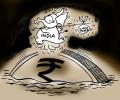
Fitch Ratings on Wednesday said India's high fiscal deficit would pose a challenge in lowering the debt to GDP ratio, which is expected to rise above 90 per cent in the next five years. It said India entered the pandemic with little fiscal headroom from a rating perspective. Its general government debt/GDP ratio stood at 72 per cent in 2019, against a median of 42 per cent for 'BBB' rated peers.

Fitch Ratings has revised India's GDP forecast to minus 9.4 per cent in the current fiscal year from a previously projected contraction of 10.5 per cent after the economy staged a sharper rebound in the second quarter. In its Global Economic Outlook, Fitch said the coronavirus-induced recession inflicted severe economic scarring and the country needs to repair balance sheets and increase caution about long-term planning. "We now expect GDP to contract 9.4 per cent in the fiscal year to end March 2021 (plus 1.1 percentage point) followed by plus 11 per cent growth (unchanged) and plus 6.3 per cent growth in the following years," the rating agency said.

Geopolitical events, macroeconomic data and quarterly earnings of corporates would guide the stock market in a holiday-shortened week ahead, analysts said. Stock markets will remain closed on Wednesday for Ram Navami. "This week promises to be crucial for the market as fresh worries about a potential conflict between Iran and Israel emerge.

India's economy contracted by 7.3 per cent in fiscal 2020-21. The pandemic, it said, will leave new economic scars and deepen pre-pandemic constraints.

'The structural story of India is a multi-decadal story.' 'One should stay invested in that story and avoid reacting to what is happening globally.'

Despite the rally in equities over the last few years, India, according to Christopher Wood, global head of equity strategy at Jefferies, is still in early stages of an equity cult. Any changes to the capital gains tax for equities - both long-term and short-term - in Budget 2024 scheduled to be announced on July 23, he believes, can trigger a bigger correction that what the markets witnessed post the Lok Sabha election outcome on June 4 that saw the Bharatiya Janata Party (BJP) lose majority, though it was able to form the government with the help of coalition partners.

The Indian economy needs to generate an average of nearly 78.5 lakh jobs annually until 2030 in the non-farm sector to cater to the rising workforce, according to the Economic Survey for 2023-24. The Survey tabled in Parliament on Monday also laid emphasis on the private sector's role to create employment in the country saying "In more than one respect, the action lies with the private sector. "In terms of financial performance, the corporate sector has never had it so good."

The country's gross domestic product (GDP) is likely to grow more than 9.5 per cent in fiscal 2021-22, an SBI research report-Ecowrap said. The economy grew at 8.4 per cent in the second quarter of the current fiscal, according to data released by the National Statistical Office (NSO) on Tuesday. The growth in the April-June quarter of this fiscal stood at 20.1 per cent. In October's monetary policy review, the Reserve Bank of India had retained its projection for real GDP growth at 9.5 per cent in 2021-22, consisting of 7.9 per cent in Q2; 6.8 per cent in Q3; and 6.1 per cent in Q4 of 2021-22.
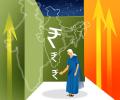
Structural reforms, pro-people programmes and employment opportunities helped the economy get new vigour, the finance minister said. After contracting by 5.8 per cent in 2020-21, the economy recorded a growth of 9.1 per cent in 2021-22.

Nirmala Sitharaman on Wednesday assumed charge as the Finance and Corporate Affairs Minister for the second consecutive term and is slated to soon present the final Budget for FY '25 that is going to set the tone for the Modi 3.0 government's priorities and direction for Viksit Bharat. Upon her reaching the North Block office, Sitharaman was greeted by Finance Secretary T V Somanathan and other top officials. Minister of State for Finance Pankaj Chaudhary was also present. Chaudhary assumed charge on Tuesday evening.
India can sustain 8 per cent annual GDP growth and the conducive macroeconomic configuration may become a launching pad for a step-up in the country's growth trajectory, said an article on the 'State of Economy' in the central bank's March Bulletin published on Tuesday. Over the period 2021-24, gross domestic product (GDP) growth has averaged above 8 per cent. The global economy is losing steam, with growth slowing in some of the most resilient economies and high frequency indicators, pointing to further levelling in the period ahead, said the article authored by a team led by RBI Deputy Governor Michael Debabrata Patra.

Chief executive officers (CEOs) across sectors have expressed intentions to expand capacities, expecting the government's target to invest a record Rs 11.11 trillion on infrastructure development will act as a catalyst for a jump in consumer demand. "With the government planning a capex of Rs 11.11 trillion, private sector investment will come in a big way. Companies will be preparing for it right from today," H M Bangur, chairman of Shree Cement, told Business Standard. For the past few years, the investment scene in India has been dominated by government capital expenditures; private investments in the manufacturing sector have remained muted.

'The real repo rate is very high in terms of core inflation.'

Billionaire Gautam Adani to two Union Ministers and Maharashtra Deputy Chief Minister Devendra Fadnavis among others on Sunday hailed India crossing $4 trillion mark though there was no official confirmation if the country has achieved the landmark. The finance ministry and the National Statistical Office did not immediately comment on the viral social media post on India's GDP crossing $4 trillion. Highly placed sources said that the viral news was incorrect and India was still shy of that landmark.

Online video platform YouTube's ecosystem has contributed over Rs 10,000 crore to India's GDP and supported more than 7.5 lakh full-time equivalent jobs in the country, according to a report. In India, over 4,500 channels had over 10 lakh subscribers and the number of YouTube channels in India making Rs 1 lakh or more in their annual revenue increased by over 60 per cent year-over-year in 2021, the YouTube Impact Report based on analysis by Oxford Economics said. "YouTube's creative ecosystem contributed over Rs 10,000 crore and supported more than 7,50,000 full-time equivalent jobs in the Indian economy in 2021. "That economic impact shows up in four ways, through direct, indirect, induced, and catalytic impacts," the report said.

India spends significantly less on defence than could be expected from a country that faces simultaneous armed threats from two hostile neighbours -- China and Pakistan.

Reserve Bank of India (RBI) is unlikely to cut the benchmark interest rate at its upcoming monetary policy review meeting, taking place soon after the announcement of the Lok Sabha election results, amid inflation challenges, said experts. The Monetary Policy Committee (MPC) may also refrain from rate cut as economic growth is picking up, notwithstanding the elevated interest rate of 6.5 per cent (repo) prevailing since February 2023. The meeting of the Reserve Bank Governor Shaktikanta Das headed MPC is scheduled for June 5 to 7.

State Bank of India chairman Dinesh Kumar Khara has pitched for tax relief on interest income, saying it would help banks to garner savings that could be used for funding long-term infra projects. Currently, banks are required to deduct tax when interest income from deposits held in all the bank branches put together is more than Rs 40,000 in a year. With regard to savings accounts, interest earned up to Rs 10,000 is exempt from tax.
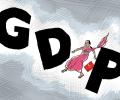
'Given that the economy is going through a slowdown, further downward revisions of the 2019-2020 growth estimates cannot be ruled out,' notes A K Bhattacharya.

'The first job you pick up may not be your ultimate dream job.' 'When the situation is no job or any job, my advice to them will be, pick up any job at the moment.' 'You should use that job as a learning experience.' 'It is easier to find a job when you are working somewhere than when you are sitting at home with no work.'

Gold prices tumbled by Rs 3,350 to Rs 72,300 per 10 grams in the local market in New Delhi on Tuesday amid subdued demand by jewellers after the government announced the customs duty cut on the yellow metal and silver to 6 per cent.

Fitch Ratings on Tuesday raised India's growth forecast for the current fiscal to 7.2 per cent, from 7 per cent projected in March, saying elevated consumer confidence will drive spending, besides increased investments. In June update to its global economic outlook report, Fitch said it expects inflation to decline to 4.5 per cent by end of this year and RBI to cut policy interest rates by 25 basis points to 6.25 per cent.

Sheikh Hasina, who was elected for a record fourth consecutive term and fifth overall term this year, was always admired by her supporters as "Iron Lady", before the dramatic development that abruptly ended her 15-year-rule in Bangladesh.

Singapore government's sovereign wealth fund Temasek is looking to invest $10 billion in India during the next three years, Ravi Lambah, Temasek's head of India and strategic initiatives, said.

Long-term macro trends indicate growth in demand for air travel. Trends from the ticketing website MakeMyTrip indicate a likely annual growth of between 11-17 per cent in Indian air travel demand over FY24-30. Through that period, InterGlobe Aviation or IndiGo may continue to make gains in market share in both domestic and international travel, aided by large fleet additions. IndiGo is the largest global customer of Airbus by far with 950 aircraft orders outstanding.
India's economy grew by 1.6 per cent in the fourth quarter of 2020-21, restricting the full-year contraction to 7.3 per cent, official data showed on Monday. The fourth quarter growth was better than the 0.5 per cent expansion in the previous October-December quarter of 2020-21. The gross domestic product (GDP) had expanded by 3 per cent in the corresponding January-March period of 2019-20, according to data released by the National Statistical Office (NSO).
Equity markets may witness a gradual up-move this week with some volatility as both election and earnings season are nearing their end, analysts said, adding that global trends and trading activity of foreign investors would hold significance in dictating investors' sentiment. Benchmark indices, which had a record-breaking rally last week, would also track global oil benchmark Brent crude and the rupee-dollar trend. The monthly derivatives expiry on Thursday may also fuel volatility in markets.
India's Gross Domestic Product (GDP) is expected to expand by 9.2 per cent in the current financial year, according to the Economic Survey 2021-22 tabled in the parliament on Monday. "Advance estimates suggest that the Indian economy is expected to witness real GDP expansion of 9.2 per cent in 2021-22 after contracting in 2020-21. "This implies that overall economic activity has recovered past the pre-pandemic levels," Economic Survey noted. Almost all indicators show that the economic impact of the "second wave" in Q1 was much smaller than that experienced during the full lockdown phase in 2020-21 even though the health impact was more severe, it said.
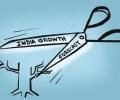
SBI economists on Tuesday sharply slashed their FY22 GDP growth estimates to 7.9 per cent - the lowest among all analysts - from the earlier projection of 10.4 per cent growth. The economists at the state-run lender seemed to attribute the impact of the second wave of COVID-19 infections as a key factor for the revision in the growth estimate, and pitched for faster vaccination. "... our analysis shows a disproportionately larger impact on the economy this time and given that rural is not as resilient as urban, the pick-up in pent-up demand is unlikely to make a large difference in FY22 GDP estimates, and hence it could only be a modest pick-up," they said.

Now that the economy is growing at a higher-than-expected rate, it is time to accelerate the pace of fiscal consolidation, and the Budget could be a good starting point, argues Rajesh Kumar.
India, the world's fifth largest economy in the world, is likely to overtake Japan to become the world's third-largest economy with a GDP of $7.3 trillion by 2030, S&P Global Market Intelligence said in its latest issue of PMI. After two years of rapid economic growth in 2021 and 2022, the Indian economy has continued to show sustained strong growth during the 2023 calendar year. India's gross domestic product (GDP) is expected to grow 6.2-6.3 per cent in the fiscal year ending in March 2024, being the fastest-growing major economy this fiscal year.
Global forecasting firm Oxford Economics on Monday revised downwards its India GDP growth forecast for 2021 to 10.2 per cent from 11.8 per cent previously, citing the country's escalating health burden, faltering vaccination rate and lack of a convincing government strategy to contain the pandemic. Oxford Economics also said that notwithstanding the likelihood of further mobility restrictions, it expects India's targeted lockdown approach, less stringent restrictions, and resilient consumer and business behaviour to mitigate the economic impact of the second wave.

The US Fed interest rate decision, domestic inflation data and global trends would be key driving factors in dictating movement in the market this week, as the Lok Sabha elections outcome and the RBI policy decision are behind us, analysts said. The past week was a roller-coaster ride for investors as markets swung sharply in both directions before closing with strong gains.

India's likely medium-term potential growth will almost certainly be markedly lower than that experienced in pre-pandemic years, warns Shankar Acharya, former chief economic advisor to the Government of India.

The finance minister's assertion that industry should not expect any spectacular announcements in the 2024 interim Budget suggest that the electoral imperatives of more tax concessions or higher expenditure on welfarist programmes could be far less pronounced than they were before the 2019 interim Budget, expects A K Bhattacharya.

Hospitality players want the government to accord infrastructure status to hotels to make investments on new properties more attractive rather than categorising them as luxury or even 'sin goods' in the upcoming Union Budget considering the sector's potential to play a key role in India's growth. They also want the government to consider incentives in the form of tax breaks or subsidies for adopting sustainable and eco-friendly practices, while asserting that the upcoming budget must accelerate the tourism agenda saying it is an opportunity to make Indian hospitality the emerging engine for GDP growth and employment generation.
 © 2026 Rediff.com - Investor Information - Advertise with us - Disclaimer - Privacy Policy - Sitemap - Feedback - About us - Terms of use - Grievances