Claims of a spike in poverty and inequality in India during the Covid-19 pandemic are patently false as such claims are based on uncomparable different surveys, according to a paper co-authored by eminent economist Arvind Panagariya. The paper also noted that inequality fell in the country during Covid years, both in rural and urban areas as well as nationally. Panagariya, Columbia University Professor and former vice chairman of NITI Aayog and Vishal More of Intelink Advisors, New Delhi have co-authored a detailed paper 'Poverty and Inequality in India: Before and After Covid-19'.

The United States has defended its decision to send former diplomat Frank Wisner to Egypt despite knowing that he worked for a lobbying group, Patton Boggs, which lobbied on behalf of the Egyptian government. Wisner was uniquely placed to deliver a 'blunt and candid private message' to Egyptian President Hosni Mubarak, State Department spokesman P J Crowley said. The Obama administration was quick to distance itself from Wisner's remarks at a Munich conference.
Former ambassador to India Frank Wisner is convinced that "the United States cannot pursue its interests in the world without cooperation with India, and India will not achieve her essential interests without cooperation with the US."

Optimism for a bright future and pride in the resurgence of India marked the 6th Annual India Business Conference of the Columbia Business School's South Asian Business Association.
Former US envoy to India Frank Wisner and industry sources expressed elation over Obama's choice of Roemer while the likes of South Asia expert Stephen P Cohen was cautious in his opinion. Some community activists were disappointed that the President had not made a high-profile nomination from the career diplomat cadres or the world of politics or business as he had for the ambassadorial posts in London and Beijing.
Frank Wisner, former American envoy to India, worried that the US may become protectionist if the economic crisis continues

An Asia Society task force -- working on advancing relations between India and United States -- on Friday urged the incoming Barack Obama administration to pursue deeper collaboration with New Delhi for mutual benefits on a host of global challenges raging from security and economic growth to climate change, education and tackling HIV/AIDS.
Former US Ambassador to India Frank Wisner is a happy man because he believes that Secretary of State Hillary Clinton's visit to India helped 'cross the bar' and silence the critics who were convinced that President Barack Obama's predecessor George W Bush was infinitely better for India than the current chief executive of the White House.

Acharya emphasised that the time is "really ripe" for land, labour and agricultural reforms in India.
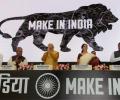
'India is going to maintain its ties to China, India is going to develop a strong relationship with the United States. It means that India is going to have the flexibility to pick and choose its friends.' 'That's traditional Indian foreign policy, and it's smart.' Former US ambassador to India Frank Wisner, one of America's sharpest minds on South Asia, tells Aziz Haniffa/Rediff.com what Washington can expect from Narendra Modi's visit.

The diplomatic row between the United States and India over the arrest of an Indian diplomat Devyani Khobragade was mishandled by both countries and it is high time to move forward and find a diplomatic resolution, two former American diplomats have said.
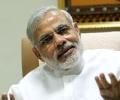
Wisner said during a discussion organised by Asia Society here yesterday on the Indian elections.
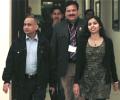
'While the Khobragade affair has "upset and diverted attention, it does not mean there is a fundamental flaw in the US-India relationship",' former American envoy Frank Wisner tells Rediff.com's Aziz Haniffa.
'If Rao had, in fact, given a word to President Clinton in 1994 that India would not test, he would not have encouraged Vajpayee to test. The note, said to have been handed over to Vajpayee by Rao with the words, 'Now is the time to accomplish my unfinished task' may not have been a reference to nuclear tests at all,' says T P Sreenivasan.
'A three generation US-Pakistan relationship is not likely to be snapped any time soon. All this presents an irritant to an India that wishes to concentrate on economic development,' says Colonel Anil A Athale (retd).
The two countries that will be most affected by the internal developments in Pakistan are India and the United States, says Bob Blackwill. Aziz Haniffa reports
If it was true that Maharashtra Chief Minister Devendra Fadnavis held up the flight to Newark to ensure that Praveen Singh Pardeshi, the state principal secretary, was on board, he had at least one excuse...

'Political meetings will be a mere side show; the main show is economic investment and the business partnership. The success of Modi's US visit will be judged on the basis of India's ability to attract American investment and setting up of manufacturing in India to give jobs to millions,' says Colonel Anil A Athale (retd).

Richard Rahul Verma, the first Indian American to serve as US Ambassador to New delhi, quips that surviving the first month in India is his first goal.

'India is no longer the India of the '70s and the '80s.' 'It's a large country with the fastest growing economy.' 'In working with India, you just can't go and humiliate the nation publicly.' USIBC President Mukesh Aghi tells Aziz Haniffa/Rediff.com about how he advises American companies to do business with India, what he thinks of Modi's government and the way forward for the India-US relationship.
 © 2026 Rediff.com - Advertise with us - Disclaimer - Privacy Policy - Sitemap - Feedback - About us - Terms of use - Grievances