If the quantity purchased from anywhere in the country exceeds 25,000 tonnes, the central government will also have to be informed in writing.

India's foodgrain requirement is expected to rise to around 61.2 million tonnes against the average procurement of last five years at 51.4 million tonnes.

While the Delhi and Haryana governments have declared that they are all set to roll-out the food security programme on August 20 -- Rajiv Gandhi's birth anniversary -- there is confusion among the chief ministers about the implementation of the ordinance which gives the right to people to receive adequate quantity of food grains at affordable prices. Anita Katyal reports.

With production hitting a three-year low of 14.7 million tonnes in this sugar season (October to September), the government is also expected to double the levy quota for the PDS from 10 to 20 per cent to tide over shortages. The levy price and quota act as a notional benchmark for open market sugar prices, which have doubled to Rs 34 to Rs 35 a kg since last September, owing to a global shortage. The price of levy sugar is half that of the open market price.

A committee of secretaries is considering a Rs 4,000-crore (Rs 40 billion) market intervention fund to provide states interest-free loans to augment foodgrain and edible oil availability, among other items. The money will enable states to intervene in the market by buying and distributing essential items to economically weaker families that are eligible for government assistance.

Not just this, if the proposal of the food ministry is anything to go by, the ban on the exports of wheat and non- basmati rice is likely to continue, so also the regime of importing wheat at zero duty. A meeting of EGoM was earlier scheduled for August 6 but it was cancelled.
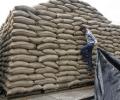
With grain procurement target significantly higher, FCI is faced with storage space shortage.
The food subsidy is likely to touch a record Rs 50,000 crore (Rs 500 billion) in the current fiscal, nearly Rs 18,454 crore (Rs 184.54 billion) higher than Rs 31,546 crore (Rs 315.46 billion) in 2007-08.
In an effort to rein in inflation, the State Trading Corporation is likely to float a tender to import up to 2 million tonnes of wheat this month.
Central government's plan to import pulses to rein in inflation is continuing with renewed vigour as state-run agencies have contracted imports of 437,000 tonnes of pulses till this week.

The benchmark M-30 variety of sugar has declined by over 3 per cent in November to trade now at Rs 3,694 per quintal
Markets regulator Sebi joined hands by banning any fresh futures market position in chana, the only commodity among pulses where such trading was allowed

UP's mills, dominated by the private sector's 94 units, have already expressed their inability to participate in the next crushing season
The government is expected to issue early next fiscal grain-bonds worth Rs 5,000 crore (Rs 50 billion) for raising funds for procurement operations of Food Corporation of India.
India is looking at massive agri-business opportunities in war-ravaged Iraq, including those for sale of wheat, rice, tea and sugar, the commodities

A senior bureaucrat and his wife were found dead under mysterious circumstances at their house in Hazrat Nizamuddin area of south-east Delhi on Friday evening.

The government has filed a lawsuit against Swiss food firm Nestle's Indian unit, seeking Rs 640 crore ($99 million) in damages on behalf of consumers after the country's worst packaged food scare in a decade.

The day-long conference will be chaired by Finance Minister Arun Jaitely and presided over by both Food Minister Ram Vilas Paswan and Agriculture Minister Radha Mohan Singh.

Making it clear that he was not opposed to the National Food Security Bill, Union Agriculture Minister Sharad Pawar on Friday said he would prefer it to be approved by Parliament after a debate.

The bill, considered by many in the Congress as a gamechanger which could boost its prospects in the Lok Sabha election, was tabled in the Budget Session but could not be taken up for discussion as Opposition stalled Parliament over a rash of scams under United Progressive Alliance.
.jpg)
According to an internal assessment of the food ministry, shared with chief ministers recently, Tamil Nadu, Kerala, Jammu & Kashmir and Himachal Pradesh will see a massive reduction in their annual grain allocation.

The govt is increasing the duty to 15 per cent from the existing 10 per cent.

India is expected to harvest bumper crop this year based on estimates of higher food grains production in Kharif (summer sown) and hopes of better Rabi (winter) crop with enough water in reservoirs, Finance Minister P Chidambaram said.

From India's first Vietnamese restaurant to a molecular restaurant, Gitanjali Gurbaxani lists her choices for a monsoon treat in Bengaluru.

According to BJP strategists, PMJAY and the PM Ujjwala Yojana will form the nucleus of the Modi government's re-election campaign.

'There is no food to eat and water to drink and people are migrating in hordes.' 'Chief Minister Fadnavis must shift his base to Marathwada in such times.' 'If you do not help during a drought, then when will you help?'

Five of the 12 BSE sectoral indices ended at 52-week highs; the oil and gas index zoomed by nearly 5%.
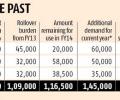
For 2014-15, the bill on this account is likely to be 12.8% more than in 2013-14.

He said the UPA had left the economy in a dire state, with Consumer Price Index and food inflation at double digit, Wholesale Price Index inflation around 6-7 per cent and growth prospects were limited.
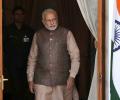
Ministers in the Narendra Modi government have been busy making presentations on their 100 days of work. But what these presentations do not mention is that decisions by ministers have been few, with plenty of papers and files moving to the Prime Minister's Office, which is increasingly emerging as a centralised clearance point, even for routine and ordinary issues. Though policy paralysis was a term used freely for the United Progressive Alliance regime, questions are now being raised about pending decisions across ministries and whether at least some ministers have turned redundant.

New Delhi bureaucrats, accustomed to leisurely lunches, golf in the afternoon and long weekends, have been shaken out of their somnolence, say authors. Fear and suspicion hang heavy over the red-sands.

'If the money we spend on importing pulses reach our farmers, there won't be any suicides'
 © 2026 Rediff.com - Investor Information - Advertise with us - Disclaimer - Privacy Policy - Sitemap - Feedback - About us - Terms of use - Grievances