
The Indian government has assured citizens that the country has ample food stocks to meet domestic demand, despite escalating tensions with Pakistan. The government has also warned traders against hoarding essential food items and creating artificial shortages, emphasizing that there is no need for panic buying. The food ministry detailed the country's current stock levels, showcasing a surplus over required buffer norms for rice, wheat, and pulses. Additionally, India holds substantial edible oil and sugar stocks, ensuring a strong food security position.
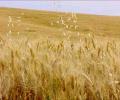
Finance Minister is unhappy over lack of storage capacity.

The wheat procurement season has ended in most big foodgrain-growing states with an all-time high purchase of almost 28 million tonnes (mt), creating a problem of storing such huge stocks.

The Union ministry of food and consumer affairs proposes to insert a new clause in the fresh discussion note for the Cabinet on allowing foreign direct investment (FDI) in multi-brand retail.

The government on Thursday banned exports of non-basmati white rice to boost domestic supply and keep retail prices under check during the upcoming festive season. There would be no change in export policy of par-boiled non-basmati rice and basmati rice, which forms the bulk of exports, the food ministry said in a statement. Non-basmati white rice constitutes about 25 per cent of total rice exported from the country.
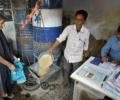
The Pradhan Mantri Garib Kalyan Anna Yojana (PMGKAY) was launched in March 2020 to provide free 5 kg foodgrains per person per month to about 80 crore beneficiaries covered under the National Food Security Act (NFSA) to reduce their hardship during the lockdown period. This was over and above the general allocation under the NFSA.
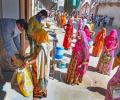
The government's food subsidy in the ongoing fiscal year is expected to be a little less than Rs 4 trillion.
The cooking oil national industry body -- Solvent Extractors' Association (SEA) of India has suggested immediate initiation of government to government (G2G) dialogue with Indonesia on the proposed palm oil export ban from April 28 by them as it would have an adverse repercussions in India. Indonesia, which is the world's largest producer of palm oil and meets nearly 50 per cent of the total palm oil requirement in India annually, had announced to ban exports till further notice apparently to contain edible oil prices in their domestic market. "We have suggested our government initiate dialogue with Indonesian counterparts at the highest diplomatic level on the cooking oil export ban.

The Taliban ousted the government in Afghanistan and took over the control of the country after capturing Kabul last month. Afghanistan is one of the top three destinations for Indian sugar exports. About 6,00,000-7,00,000 tonne of the sweetener is exported annually.
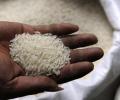
A 6-7 million tonnes shortfall in rice production due to a fall in paddy sowing area is likely to keep rice prices at elevated levels, adding to the inflationary pressure that the slowing economy is already grappling with. Elevated food prices, including that of cereals, had led to retail inflation reversing a three-month declining trend, to touch 7 per cent in August. Similarly, the wholesale price inflation, which declined to 11-month low, also showed price pressures from cereals resulting from wheat output being impacted by severe heat waves in some parts of the country.

A decision in this regard was taken in the Cabinet meeting chaired by Prime Minister Narendra Modi.

Gujarat, Kerala and Tamil Nadu have topped an index that ranks states on food safety parameters for the 2020-21 year, according to an FSSAI report unveiled by Health Minister Mansukh Mandaviya on Monday. The index ranks states on five parameters of food safety: human resources and institutional data, compliance, food testing facility, training and capacity building besides consumer empowerment. Gujarat, Kerala and Tamil Nadu have topped in the list of large states on the index.

According to the food ministry, about 142 lakh migrants will benefit in Uttar Pradesh and in Bihar (86.45 lakh), Maharasthra (70 lakh), West Bengal (60.1 lakh), Madhya Pradesh (54.64 lakh), Rajasthan (44.66 lakh), Karnataka (40.19 lakh), Gujarat (38.25 lakh), Tamil Nadu (35.73 lakh), Jharkhand (26.37 lakh), Andhra Pradesh (26.82 lakh) and Assam (25.15 lakh).
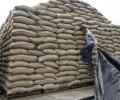
Wheat will be now be sold to the schemes at Rs 2 per kg, while rice would be given at Rs 3 per kg.

The central government on Friday stopped the doorstep delivery of ration scheme MMGGRY (Mukhya Mantri Ghar Ghar Ration Yojana) of the Delhi government, scheduled to be launched on March 25.
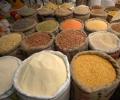
Now the PMO needs to take the food sector reforms forward.
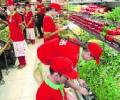
As part of an overall strategy of improving food management to reduce inflationary pressure, the food ministry has written to Prime Minister Manmohan Singh to incentivise organised retail trade in the farm sector.

'It has been a phenomenal effort at all levels of the government.' 'People were working 15-16 hour shifts in the central government, in the state governments, in the districts....'

The NDA is looking to reduce fiscal deficit not by chopping social sector spending but by paring it down

Agriculture ministry to prepare blueprint for purchasing onions directly from farmers and the expenditure on damages would be shared equally between the Centre and state governments.

Amid talk of an ordinance on the Food Security Bill, the law ministry has warned that without putting a proper mechanism in place to distribute foodgrains, a law should not be implemented.
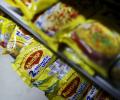
The claim is filed with a consumer body.

Some UTs to start from April 1 and other transfers to be launched from January.
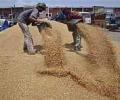
The food ministry has supported the suggestion of Rangarajan panel to allow export of 2 million tons of wheat from government stocks immediately to ease pressure on storages, the Rajya Sabha was informed on Monday.

In the 2010-11 marketing year (October-September), the government had procured 34.19 million tonnes, according to the Food Ministry data.
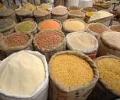
Concerned over possible fall in pulses production due to poor monsoon so far, the government is considering reintroducing its scheme to sell subsidised pulses through ration shops to give relief to common man from price rise.

The country has exported about 5 lakh tonnes of raw sugar so far availing the benefit of the subsidy, according to the Indian Sugar Mills Association (ISMA).
The government on Monday notified the decision allowing free export of sugar, a move that will help industry ship surplus sweetener and clear cane payment arrears to farmers that have mounted to over Rs 10,000 crore (Rs100 billion).
The job guarantee scheme is set to provide food grain as part of wages.

The Planning Commission's de-linking entitlement benefits for the poor from the Suresh Tendulkar committee's recommendation on determination of poverty has left a big question mark on the number of beneficiaries to be covered under the proposed Food Security Act.
To ensure effective distribution and supply of foodgrains through rations shops, the food ministry has called for creating advisory committees of experts in places where godowns of Food Corporation of India (FCI) and other state agencies are located.

The working group on food and public distribution constituted under the chairmanship of Planning Commission Deputy Chairman Montek Singh Ahluwalia is likely to recommend using the numbers effectively for streamlining PDS.

Officials from the food ministry said if the situation continued, the country could face a problem of plenty, as grain stocks this year are at a high level of 65 million tonnes (mt), while the total storage space available with the Food Corporation of India and state agencies, both covered and uncovered, is estimated at 63 mt as on June 1.

The government on Wednesday sought public comments on the draft National Food Security Bill, which seeks to provide a legal entitlement to subsidised foodgrains to 75 per cent of the country's rural population and 50 per cent of urban India.

This Budget, the finance ministry may consider a proposal for a seed fund that would provide financial support to states willing to sell items other than foodgrain, sugar and kerosene through the public distribution system (PDS). The move, experts believe, will help reigning in food inflation that remains in double digits, despite moderation.
Main difference has been on including people above the poverty line in the Food Security Bill.

A recent study shows that more than 100 million people are excluded from the public distribution system because the central government insists on using 2011 population figures to calculate state-wise PDS coverage, which effectively leaves out 100 million people, reports Sanjeeb Mukherjee.
A study by eminent economists, by Jean Drze, Reetika Khera and Meghana Mungikar released few days back shows that more than 100 million people are excluded from the PDS because the central government insists on using 2011 population figures to calculate state-wise coverage under the National Food Security Act.
Two days after the Congress Working Committee (CWC) witnessed Pawar-bashing at the hands of senior Congress leaders, the party once again attacked the Union Agriculture Minister, saying that prices were responsibility of the Agriculture and Food Ministry and "it is natural for the party to articulate the concerns of millions of people".

The food ministry is likely to fix the selling price of wheat and rice lower than the current market price.
 © 2026 Rediff.com - Investor Information - Advertise with us - Disclaimer - Privacy Policy - Sitemap - Feedback - About us - Terms of use - Grievances