
Among the Sensex firms, Hindustan Unilever, Reliance Industries, Infosys, Asian Paints, ITC and UltraTech Cement were the major gainers. State Bank of India, JSW Steel, Axis Bank, ICICI Bank, Tata Steel and Tata Motors were among the laggards.
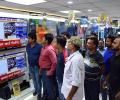
Nearly all FMCG companies like Marico, HUL, ITC and the rest have been indicating that the operating environment has been challenging, with drop in consumption, especially in rural areas, severe crunch in market liquidity conditions, and disruptions and floods in several parts of the country. To overcome this, they are boosting their direct reach in the countryside.

India is likely to grow by 7.5 per cent in the first quarter of the current financial year, driven by rising aggregate demand and non-food spending in the rural economy, according to an article in the RBI's May Bulletin released on Tuesday. The Indian economy has demonstrated marked resilience in the face of geopolitical headwinds impacting the supply chain, said an article on the state of the economy published in the May Bulletin.

The severity of the second wave of COVID-19 infections in India poses a key challenge for the FMCG industry and the spread of the virus to rural areas on a relatively higher scale as compared to the first wave is also expected to weigh on industry growth outlook, according to ITC Ltd. There is heightened uncertainty around the timing and shape of the recovery trajectory of overall economic growth in India due to the virus, the company said in its Annual Report for 2020-21. In terms of consumption, urban-led recovery may be relatively muted compared to the first wave as consumers switch to precautionary savings mode and rising healthcare costs eat into household spending, while rural demand may also be blunted by the large-scale spread of the virus to the hinterland in the second wave.

'Investors should consider small and midcaps only if they can handle volatility and have a longer investment horizon.'

Equity benchmark indices Sensex and Nifty closed marginally lower on Friday as investors booked profit in FMCG, IT and healthcare stocks after the BSE Sensex and Nifty hit fresh lifetime highs in intra-day deals. The 30-share BSE Sensex dipped 7.65 points or 0.01 per cent to settle at 75,410.39. During the day, it rallied 218.46 points or 0.28 per cent to hit its all-time intra-day high of 75,636.50.

Overall, the domestic FMCG market bounced back to levels of 98 in June compared with 75 in May and 101 in March before the nationwide lockdown was announced. The pre-Covid March index for foods was 103, and for non-foods, it was 99.
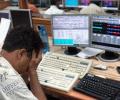
Infosys fell the most among Sensex stocks, declining by 2.85 per cent. Among other IT stocks, TCS fell by 1.87 per cent, Wipro by 1.52 per cent, and HCL Tech by 1.70 per cent. NSE Nifty plunged by 174.65 points to close at 17,938.40.

FMCG CEOs indicate that the market should stabilise post the general elections and that some growth should make its way back especially in rural areas

While green shoots are beginning to emerge, with June sales rebounding to pre-Covid levels thanks to a rural revival, most FMCG chief executives have voiced concerns about localised lockdowns that began in July and have extended into August in some states.

From the Sensex firms, Power Grid, NTPC, Tech Mahindra, Bharti Airtel, Tata Motors, IndusInd Bank, Reliance Industries, Kotak Mahindra Bank and Maruti were among the laggards. Asian Paints, Wipro, JSW Steel, Hindustan Unilever, Bajaj Finserv and Mahindra & Mahindra were among the biggest gainers.

A break-up of business shows that 75% of a firm's turnover is led by volume growth, while 25% is price-led. Companies such as Britannia, Nestl, Dabur, Marico, Kellogg, Parle Products, and Hindustan Unilever have increasingly focused on smaller packs of their key products, aimed at improving sales.

60-65 per cent of the FMCG industry's overall sales come from urban areas; 35-40 per cent from rural areas.

Consumer goods firms and auto companies are witnessing an upturn in rural demand, which had been lagging for most of FY24. Expectations of a bumper rabi crop harvest have helped turn the tide. The Reserve Bank of India's (RBI's) Monetary Policy Committee kept the repo rate unchanged last week, noting that as rural demand catches up, consumption is expected to support economic growth in 2024-25.
Recent data from market analytics firm Nielsen shows that the rural market in the country's 630,000-odd villages is pulling down the overall FMCG business.

West Bengal is home to 43,000 Durga Pujas, and the business around it is a major economic driver.

'Bilateral trade has suffered seriously because of the growing unrest.' 'There is a standstill on both sides amid the curfew.'

Companies whose products have not been picked up for distribution in Gujarat under a "non-cooperation movement" include Marico, Dabur, Emami, Britannia, Reckitt Benckiser, and Godrej Consumer Products.

ITC was the top gainer in the Sensex pack, rallying over 7 per cent, followed by Asian Paints, Hero MotoCorp, Maruti, Bajaj Auto, Sun Pharma, TCS and HCL Tech. On the other hand, IndusInd Bank, NTPC, Bajaj Finance, HDFC and L&T were among the laggards. NSE Nifty advanced 39.70 points, or 0.44 per cent, to 9,106.25.

With a gradual rise in temperature and the start of heatwave, FMCG and dairy firms selling cola-based fizz drinks, juices, mineral water, ice creams and milk-based beverages expect a spike in sales and have ramped up their production and stocks to meet the anticipated consumer demand. The makers are launching new products keeping in mind the evolving consumer preferences and also investing substantially on promotions and expansion of the channels this season, company executives of beverage and ice cream makers said. Beverages major PepsiCo said summer months are naturally the most favourable season for its category and it is "optimistic" that its portfolio of brands will continue to delight consumers during the period.

'Although currently, urban areas contribute more to growth than rural, there is no reason why rural areas should not contribute.'

'While every year presents new challenges, it also provides opportunities for better growth and performance.'

'We expect market consolidation and recommend buying during market dips.'

Net capital gains from the sector over a full cycle may be more than the gains logged by cyclical sectors.

'We are confident that over the next few years the government will strike a fine balance between populist measures and growth, and manage coalition partners well.'

Fair trade regulator CCI on Tuesday said it has approved the demerger of the hotel business of diversified entity ITC Ltd into a separate entity. After the completion of the demerger, shares of ITC Hotels Ltd, a new entity, will be listed on the stock exchanges. The proposed combination relates to the demerger of the demerged undertaking to ITC's wholly-owned newly incorporated subsidiary, ITC Hotels.

FMCG major Britannia Industries' results for the January-March quarter (Q4) of the financial year 2023-24 (FY24) were received enthusiastically by the market with the share going up by 6.7 per cent on Monday to close at Rs 5,061.60 on the BSE. However, analysts said the results were in line with margins, and disappointing in terms of revenue growth. The consolidated net sales (excluding other operating income) rose 3 per cent year-on-year (Y-o-Y) to Rs 4,010 crore in Q4.
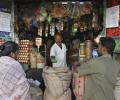
Sales of fast-moving consumer goods (FMCG) witnessed significant recovery in September after enduring a double-digit decline in August, according to data furnished by Bizom. Kirana stores in rural areas stocked up in preparation for the festival season, which began in September. This, combined with rainfall reaching 113 per cent of the long-perid average for the month, contributed to a boost in sales.

The surge in IT, auto and FMCG stocks were led by investors seeking safety against market volatility.
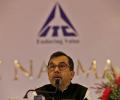
Sanjiv Puri, chairman and managing director of ITC, is looking to expand the conglomerate's play outside India by taking "strategic positions" in markets close to home in the non-cigarette fast-moving consumer goods (FMCG) and hospitality businesses. In a recent conversation with Business Standard, Puri revealed that ITC is setting sights beyond India's borders. "We already export to 100-odd countries. We want to scale that up and take some strategic positions in markets close to us," he said.
Among the Sensex firms, Tata Steel, JSW Steel, Tata Motors, Bajaj Finserv, Bajaj Finance, Asian Paints, ITC and Nestle were the major gainers. Mahindra & Mahindra, Reliance Industries, Axis Bank, ICICI Bank and Power Grid were among the laggards.
The slowdown had been brewing since 2016 but was intensified further by several disruptions in the past two years including demonetisation.

Among Sensex shares, Bajaj Finserve, ICICI Bank, Bharti Airtel, Bajaj Finance, Sun Pharma, Maruti Suzuki, ITC, and Nestle were the lead gainers. On the other hand, L&T Wipro, IndusInd Bank and TCS and Tata Motors were the lead losers.

The Tata group firm has enhanced its product portfolio through "targeted acquisitions" as it aspires to be a formidable player in the FMCG category, said Chandrasekaran, who is also the chairman of Tata Sons. Besides, it has stepped up the pace of innovation across markets in line with consumer trends such as health and wellness and convenience, he said in his message to shareholders in the latest annual report of TCPL.

Among the Sensex firms, ITC, Kotak Mahindra Bank, ICICI Bank, Nestle, Axis Bank, IndusInd Bank, UltraTech Cement, Bajaj Finance, Maruti and HDFC Bank were the major laggards.

FMCG has been behaving unlike a defensive category in recent quarters.

ITC was the top loser in the Sensex pack, shedding 1.97 per cent, followed by Tata Steel 1.80 per cent, HUL 1.57 per cent, Vedanta 1.44 per cent, Bharti Airtel 1.37 per cent and M&M 1.35 per cent.
Stock market barometers Sensex and Nifty ended marginally higher on Monday as rise in wholesale inflation capped early gains despite a positive trend in global markets. The 30-share index settled 32.02 points or 0.05 per cent higher at 60,718.71 with half of its constituents ending in green. The broad based Nifty edged up 6.70 points or 0.04 per cent to close at 18,109.45.

'We plan to touch Rs 1 trillion of Amul brand's turnover in the next five years.'

 © 2026 Rediff.com - Investor Information - Advertise with us - Disclaimer - Privacy Policy - Sitemap - Feedback - About us - Terms of use - Grievances