
Industry officials say the crunch has not only affected manufacturing of edibles but even of items like nozzle pumps and other goods used in packaging.

Discount retailer DMart (Avenue Supermarts) hit its highest levels in a year and a half last week and is up over 11 per cent in the last one month. The company depends on low operating costs to offer the lowest prices to consumers, which enables sales velocity and scale, further reducing costs. This virtuous feedback loop has helped DMart gain market share in a sector dominated by unorganised stores.

Expect fast-moving consumer goods makers (FMCG) to raise prices again next month owing to raw materials, transport, labour and packaging material costs remaining high or becoming even costlier. Whether it is packaged wheat flour and basmati rice or biscuits and shampoos, these products will become 2-10 per cent more expensive. Adani Wilmar will hike the price of its packaged wheat flour by 5-8 per cent and of its basmati rice by 8-10 per cent next month.

Titan Company, Axis Bank, NTPC, Tata Motors, ITC, Tech Mahindra, Bajaj Finserv, ICICI Bank, HDFC Bank and Bajaj Finance were the other laggards. Bharti Airtel, Power Grid, Infosys and Larsen & Toubro were among the gainers.

FMCG firms such as ITC, Parle Products, Marico, Emami, PepsiCo India and CG Corp Global on Wednesday assured uninterrupted supply of their products based on the learnings from the last year's lockdown, even as surge in COVID-19 cases in India forced Maharashtra to declare a 15-day curfew while other states also imposing various restrictions.
The lowest FMCG index valuation has been around PE 27, while the highest have been above 42PE.
Most of the labourers in manufacturing plant are migrant workers. With them moving back to native places, there is going to be a huge challenge.

Today, the company has created a portfolio of vibrant world-class brands.

To double its current turnover of Rs 13.53 billion in five years, the firm plans to generate 25 per cent of this consolidated revenue from FMCG sales.

Equity benchmark index Sensex on Wednesday crashed over 900 points to sink below the 73,000 level due to widespread selling pressure amid a sharp fall in smallcap and midcap indices. Besides, deep losses in utility, energy and metal stocks and recent selling by foreign investors added to the gloom, analysts said. Benchmark indices started the session on a positive note, but the selling intensified during afternoon trade, with all sectoral indices ending in the red.

Launched this April, the FCG business will end the year with a turnover of Rs 500 crore

Domestic customers will get access to high-quality Swiss products such as watches, chocolates, biscuits, and clocks at lower prices as India will phase out customs duties under its trade pact with the EFTA bloc on these goods over a period of time. India and the four-European nation bloc EFTA signed a trade and economic partnership agreement (TEPA) on Sunday to boost trade and investments between the two regions. The European Free Trade Association (EFTA) members are Iceland, Liechtenstein, Norway, and Switzerland.

'Today's engineering graduates have to learn the skills to solve problems which is actually a higher order skill.'

Domestic customers will get access to high-quality Swiss products such as watches, chocolates, biscuits, and clocks at lower prices as India will phase out customs duties under its trade pact with the EFTA bloc on these goods over a period of time. India and the four-European nation bloc EFTA signed a trade and economic partnership agreement (TEPA) on Sunday to boost trade and investments between the two regions. The European Free Trade Association (EFTA) members are Iceland, Liechtenstein, Norway, and Switzerland.
Although large companies like Nestle, Dabur or HUL have been impacted by this slowdown in demand, it was the small, local players that have been hit harder.
The first to see price hikes will be soaps. In the past six months, domestic palm oil prices have increased by 46 per cent. Palm oil is a key input going into soaps.
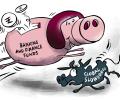
Even as banks and finance companies are reporting record-high earnings, their weighting in the benchmark National Stock Exchange Nifty50 Index has seen a downward trajectory. Investors expect a stronger performance from other sectors in the new year. Currently, banking, financial services and insurance (BFSI) companies collectively hold a weighting of 34.5 per cent, down from 36.7 per cent at the end of December 2022 and a record high of 40.6 per cent at the end of December 2019. This represents the sector's lowest weighting in the index since December 2021 when it stood at 33.7 per cent.

Among Sensex shares, HCLTech, Asian Paints, Maruti, JSW Steel, TCS, SBI, ITC and Bharti Airtel were the major losers. On the other hand, Bajaj Finserv, Mahindra & Mahindra, Titan, L&T and Wipro were the major gainers.

Lower income groups earning less than Rs 100,000 a year are yet to recover as are those earning between Rs 100,000 and Rs 200,000.

CFO of Marico Industries Milind Sarwate believes that the FMCG sector has emerged out of the rut that it was in until a few years ago.

Dabur India has been the worst performer in the fast-moving consumer goods (FMCG) space this year (CY23), posting a 1 per cent decline even as its peer index, the Nifty FMCG, has delivered returns of over 29 per cent in this period.

The Competition Commission of India has approved the acquisition of 31.27 per cent of additional stake in Religare Enterprises by four entities of Dabur India promoter Burman family, enabling them to become majority owners in the financial services firm. The fair trade regulator allowed the four entities to acquire Religare's 5.27 per cent through stock market purchase and another 26 per cent through an open offer.

'Due to rural stress, volumes continue to remain an issue for the industry, and we are yet to see any revival in demand.'

Beauty creams, hair oil, shampoos and other household items will cost more as FMCG firms plan to increase prices by up to 7 per cent due to the excise duty hike announced in the Budget.
Despite a handsome performance by leading fast moving consumer goods (FMCG) companies in the June quarter, the road ahead appears full of hurdles.

The biggest headwind to the consumption story in FY23 is a sharp decline in government subsidies on food, fertiliser and fuel, and overall decline in revenue expenditure net of interest payments. This, analysts say, will adversely impact purchasing power of households at the lower end of the income pyramid, translating into lower spending on consumer goods and services.
Hindustan Unilever, GlaxoSmithkline Consumer Healthcare, Godrej Consumer Products, Dabur, Nestle and other FMCG companies are lining up initiatives to maximise returns from modern trade channels including hypermarkets and supermarkets.

British multinational BAT PLC on Tuesday said it plans to sell up to 3.5 per cent stake in India's ITC Ltd to institutional investors through a block trade. In a statement, British American Tobacco PLC (BAT), the single largest shareholder in ITC Ltd (ITC), said its wholly-owned subsidiary Tobacco Manufacturers (India) Ltd (TMI) intends to sell up to 43,68,51,457 ordinary shares in the Indian diversified entity to institutional investors by way of an accelerated bookbuild process (block trade), subject to customary closing conditions.
Fast-moving consumer goods (FMCG) companies can rejoice as the Rs 27,369 crore rural market in the country registered a growth rate of 17 per cent in the first 10 months this year.

Among Sensex gainers, Power Grid jumped the most by 4.16 per cent after its board approved an investment of Rs 656 crore in transmission projects. Private lenders HDFC Bank, Axis Bank, Kotak Bank, IndusInd Bank and ICICI Bank were also among lead gainers. NTPC, Nestle and Hindustan Unilever also ended the session with gains.

After a sharp fall in the share prices of HDFC Bank and other private sector lenders in the past three days, the BFSI (banking, financial services and insurance) sector weighting in the Nifty50 has slipped to a seven-year low of 32.03 per cent, down from nearly 36.6 per cent at the end of March 2023 and 34.5 per cent at the end of December 2023.

The rise in excise duty will have a negative impact on FMCG companies, which FMCG companies will pass on to consumer.

The biggest bounce is in the realty sector, where the industry index jumped 80%. There's been a turnaround also in automobiles and ancillaries (up 45%). The pharma and health care indices have a welcome return of roughly 35%.

Among the Sensex firms, State Bank of India, ITC, Nestle, Asian Paints, Tech Mahindra, Mahindra & Mahindra, Tata Consultancy Services and Hindustan Unilever were the major laggards. In contrast, HCL Technologies, Power Grid, Sun Pharma, NTPC, Bajaj Finance and Titan were the gainers.

Operating margins have been the primary driver of corporate earnings in India in recent quarters, despite revenue growth suffering from weak consumer demand. Companies across sectors have reported a sharp improvement in earnings before interest, tax, depreciation, and amortisation (Ebitda) margins over the past two years, benefiting from lower commodity and energy prices. Higher margins more than compensated for slower revenue growth, resulting in double-digit growth in net profit for five consecutive quarters.
The "asset-right" strategy, reiterated by ITC chairman Sanjiv Puri during the company's 112th annual general meeting (AGM) on August 11, received a thumbs up from the analysts. They, however, believe that sustained earnings growth and synergies with the demerged hotel's vertical will help the stock break out from the ongoing consolidation. "The stock is expected to consolidate between Rs 420 and Rs 450 in the near future.

Companies from Nestle and ITC to Hindustan Unilever and Patanjali have pledged to reduce use of unhealthy ingredients by five to 50 per cent

Over the past year, Amul has undergone a transformative journey, evolving from a dairy-centric entity to a comprehensive foods company. Since 2022, PepsiCo India, too, has embarked on extensive launches in the food category. Not to be left behind, ITC, which has been introducing an average of 100 fast-moving consumer goods (FMCG) products across categories every year, has also launched a number of packaged food items.

Talks on with P&G, HUL, Patanjali, among others to push their products via 250,000 common centres
 © 2026 Rediff.com - Investor Information - Advertise with us - Disclaimer - Privacy Policy - Sitemap - Feedback - About us - Terms of use - Grievances