
The Reserve Bank of India fears that rising current account deficit in the United States could adversely impact interest rates and inflation globally and India could not be an exception.

The BJP still does not have a majority in Upper House of Parliament, the Rajya Sabha, and this will pose hurdles to the party's legislative reform agenda
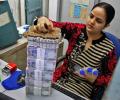
'The Budget numbers presented severely underestimate the magnitude of the unstated fiscal crisis that we went through in 2018-2019, which cannot be conceivably be fully reversed in 2019-2020,' points out Rathin Roy, director, National Institute of Public Finance and Policy.

Germany is now sitting on a mountain of savings.

India needs to sustain a GDP growth rate of 8 per cent to become a five trillion dollar economy by 2025, the Economic Survey has stated.

Government looking at cushioning slowdown due to demonetisation with sops and higher outlay for micro, small and medium enterprises, agriculture, and affordable housing.

A weaker rupee could aid corporate earnings through its positive impact on export intensive sectors such as information technology services, pharmaceuticals and commodity producers such as metal and mining, and oil and gas companies.
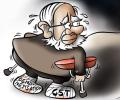
We have to wait and see whether Jaitley's Budget speech translates into actions and desired outcomes, says T N C Rajagopalan.

In its essence, GST is a national level system of value added taxation of goods and services, says Shankar Acharya.

Public investment is very crucial for GDP growth, says finance ministry.
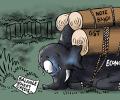
'The current budgetary practice of shifting expenditures off-balance sheet in order to be seen to be meeting fiscal targets should be discontinued; additional fiscal stimulus would be imprudent; individual income tax rates should not be cut; GST rates should not be raised now,' advise Arvind Subramanian and Josh Felman.

Kudlow, who served as Trump's informal economic adviser during the 2016 campaign, is a well-known conservative voice.

The Modi government has handled inflation far better than any government in the past two decades. Both the stock market and currency indices have begun to show confidence in the economy, despite the mounting global headwinds of trade.
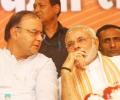
This move will enable it to incur higher-than-mandated borrowing, and possibly spending, till the 2024 Lok Sabha election cycle.

Jaitley does not believe in living on borrowed money.

The BJP maintained that stability in economic growth and economic policies of the government along with strong currency attracts foreign investment.

The Budget would preserve macro-economic stability.

'Concerns about India's future are hampering private investment.' 'If the private sector sees strategy, teams and execution on these issues, this will inspire confidence in India.' 'This should be our main strategy for 2017,' says Ajay Shah.

As mostly sports-mad Mongolians cheer on the country's two medalists at the Rio Olympic Games, deepening economic troubles at home mean the new government cannot afford to pay its athletes.
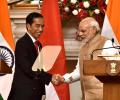
'Joko's re-election bid has been as tough as Modi's.' 'But in a curious reversal of roles, what Joko faced was a platform somewhat akin to Modi has chosen for himself to woo voters,' notes Ambassador M K Bhadrakumar.

A well-established tax system would have a predictable buoyancy - how fast the collections grow as a proportion to the growth of the economy. But that is not the case with GST. It is still undergoing substantial changes as the government responds to structural as well as administrative glitches.

RBI expects the growth in the next fiscal to strengthen gradually, notwithstanding the significant headwinds.
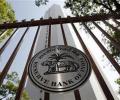
The report said efforts to stabilise the economy through monetary policy interventions need to be complemented by appropriate fiscal policy measures.
.jpg)
India's economy grew 4.7 per cent in 2013-14, following an expansion of 4.5 per cent in 2012-13. In the fourth quarter of 2013-14, growth remained subdued at 4.6 per cent, mainly due to a decline in manufacturing and mining output.

The federal government uses a fiscal year that begins in October; on that basis, the 2014 fiscal year ended in September saw a deficit of $483 billion, the lowest of Barack Obama's presidency

Demonetisation was not a good idea and the time should have been utilised instead to fine-tune the Goods and Services Tax before it was introduced, said Gita Gopinath, John Zwaanstra Professor of International Studies and of Economics at Harvard University, in an interview with Advait Rao Palepu.

India's fiscal deficit trends are a bit like an alcoholic trying, unsuccessfully, to reform. Virtue does not last for too long, says Shankar Acharya.
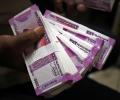
Sustained dollar unwinding from exporters and banks amid weak overseas trend gave a boost to the rupee

Private sector output in India expanded for the first time in 8 months in February as slump in the services sector moderated and manufacturing grew at a stronger pace, an HSBC survey said.
The report cautioned that low capacity utilisation and stressed balance sheets of banks and businesses will prevent a strong investment revival in the short term.
The non-oil, non-finance sector of the economy is under severe stress.

The focus shall also be on consolidation of public debt and reducing rollover risk through active switch/buyback operations.


'If you keep inflation low, everything else like messing up after after demonetisation will be forgiven,' says T C A Srinivasa-Raghavan.

If Mr Modi and his team expect to win the 2019 elections, groundwork for improved performance in their second term should be done now.
The rupee hit a near 10-month high as an alliance led by pro-reform and business friendly Hindu nationalist Narendra was on course for an absolute majority.

The Reserve Bank of India is widely expected to lower interest rates for a third time this year.
 © 2026 Rediff.com - Investor Information - Advertise with us - Disclaimer - Privacy Policy - Sitemap - Feedback - About us - Terms of use - Grievances