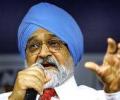
Buoyed by over 17 per cent of industrial growth in April,the highest for 2010 so far, Planning Commission on Friday said the government's policies were "working" and that it should continue with gradual withdrawal of stimulus.
'I am sure Dr Patra will get the fullest cooperation from the finance minister who needs workhorses, not prima donnas constantly looking to improve their CVs,' says T C A Srinivasa-Raghavan.

Not only is the current US financial crisis not solved, the seeds are there for even more serious crises in the future, writes Deepak Lal.

Prime Minister Manmohan Singh ruled out any rollback in hike in petrol and diesel prices, saying the economy has the capacity to absorb the increase without triggering an inflationary spiral. Singh also made it clear that following populist fiscal policies for long harmed the economy, two days after key United Pogressive Alliance allies Trinamool Congress and Dravida Munnetra Kazhagam made a strong pitch for the rollback.
For a long time, the Indian economy has been drifting without a credible monetary anchor.

The recovery in the second half of 2009 would be largely due to the hefty stimulus packages.

The upward revision in growth forecast for current fiscal comes in the backdrop of GDP expanding 8.2 per cent in April-June quarter, higher than Fitch's expectation of 7.7 per cent.
Ahead of the Budget 2009-10, the economic survey on Thursday suggested tax cuts and increase in government expenditure as part of another stimulus package to help the economy overcome the global shock.

Despite a slowing economy, the Budget does not envisage any major stimulus through the budgeted fiscal deficit figures, said Goldman Sachs.

'Investors hate uncertainty and the demonetisation move certainly creates that.'
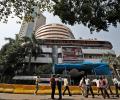
Participants are keeping an eye on the Winter Session of Parliament, which started today, and US fiscal policies to be followed by President-elect Donald Trump
The high deficit was bad enough, Parliament's standing committees won't be scrutinising budget proposals either.
Several questions arise on the appropriateness of the measure in the already strained fiscal scenario, says M Govinda Rao.
Although its ratings outlook for foreign currency and local currency is stable, Moody's outlook for the country says it faces challenges in macroeconomic management and a backlog of structural reforms. "India's ratings are based on the assessment of the country's moderate levels of economic and institutional strength, that are supported by a rapidly growing and well-diversified economic structure," said Aninda Mitra, VP and senior analyst at Moody's.

It would be futile to believe G-20's promises to rein in monetary and fiscal policies
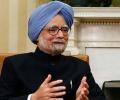
There is a need for tax reforms in the country in a bolder way, Singh said.
Three policymakers aware of the central bank's deliberations on the Budget said they are combing through the numbers to test how Jaitley struck a balance, and question some of the assumptions.
'Since the growth is not fast enough to provide jobs for the young, the fallout will be political and social,' warns T N Ninan.

How do we get back to higher trend growth? The heart of the problem lies in private corporate investment, recommends Ajay Shah.

India is among the worst-performing BRICS nations along with Brazil (ranked even lower than India at 71st this year).

The Economic Survey seems convinced that 2019-2020 saw the bottom of the economic cycle, points out Abheek Barua, chief economist, HDFC Bank.

IMF believes it is mostly cyclical, not structural, but because of the financial sector issues, recovery will be not be quick. IMF said, it saw an opportunity with the strong mandate of the new government to reinvigorate the reform agenda to boost inclusive and sustainable growth.
Fitch reaffirmed India's rating at 'BBB-' with a Stable Outlook saying the rating balances a still strong medium-term growth outlook compared with similar category peers and relative external resilience stemming from solid foreign-reserve buffers against high public debt, a weak financial sector and some lagging structural factors, including governance indicators and GDP per capita.
Prime Minister Manmohan Singh has said that India's economic growth in 2008-09 is estimated to have fallen below 7 per cent and is likely to remain at that level in the current fiscal on the back of fiscal and monetary initiatives.
Rating agency Moody's has described Budget 2007-08 as "largely unremarkable", as it disappointed businesses and the market's hope for meaningful economic reforms.

Protectionism and a rollback of regulation. Defusion of tensions with Russia and a lowering of geo-political risks. Looser fiscal policy and tighter monetary policy. At least Donald Trump can't be faulted for not trying something different where existing policies have disappointed, says T T Ram Mohan.
The government needs to do some more to get real estate transactions going. One is to figure out a way to bring prices down to more realistic levels, without crossing into the realm of formal controls.
The RBI expects change, presumably commencing in the next Budget, but must hold its current view until this actually happens.

Refusing to link his seeking voluntary retirement, a year before his superannuation, to his transfer to the relatively low profile power ministry, he said that he had conveyed his decision to the Prime Minister's Office on July 18.
Indians must be willing to swallow some bitter medicine during this phase when India is witnessing progressive growth, finance minister P Chidambaram said.

The government on May 17 formed a five-member committee.

'At a time when the economy is depressed, a pandemic is raging, and the Chinese are making noises on the border, the NRC could be resuscitated.'

'The no-rate cut policy and preference to wait for the Budget and clarity on the fiscal front demonstrate RBI Governor Shaktikanta Das is maturing in his new role,' notes Tamal Bandyopadhyay.
With only three days to go before Finance Minister P Chidambaram delivers the Budget in Parliament, market expectations with respect to reforms are running high.

His finest years came when he served as deputy governor under C Rangarajan.
A task force set up by the heavy industry department will examine the definition of "small car" and suggest ways, including changes in the fiscal policy, to turn India into a manufacturing hub for such cars.\n\n

''Even without major reforms, with a business as usual scenario, and with current inflation trends, we should be clocking around 11 to 12 per cent nominal growth.' 'That is not happening and is a source of worry,' Rathin Roy tells Arup Roychoudhury.
 © 2026 Rediff.com - Investor Information - Advertise with us - Disclaimer - Privacy Policy - Sitemap - Feedback - About us - Terms of use - Grievances