
The Securities and Exchange Board of India (Sebi) is set to undertake a comprehensive overhaul of the small and medium enterprise (SME) listing framework and tighten accountability around the use of artificial intelligence (AI) and machine learning (ML) in financial markets, Sebi Chairman Tuhin Kanta Pandey announced.

Restoration of indexation benefits on debt mutual funds, rationalisation of taxation for alternative investment funds are some of the demands.
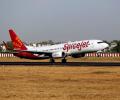
SpiceJet's board has approved a proposal to raise up to Rs 5,500 crore through various financial instruments, including equity, as the airline grapples with significant unpaid dues, salary delays, and operational disruptions. The move aims to address cash-flow constraints and strengthen its balance sheet amidst ongoing financial and regulatory scrutiny.

SBI Chairman CS Setty has cautioned against the potential for Artificial Intelligence (AI) systems to exclude rural, small, and new-to-credit borrowers due to inherent biases. Speaking at an event, Setty emphasised that financial inclusion must be a core principle in the design and deployment of AI tools, highlighting the responsibility of bank boards to ensure fair and inclusive systems. He also noted the importance of AI training for bank directors.

Keep enough cash for near-term needs so that a bear phase doesn't force you to sell equities at unfavourable prices.

Perhaps we spend too much time planning how to become financially free and too little asking what we want to be free for, notes Harsh Roongta.

Fintech firm Razorpay has secured approval from markets regulator Sebi for its proposed initial public offering (IPO) of Rs 5,000-6,000 crore, targeting a valuation of around USD 5 billion. The company, founded in 2014, offers various financial services and attained unicorn status in 2020. This development follows its confidential IPO filing in June, while rival PhonePe's IPO is currently on hold.

Analysts predict that the Indian stock market's direction in the upcoming holiday-shortened week will be primarily influenced by foreign investor activity, crude oil prices, and broader global economic trends, with significant FPI inflows already observed.

Indian equity benchmark indices extended losses for a second consecutive session, with the Sensex dropping 143 points, driven by a sell-off in power, banking, and financial stocks, coupled with elevated crude oil prices and persistent FII selling.

Analysts predict that the Reserve Bank of India's interest rate decision, crude oil prices, and global bond yields will be the primary factors influencing the Indian stock market this week, alongside macroeconomic data and foreign investor activity.

Indian stock market benchmark indices Sensex and Nifty experienced a decline in early trade, primarily due to selling pressure in blue-chip IT firms and profit-taking following a recent sharp rally in equities. Track Sensex, Nifty on November 9.
Analysts predict that the US midterm election results, which saw Democrats gain control of Congress, will primarily influence Indian markets through changes in global financial conditions, trade policy expectations, and geopolitical developments, with a keen focus on the US administration's actions in West Asia and their potential impact on crude oil prices.

'The Indian market has struggled over the past two years.' 'It peaked in September 2024, and although it has moved up and down since then, investors have not really made money.'

Indian stock market benchmark indices Sensex and Nifty rallied significantly in early trade, driven by robust foreign fund inflows, better-than-expected Q2 results, and a sustained moderation in crude oil prices. The 30-share BSE Sensex jumped 1,097.33 points, while the 50-share NSE Nifty rallied 274.30 points. Track Sensex, Nifty on November 11.

Indian equity markets, represented by the Sensex and Nifty 50, concluded Samvat 2082 with significant weekly gains, marking their strongest performance in nearly six years, despite it being their weakest Samvat in 15 years overall. The late recovery was driven by hopes of tax changes, resilient corporate earnings, and easing geopolitical tensions.

Tata Motors is maintaining its lead over Mahindra & Mahindra in the race for the second position in India's passenger vehicle market, largely driven by its strong performance in electric vehicle sales. Both companies are aggressively expanding their SUV and EV portfolios and scaling up production to meet surging demand, indicating a fierce competition ahead.

Indian stock markets are set to be influenced by a confluence of factors this week, including escalating geopolitical tensions, particularly concerns over US-Iran conflict, volatile crude oil prices, and the ongoing quarterly earnings season. Additionally, the US midterm elections, foreign investor activity, and key macroeconomic data releases will also be closely monitored by investors.

Indian stock markets, including the Sensex and Nifty, experienced a significant tumble in early trade, driven by escalating tensions in West Asia that pushed crude oil prices close to the USD 100-per-barrel mark, alongside selling in IT stocks and fresh foreign fund outflows.

Indian benchmark indices, Sensex and Nifty, closed lower on Tuesday, with the Sensex declining 329.91 points to 74,529.08 and the Nifty dipping 85.30 points to 23,329, primarily dragged by underperformance in IT, financial, and capital goods stocks despite positive global market trends and easing crude oil prices.
Indian equity benchmarks, the Sensex and Nifty, opened higher on Friday, driven by a strong rally in IT stocks, despite a significant overnight decline in US technology shares and broader Asian markets. Experts anticipate further market support from falling US bond yields, a strengthening rupee, and a substantial liquidity inflow following the Jio Platforms IPO allotment. Track

Financial services attracted the bulk of the inflows, followed by telecommunications, automobiles and information technology.

Artificial intelligence company Anthropic, developer of the Claude chatbot, has made its Nasdaq debut following a record $81.34 billion initial public offering (IPO), securing a valuation of approximately $1.5 trillion amidst growing investor interest in AI.

'They allow people to enter and exit. And there is transparency. There is market infrastructure. There is technology. There is cyber security. And then there are enough enablers.'

Nadeem Omar, owner of the Pakistan Super League (PSL) franchise Quetta Gladiators, has announced his intention to sell the team. He attributes this decision to the PSL's inability to compete commercially with the Indian Premier League (IPL), citing limited market, lack of sponsors, and poor merchandising revenue compared to the IPL's robust financial model. Omar expressed disappointment over not achieving his goals for the team and Pakistan cricket.

Cash-strapped SpiceJet has cancelled over 70% of its scheduled flights across major Indian airports, including Delhi, Mumbai and Bengaluru, as the airline grapples with severe financial and operational challenges, impacting thousands of travellers.

Public shareholders in One 97 Communications (Paytm) have seen approximately 1.7 times returns on their investment over the past five years, driven by the fintech company's rising share price. This growth reflects a substantial increase in public ownership and institutional participation since its market debut, alongside improved financial performance and six consecutive quarters of profitability.

India's markets regulator, Sebi, is set to issue comprehensive guidelines for the responsible use of Artificial Intelligence (AI) in capital markets, aiming to balance technological innovation with robust investor protection. The guidelines will focus on disclosures, accountability, and human oversight in critical AI-driven decisions.
The Securities and Exchange Board of India (Sebi) is reportedly 'close' to approving the National Stock Exchange's (NSE) initial public offering (IPO) draft documents, with an expected market debut by early next month. Sebi Chairman Tuhin Kanta Pandey also emphasised the regulator's focus on enhancing market resilience against evolving risks, including technology failures and the impact of artificial intelligence.
Indian benchmark indices Sensex and Nifty experienced declines in early trade, influenced by the Reserve Bank of India's (RBI) recent repo rate hike and its signal for continued monetary tightening, coupled with rising crude oil prices and foreign fund outflows. Track Sensex, Nifty on October 8.

Indian stock markets witnessed a significant rebound, with the Sensex rallying 1,109 points and the Nifty closing above 22,720, driven by strong performances in IT and financial sectors, a recovering rupee, and Finance Minister Nirmala Sitharaman's comments on long-term capital gains (LTCG) tax.

Investors are set to monitor quarterly earnings, crude oil prices, the Jio Platforms initial public offering, and foreign investor activity in the upcoming holiday-shortened week, according to market analysts.

Indian benchmark equity indices, Sensex and Nifty, extended their winning streak for a third consecutive day, driven by sustained foreign institutional investor (FII) inflows and a dip in global crude oil prices. The Sensex closed above 81,900, while the Nifty settled near 25,300, despite mixed global cues.
The Reserve Bank of India (RBI) is planning to extend tokenisation to various financial asset classes, building on its successful trials with certificates of deposit (CDs). This move aims to enhance the efficiency of issuance, trading, and settlement of financial assets, leveraging blockchain technology and wholesale Central Bank Digital Currency (CBDC) for atomic settlements.

Financial independence begins not only with earning or investing more but also with knowing what one owns, understanding where one's money is held and taking responsibility for managing it.

Goldman Sachs has upgraded India to 'overweight' with a Nifty target of 28,500 by 2027-end, driven by an anticipated 15 per cent earnings growth, strong domestic demand, robust earnings, and historically low foreign positioning.

S Mahendra Dev, chairman of the Economic Advisory Council to the Prime Minister (EAC-PM), stated that India needs to increase the manufacturing sector's share in its GDP from the current 16-17 per cent to 25 per cent by 2047 to achieve developed economy status. This goal requires an average real GDP growth of around 8 per cent annually over the next 21 years, supported by a 34-35 per cent investment rate and diversified long-term financing.

Indian benchmark equity indices, Sensex and Nifty, experienced declines in early trade due to elevated crude oil prices and persistent geopolitical uncertainties, particularly following the expiry of the US-Iran ceasefire. Track Sensex, Nifty on August 19, 2026.

Delhi Police's IFSO unit has dismantled a pan-India cyber fraud network that allegedly duped a family of Rs 67.78 lakh through fake stock market and IPO investments. Seven individuals from five states have been arrested for their roles in creating mule accounts, supplying account kits, and providing technical assistance to divert fraudulent proceeds.
Indian benchmark stock indices, Sensex and Nifty, closed higher on Monday, driven by sustained foreign fund inflows and a decline in crude oil prices. The Sensex gained 512 points, while the Nifty settled near 25,300.

Paytm's Singapore arm, Paytm Singapore Pte Ltd, will invest up to Rs 200 crore in subsidiaries of Singapore-based Funding Societies, including a 19.1 per cent stake in CardUp. This strategic move aims to expand Paytm's technology-led payments and financial services in Singapore through a "partner operated" model.
