
Fuel loading at India's first prototype fast-breeder reactor in Kalpakkam is expected to start next week, marking a significant step in the country's nuclear program.

Two more fast breeder reactors of 500 mega watt electric capacity each would be set up here by 2020, a top official of the Indira Gandhi Centre for Atomic Research said on Tuesday.
India will commission its first 500-Mw fast breeder reactor (FBR) for generating commercial nuclear energy by the end of next year. The reactor, when commissioned, will mark the country's entry into the second phase of its three-stage nuclear energy programme.
"Work on the PFBR is on schedule and we expect it to be completed by 2010," Atomic Energy Commission Chairman Anil Kakodkar told reporters in Delhi on Thursday evening.
Fast breeder reactors not up for inspection

India's 500 MWe Prototype Fast Breeder Reactor (PFBR) at Kalpakkam in Chennai has achieved first criticality, marking a significant advancement in the country's nuclear energy capabilities and long-term energy security.
After three decades of hard work, and despite the devastating tsunami of 2004, the 500 megawatt Fast Breeder Reactor at Kalpakkam is coming up at a furious pace, says Shivanand Kanavi who visited the project site recently. It also happens to be the first tsunami-ready reactor in India.
But the father of the French fast breeder reactor programme Dr Georges Vendryes Tueday sounded a note of caution, saying the way forward was now fraught with risks. \n

In many ways, this is only the beginning -- of a new chapter in India's nuclear story, and of a future where its vast thorium reserves could finally power its ambitions.
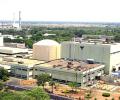
A contract labourer at the Madras Atomic Power station at Kalpakkam in Tamil Nadu has been arrested after some pen drives and a mobile phone that had over 400 photos of the BHAVINI Prototype Fast Breeder Reactor were seized from him, police said on Thursday.
The Central Information Commission (CIC) has turned down an application seeking cost-related information on the country's unique fast-breeder reactor being developed at Kalpakkam.

India and Russia are expected to unveil a major nuclear energy partnership during Vladimir Putin's visit, potentially involving Russian small modular reactors and expanded cooperation as India pushes toward its 100-GW nuclear goal by 2047.
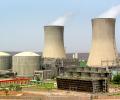
'Chinese are going bang, bang, bang building 30-35 reactors.' 'We should announce a programme of 50 new reactors and show that we mean business on the ground and not just announcements.'

Construction major L&T is gearing up to expand its footprint in the global nuclear supply chain, a senior company official has said, while calling for amendments to key legislations on the domestic front to pave the way for the entry of private players and foreign capital necessary for capacity enhancement.

AAERB's permission for RAPP-7 paves the way for the subsequent phases of reactor commissioning leading to its commercial electricity generation.
A 200-tonne safety vessel was successfully lowered into the reactor vault of the 500 MW Prototype Fast Breeder Reactor(FBR) in Kalpakkam in a "historic moment" for the country's indigenous nuclear programme.
Congratulating engineers and scientists for constructing the sophisticated complex in the coastal region here in Thane district of Maharashtra, Singh said the reprocessing plant was essential for the country's closed-fuel-cycle three-stage nuclear programme.
Pakistan plans to generate 8,800 mw from nuclear sources by 2030, the study says, adding the government has already formulated an energy security plan in this regard.
Union Minister for Science and Technology Kapil Sibal Saturday said India "converted adversity into opportunity" by developing its own civilian fast-breeder reactors when it was denied nuclear technology post-Pokhran.
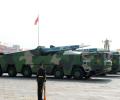
China has more than 500 nuclear bombs in its arsenal and is developing new Inter-Continental Ballistic Missiles (ICBMs) that will significantly improve its nuclear-capable missile forces, the Pentagon said on Thursday.

After nearly two decades of nuclear competition with Pakistan, India with the several long-range ballistic missiles in development is seemingly now paying attention to its future strategic relationship with China, a think-tank report has said.
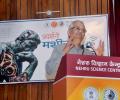
'Why should we disclose classified information to satisfy those who doubt our Hydrogen Bomb capability?'
The UPA government on Friday insisted that the country's "sovereign" interests, including in strategic nuclear field, were protected in the IAEA safeguards agreement and expressed confidence about getting an exemption from the Nuclear Suppliers Group.
Nuke scientists support AEC chief's contention

India has said it is committed to implementing the highest safety standards at its nuclear power plants as it seeks to harness the benefits of atomic energy to meet its growing energy requirements.
China is expanding its nuclear force and is likely to have a stockpile of about 1,500 warheads by 2035, up from the current estimated number of 400, the Pentagon has said in a report that notes that Beijing aims to expand its national power through both domestic and foreign policy initiatives.

Several nuclear power projects held up for the lack of such an insurance pool can now be expected to move forward.

'If not, we can become frighteningly chaotic, more chaotic than what we are today.' 'In today's environment in the country, we still have a window of opportunity.'

'The biggest lacuna in this agreement is it is called 'full civil nuclear cooperation agreement.' Actually, it is anything but full.'
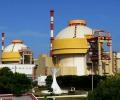
'Decisions on nuclear power have so far been taken by a small select group, primarily interested in profiteering from their actions, stating 'secrecy' as necessary from the national security point.' 'This argument is false, because we are dealing with the 'civilian' nuclear power sector, which is open even to the IAEA,' says Dr A Gopalakrishnan, former chairman of the Atomic Energy Regulatory Board.
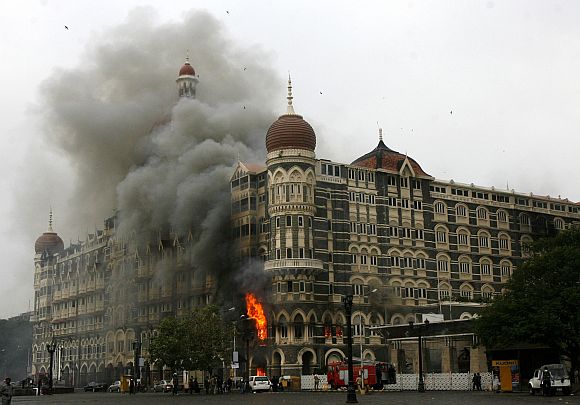
'Headley's testimony indicates to what extent the Pakistan government and its proxies can go to destroy not only Indian scientific talent but also international expertise.'

'The India-France relationship has been that of the elites of two countries, who appreciate each other's philosophical traditions -- whether it is ancient Indian civilisation and Sanskrit texts or the French tradition of Rene Descartes, Albert Camus, (Jean-Paul) Sartre... This is a drawback. It doesn't create the buzz, the excitement necessary for a relationship. We need more people-to-people contact, especially among students,' says former Ambassador to Paris, Rakesh Sood.
'There has definitely been a breakthrough in the nuclear logjam. It is good to see nuclear energy back on the rails,' says Dr Anil Kakodkar, former chairman, Atomic Energy Commission.

Former President A P J Abdul Kalam kindly answered rediff.com's questions for an exclusive interview.

'No PM has said no to anything we have proposed. I am not a politician and I cannot give speeches about things, but a lot of good things have been done in science by previous governments.' 'Under Dr Manmohan Singh, we could do a few important things. I used to meet him once in 6, 8 weeks. He often said, 'Professor Rao, you assume that you have my approval and carry on.' He was shy and decent. He is a real gentleman.' 'Science keeps me going at 80. I feel young.' Professor C N R Rao, the eminent scientist who was honoured with the Bharat Ratna, on the state of science in India.
