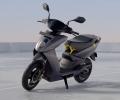
If you thought electric scooters have caught the fancy of only people in the metros, think again. According to data from electric two-wheeler maker, Ather Energy, 54 per cent of its sales of scooters, starting from Rs 1.2 lakh, come from Tier 2 and Tier 3 cities. Based on sales per lakh population, the top five cities for the company are Calicut, followed by Kochi, Kolaphur, Trivandrum and Pune.
as the FAME II deadline of March 31, 2024, nears, EV manufacturers are worried about their investments and future plans.
Sales of total electric vehicles in India are expected to be around 10 lakh units this year, equal to what was sold collectively in the last 15 years, mainly riding on the good traction witnessed by electric two-wheelers, Society of Manufacturers of Electric Vehicles (SMEV) said on Thursday. In 2021, the sales of electric two-wheelers (E2Ws) in the country jumped over two-fold at 233,971 units driven by a good traction of high-speed scooters as compared to 100,736 units in 2020, SMEV said in a statement. "We haven't seen better days than the last few months in the entire EV journey.
With increasing incidents of electric two-wheelers catching fire, Union minister Nitin Gadkari on Thursday said the companies found negligent will be penalised and a recall of all defective vehicles will be ordered after receiving the report of an expert panel that has been formed to enquire into the matter. In a series of tweets, Gadkari said several mishaps involving electric two-wheelers have come to light in the last two months. "We have constituted an expert committee to enquire into these incidents and make recommendations on remedial steps.

'The aim is also to probe how the ministry and testing agencies made negligence in examining these OEMs, so that such negligence is avoided in the future.'
'Through volume numbers and unit sales one can see, we are not making a loss'
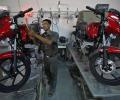
Bajaj Auto's market capitalisation (market cap) hit Rs 2 trillion mark for the first time. The stock of the two and three-wheeler major rallied 6 per cent to hit a new high of Rs 7,420 on the BSE in Tuesday's (January 9) intraday trade after its board approved Rs 4,000 crore share buyback at Rs 10,000 per share. The stock ended the day at Rs 7,093.75, up 1.55 per cent and its market cap a shade above Rs 2 trillion.

From the customer point of view too, LFP batteries are safer and offer a longer life.

TVS Motor Company has been one of the best-performing two-wheeler stocks in the current financial year (FY24), enriching investors with gains of 24 per cent. Among listed two-wheeler stocks, only Hero MotoCorp has done better in this period. New launches, market share gains, steady margins and expectations that its performance will continue in FY24 are expected to support TVS Motor's stock.

Ola Electric will miss its target to fully utilise installed production capacity in next six to eight months and will achieve only 50 per cent of it by November 2023, founder and CEO Bhavish Aggarwal said on Friday. At the time of launch of the new S1 Air electric scooter ahead of Diwali last month, he had said the company was already producing more than 1,000 a day at its 'future factory' and would be scaling it up significantly beyond that.
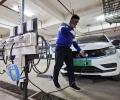
New Delhi's timing couldn't have been worse, both for India's fledgling electric vehicle (EV) sector and prospective electric bike buyers. It was hard to miss the perfect storm brewing for India's EV industry since early 2022. On one hand, you had several accidents involving battery fires that unnerved consumers; on the other, uncertainty had crept in over subsidies.

Passenger Vehicle makers are likely to see their cumulative earnings at an operating level erode by Rs 1,800-2,000 crore in the year ending March 2022 on account of the shortage of semiconductors, rating agency Icra said at a webinar on Wednesday. The industry, it pointed out, is estimated to lose production of 500,000 units at the end of FY22 due to the chronovc shortage the chip, which is critical in safety, entertainment and the various other smart features of a car. "In absence of the chip crisis, the industry volumes are likely to have exceeded the all-time peak annual volumes." Icra has pared its growth estimates for the PV market from the earlier 10-14 per cent to 8-11 per cent now in FY22.

Ola Electric, India's largest maker of electric scooters, launched its most affordable ride on Tuesday, in an attempt to woo more customers and expand its electric two-wheeler lineup.
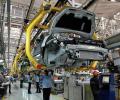
Automobile manufacturers are likely to report strong numbers for the September quarter of Financial Year 2023-24 (Q2 FY24), riding on growth across segments and offset by a marginal drop in overall two-wheeler (2W) volumes. Higher average selling price (ASP) year-on-year (YoY), which was necessitated by price hikes taken by original equipment manufacturers (OEMs), and an improved product mix will also aid revenues and margins. Moreover, commodity prices are down on a YoY basis, leading to higher margins in earnings before interest, taxes, depreciation and amortisation (Ebitda).

Vader is the first electric bike in India to offer 7-inch Android display.

Ola Electric on Monday said it will foray into the electric car segment with plans to launch its first model by 2024. The company, which struggled with deliveries for its electric scooters after it announced entry into the segment exactly a year ago, has set an ambitious target of selling 10 lakh electric cars by 2026-2027. In a press conference, Ola founder and CEO Bhavish Aggarwal said Ola Electric aims to provide a range of electric two-wheelers to electric cars which are priced in the range of Rs 1 lakh to Rs 50 lakh.

Five cities -- Delhi, Bengaluru, Kolkata, Hyderabad and Surat -- ceded their power of procurement and agreed to a different procurement model to operate state-run buses.

The country saw a massive year-on-year surge in the demand for electric vehicles, with retail sales of electric two-wheelers rising by 58 per cent, passenger vehicles by 130 per cent, three-wheelers by 82 per cent, and commercial vehicles by 171 per cent in March 2023, according to the data shared by the Federation of Automobile Dealers Associations (Fada). According to a report by JMK Research, the EV segment as a whole grew by 157 per cent during FY23, to 1,180,597 units, from 458,746 units a year ago. Overall, EV sales in March 2023 rose by 82 per cent from the March 2022 figure, the JMK report added.

In doing so, Bajaj has become the first internal combustion engine two-wheeler company to launch an all-electric two-wheeler in India.
SoftBank-backed Ola Electric took the wraps off its maiden e-scooter offerings -- Ola S1 and S1 Pro -- for a commercial launch on Sunday. With prices starting from Rs 99,999 (excluding state government incentives, registration fee, and insurance cost), the Bhavesh Aggarwal-founded firm said the e-scooters are designed and engineered in India for the world and will deliver the best scooter experience to the consumer. He suggested that after 2025, sale of petrol-powered two-wheelers should not be allowed.
The electric scooter juggernaut which has been picking up momentum with heady growth month-on-month is now slowing down. The combined number of registrations in April of eight electric two wheeler companies has seen a dip of over 1 per cent to 43,061 vehicles, according to data from the Ministry of Road Transport & Highways' site VAHAN. The reasons are the continuing shortage of chips, especially after the Ukraine-Russia war, and the spate of fires which have led to scooters being recalled by manufacturers.

India's largest two-wheeler maker by volume - Hero MotoCorp (Hero) - posted a better-than-expected operating performance in the January-March (fourth quarter, or Q4) quarter of 2022-23 (FY23). Riding on higher average selling prices which were up 5 per cent year-on-year (YoY) and volume growth of 7 per cent, the company registered a 12 per cent growth in revenue to Rs 8,306 crore. The company sold 127,000 units in the quarter, largely driven by domestic sales which were up 11.6 per cent, while exports saw a sharp fall of 57 per cent over the year-ago quarter.

As the government plans no further extension of the scheme beyond FY24, the task is to achieve the unfinished target of subsidising 914,707 EVs.

Almost all of these companies either unveiled their new electric vehicle or alternative energy-powered models.
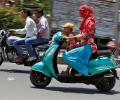
After lagging behind other segments in the automotive (auto) space over the past few years, two-wheelers are expected to reverse their volume underperformance. After witnessing a 36.3 per cent volume decline over the 2018-19 (FY19) through 2021-22 (FY22) periods, the sector staged a recovery in 2022-23 (FY23), with volumes rising 17 per cent. While volumes are still a quarter lower than the FY19 peak of 21 million units, a double-digit growth trajectory is expected to prolong.

As much as 35 per cent to 40 per cent of all vehicles sold in the country across segments will be electric by 2030, up from a mere 2 per cent this year, says a Bain & Co report released today. This translates to 14-16 million new electric vehicles (EVs) selling in a year. The inflexion point, which is now being seen month on month in many segments (such as two-wheelers which hit around 4-5 per cent in December), will be more than visible in 2026, when 4-5 million EVs across segments are expected to be sold, accounting for 15-20 per cent of the total sales, says the report.

Innovation ranging from exterior designs of vehicles to EV charger locks grabbed eyeballs at the expo
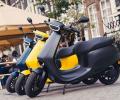
From powering mobile devices, US chip designer Qualcomm has tied up with Ola Electric to power its electric scooters. Qualcomm is providing the key 4G connected octa core android platform which provides connectivity, computing capabilities and enables rich immersive displays with power saving software.

India will have 30 per cent of its two-wheeler industry turning electric by 2030 as new manufacturers lead the shift, said a report on Monday. Passenger vehicles will be 15 per cent electric and the three-wheeler segment 75 per cent electric by 2030, said the report by BNP Paribas called 'India Autos-Electric vehicles: Minutes to midnight'. "We see FY22 as the year of inflection for the two-wheeler EV industry, with an accelerated EV adoption helped by incentives, wider availability, model launches, rise in crude prices and improved general awareness. We see 30 per cent of the 2W industry turning electric by 2030; the pace of incentive withdrawal presents an upside/downside risk," the report (India Autos - Electric vehicles: Minutes to midnight) said.

With its new premium Primus and Ampere NXG, it is targeting buyers seeking a faster and more stylish ride

The car was expected to have a price tag of Rs 10 lakh and launch was slated for this June.
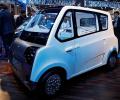
The EV industry is at an inflection point and batteries will play a critical role ahead -- batteries and related components typically constitute 35-45 per cent of an EV's costs.

Ahead of the upcoming Union Budget, Society of Manufacturers of Electric Vehicles (SMEV) has asked Finance Minister Nirmala Sitharaman to either rejig the FAME II scheme or reintroduce FAME I, saying the programme meant to promote EVs in its second avatar has been able to achieve less than 10 per cent of its target. The Rs 10,000-crore FAME-II scheme which is to be implemented over a period of three years, came into effect from April 1, 2019. It is the expanded version of FAME India I (Faster Adoption and Manufacturing of (Hybrid) and Electric Vehicles (FAME) which was launched on April 1, 2015, with a total outlay of Rs 895 crore.
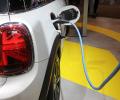
Electric vehicle retail sales in the country witnessed over three-fold jump last fiscal with two-wheeler offtake leading the segment, according to data compiled by automobile dealers' body FADA. Total electric vehicle (EV) retails reached 4,29,217 units in 2021-22, a rise of three-fold from 1,34,821 units in the financial year 2020-21, the industry body said. Total EV sales had stood at 1,68,300 units in the 2019-20 fiscal, it noted.

Ratings agency ICRA on Wednesday revised downwards growth forecast for the domestic passenger vehicles industry to 8-11 per cent in the ongoing fiscal from the earlier estimate of 14-17 per cent on account of the ongoing semiconductor shortage. Similarly, for the two-wheeler segment, it said the volumes are expected to contract by 1-4 per cent in FY2022 against an earlier prediction of 6-8 per cent growth as affordability and demand sentiments of target clientele was hit sharply by the second wave of COVID-19 pandemic. With around 5 lakh units of production lost by various automakers in the passenger vehicles segment due to the semiconductor shortage, ICRA said the earnings loss for the OEMs (Original Equipment Manufacturers) could be around Rs 1,800 crore to Rs 2,000 crore for the ongoing fiscal.

By 2025, Uber projects that 25,000-30,000 cars -- or 12 to 16 per cent of vehicle additions -- would be EVs, reports Surajeet Das Gupta.

To ramp up domestic battery manufacturing capacity and reduce the dependence on imports, the government has initiated talks with a few lithium-rich countries to supply the mineral to Indian companies, industry sources informed Business Standard. The Ministry of External Affairs (MEA) held a meeting with the ambassadors of countries, including Argentina, Chile, and Bolivia, among others, to put forth its request.
Ola Electric's technology team is working hard to iron out the technical kinks that marred the electric vehicle company's hyped online sale of its electric scooters (e-scooters) - the S1 and the S1 Pro - on Wednesday, said company sources. The SoftBank-backed firm is facing technical difficulties in making the website live for the purchase of its e-scooters. According to company sources, the website couldn't go live as there were integration issues.
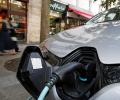
Automobile manufacturers, new and old, as well as ancillary suppliers are set to spend a combined Rs 70,630 crore over the next five years on either entering the electric vehicle segment or stepping up their presence in it. Data culled from announcements made by firms shows India, the world's fifth largest automobile market, is poised to receive one of the biggest capex pushes ever to fuel the transition from internal combustion engines to electric motors and batteries as part of a green drive. The EV push, egged on by the government's emphasis on electric mobility to meet its net zero targets, is expected to yield at least 25 electric vehicles - new ones as well as electrified versions of existing vehicles running on internal combustion engines.
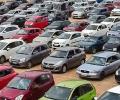
Retail sales of passenger vehicles grew last month but the sales of two-wheeler and commercial vehicles remained low compared to the pre-COVID month of May 2019, according to automobile dealers' body FADA. On Monday, FADA said that overall auto retails stood at 16,46,773 units in May, down from 18,22,900 units in May 2019. "May 2022 retails when compared to May 2019 reveal that sales are still not on a growth trajectory as overall retails were down by 10 per cent.
 © 2026 Rediff.com - Investor Information - Advertise with us - Disclaimer - Privacy Policy - Sitemap - Feedback - About us - Terms of use - Grievances