Upon completion, the factory will create almost 10,000 jobs and will initially have an annual capacity of 2 million units.
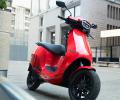
The government-appointed expert committee, which probes incidents of Ola Electric's S1 Pro and Okinawa vehicles catching fires, has added the latest case of fire involving PureEV electric scooter to its investigation, a senior government official told Business Standard. "A team comprising experts from Indian Institute of Science (IISC) and Centre for Fire, Explosive and Environment Safety (CFEES) are investigating the cases. "As soon as the report is submitted, we shall take appropriate action," said Giridhar Aramane, secretary at the ministry of road transport and highways.
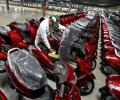
So far at least eight incidents of EV fires have been reported in just over a month's time.
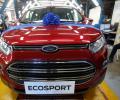
Ford, which had announced to quit the Indian market last year, said it was exploring the possibility of using one of its plants in India to produce electric cars for exports.

As a 75-year-old septuagenarian, Bajaj Auto has adapted itself as a nod to competition, regulations, and changing buyer preference. It will continue to do so, said its managing director Rajiv Bajaj at the launch of the all-new Pulsar 250. This was in response to a question on the company's preparedness for disruption by electric two-wheeler start-ups.
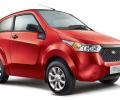
If the drop in sales over the past two years is anything to go by, India's dream of putting seven million electric vehicles on road by the end of this decade has come a cropper.
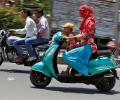
The two-wheeler sector has been underperforming its peers on the volumes front for over five quarters now. Even in the March quarter, Bajaj Auto and Hero MotoCorp posted a 17-24 per cent YoY decline in volumes, the sharpest in the listed auto universe. The ongoing impact of frequent price hikes, all-time high fuel prices, and muted rural sentiment has led to the lacklustre showing by two-wheeler makers. What has aggravated the situation for two-wheeler companies, which get almost all their sales from the internal combustion engine or ICE-based units, is the traction for electric two-wheelers (EV).

If the drop in sales over the past two years is anything to go by, India's dream of putting seven million electric vehicles on road by the end of this decade has come a cropper.
Under the scheme, the government will provide financial incentives for each electric vehicle sold in India during the remaining part of the 11th Plan.

Besides electric vehicles, some start-ups present are working in the area of bike customisation, motorsports, auto gaming arena, autonomous vehicle and so on
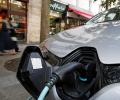
Society of Manufacturers of Electric Vehicle (SMEV) on Thursday said sales of EVs in India fell 20 per cent in the financial year 2020-21 to 236,802 units. In 2019-20 sales of electric vehicles (EVs), including electric two-wheelers (E2W), electric three-wheelers (E3W) and electric four-wheelers (E4W), stood at 295,683 units. For FY21, the E2W segment sales declined by 6 per cent to 143,837 units, as compared to 152,000 units in FY20, SMEV said in a statement, adding that the FY21 E2W sales included 40,836 high-speed and 103,000 low-speed E2W. The E3W segment registered sales of 88,378 units as against 140,683 units sold in FY20.
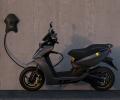
The soaring prices of metals like lithium, nickel and cobalt, which are the primary constituents of the cell, as well as supply chain bottlenecks, are also pushing up the cost of batteries
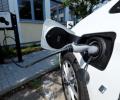
While traditional automakers in India are reeling under a global shortage of semiconductors, the country's electric vehicle (EV) makers, too, are now facing a shortage of lithium-ion batteries, a key raw material. The soaring prices of metals like lithium, nickel and cobalt, which are the primary constituents of the cell, as well as supply chain bottlenecks, are also pushing up the cost of batteries. Battery manufacturers say that prices have been increasing every quarter since the beginning of 2021.

Leading two-wheeler maker Hero MotoCorp is going full throttle to launch a Harley-Davidson model with retro styling as it looks to enter a very profitable segment in the premium motorcycle space, according to a senior company official. The alliance between Hero and Harley-Davidson fructified last year after the iconic US two-wheeler maker announced discontinuation of sales and manufacturing operations in India, a decade after it started selling its premium bikes in the country. "There are two legs to the Harley tie up strategy. One of course is that we are the sales distributors for Harley bikes in India.
Arvind, Electrotherm, Shah Alloys have surplus power to sell. Ahmedabad-based stainless steel manufacturer Shah Alloys, denim maker Arvind Ltd and electric two wheeler producer Electrotherm are currently producing surplus power from their CPPs and they are looking at selling it.
The Ahmedabad-based company plans to collaborate with local garage owners in installing battery charging stations at a radius of around three kms. Delhi, Mumbai, Chennai and Bangalore are some of the cities identified for setting up battery stations. The initiative is planned to be implemented during the first quarter of 2009.
Scooters India Limited (SIL), a public sector automotive company, is mulling foray into the electric two-wheeler segment and is presently evaluating the expressions of interest (EoIs) by some domestic companies for a possible collaboration. The Lucknow-based company aims to augment its product range from passenger three-wheelers to include green two-wheelers.
Speaking on the cancellation of the deal, Joe Bowman, chief executive officer of Ultra Motors, said, "The opportunity cost of selling electric vehicles in India does not fit strategically under this joint agreement. We intend to create shareholder value and positively impact those markets where we operate. We have come to believe India is one of the largest markets in the world. So we are looking forward to develop it independently."

'It is going to be extremely rapid and anybody who is not there, be it investor, manufacturer, supplier, will miss out.'

Irdai has proposed to increase the Motor Third Party premium rates for cars below 1000 cc to Rs 2,120 from the existing Rs 1,850 for the fiscal 2019-20.
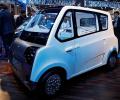
An EV has to be purchased along with the battery as there are hardly any battery swapping, rental, or leasing business models available across India.
The government will create an EV Venture Capital Fund, for financial support to start-ups in the segment. The overall aim is to make Tamil Nadu the preferred destination for EVs and component makers.
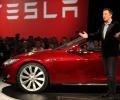
What will it take for Tesla to plug and play in India? Sector pundits say it's a mix of strategy, getting the price right, timing, the right talent, and above all, patience.

As a tech services company, Ola has never been in hardcore manufacturing. And unlike in ride hailing, which is a two-player market (Uber is the only other competitor), in two-wheelers it faces many entrenched players. But most of all, rivals say Ola's targets are out of sync with most, even ambitious, projections.

'We are working on both electric scooters and motorcycles.'
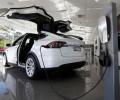
The $306-million investment in Ola Electric Mobility by SoftBank Corp, Arun Sarin Family, Ratan Tata and Matrix has been the biggest funding in this space in value terms this year.

While home-grown firms like Tata and Mahindra have been actively participating in the government's e-mobility mission, by launching electrified versions of their existing models, the global firms believe electric is not the best solution for a country where the primary source of power generation is coal, and where infrastructure is a big impediment.
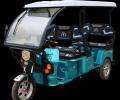
A series of flip-flop on policies and a non-existent charging infrastructure are the biggest challenge in achieving the target of selling 6-7 million hybrid and electric vehicles by 2020.
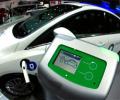
May invest around $100 mn in setting up a 200-acre park
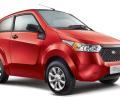
Arun Jaitley presented the Budget in Parliament on Saturday.

Policy lays out a 5-year road map seeking creation of 3.5 mn jobs and promoting 10,000 start-ups.

Maruti will showcase its first concept electric vehicle, the e-SURVIVOR; M&M it's six new EVs, including two futuristic concepts

Companies are drawn to the parks by the infrastructure and ready-to-occupy land.

Tata, whose latest investment was in Ampere, a start-up that produces electric two-wheelers and three-wheelers from Coimbatore.
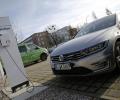
The electric vehicle market in India needs a policy push that goes beyond targets, says Vandana Gombar.

At Rs 1.24 lakh, it's the most expensive scooter manufactured in the country but the 450 deserves every penny.
 © 2026 Rediff.com - Investor Information - Advertise with us - Disclaimer - Privacy Policy - Sitemap - Feedback - About us - Terms of use - Grievances