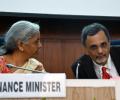
'... and without necessarily calling them Economic Surveys.' 'One should stick to the main focus, which is to give people a good perspective on how the economy is doing.'

Buoyancy in the real estate sector along with improved construction activities created jobs and facilitated the return of migrant workers to cities, the Economic Survey for 2022-23 tabled in Parliament on Tuesday said. This assumes significance in view of loss of jobs due to lockdown restrictions imposed in various parts of the country from time to time amid different waves of pandemic since March 2020. The survey points towards sustained recovery in the economic activities during 2022-23 fiscal year.

Equity benchmarks climbed in early trade on Wednesday amid an overall positive trend in the global markets and ahead of the presentation of Union Budget 2023-24. The 30-share BSE benchmark Sensex jumped 516.97 points to 60,066.87. The broader NSE Nifty climbed 153.15 points to 17,815.30.

In order to promote India as a major tourism destination, states need to complement Centre's actions by rationalising luxury taxes and allowing easy clearance to hotel projects.

RBI's projection of retail inflation at 6.8 per cent in the current fiscal is neither too high to deter private consumption, nor so low as to weaken inducement to invest, the Economic Survey said on Tuesday. However, entrenched inflation may prolong the tightening cycle and therefore, borrowing costs may stay 'higher for longer', it said. The Economic Survey 2022-23 was tabled in Parliament by Finance Minister Nirmala Sitharaman.

Our caste warriors will not even ask these questions, let alone explore better solutions to address the problems of inequality and skewed life outcomes, argues R Jagannathan.

How India performed in 2010-2011 and what Mamata has in store for 2011-12.

With general elections on the horizon, the government's privatisation bandwagon has almost but stalled as a government wary of being accused of selling family silver opts for minority stake sales on stock exchanges over outright privatisation. The result -- the divestment target for current fiscal year is again likely to be missed. Big ticket privatisation plans such as that of Bharat Petroleum Corporation Ltd (BPCL), Shipping Corporation of India (SCI) and CONCOR are already on the backburner and analysts feel meaningful privatisation can happen only after April/May general elections.

Prime Minister Narendra Modi's state visit to the US is expected to see discussion on India's possible entry into a US-led global alliance on critical minerals, officials told Business Standard. In June last year, the US, the European Union, and other G7 partners launched the Minerals Security Partnership to ensure that China did not further strengthen its grip on supplies of critical minerals the world over. Various ministries, including the Ministry of Finance, have communicated to the Ministry of External Affairs to explore the possibility of India joining the partnership, officials said.

Indian economy is poised to do better on the back of reforms undertaken by the government and is expected to clock a 6.5-7 per cent growth in the remaining part of the decade, Chief Economic Advisor (CEA) V Anantha Nageswaran said on Tuesday. Addressing reporters here after the tabling of the Economic Survey in Parliament by Finance Minister Nirmala Sitharaman, Nageswaran said that by and large, inflation is likely to be "well behaved" in FY2023-24 barring headwinds. "My optimism is that in the coming decade, rest of the decade, the potential GDP growth, without taking into account export potential, because global economy is still rife with uncertainty, the growth rate would be around 6.5 to 7 per cent, rather than between 6 per cent and 6.5 per cent," he said.

The gross tax revenues have touched 65 per cent of the Budget estimates at Rs 17.81 lakh crore during the first eight months of the current fiscal till November, propelled by corporate and personal income tax mop-up, according to the Economic Survey 2022-23 presented in Parliament on Tuesday. The survey, authored by Chief Economic Advisor V Anantha Nageswaran, said the 'substantial reforms' in India's taxation ecosystem post-2014 and policy reforms have removed the distortionary incentives from the economy. Reforms like GST, reduction in corporate taxes, exemption of sovereign wealth funds and pension funds from taxes, and removing Dividend Distribution tax have reduced the tax burden on individuals and businesses.

In the Sensex pack, major gainers were Tech Mahindra, Wipro, Bajaj Finserv, Infosys, SBI and PowerGrid. NSE Nifty rallied 237.90 points to 17,339

The Indian rupee may remain under depreciation pressure on account of plateauing of exports and subsequent widening of the current account deficit, said the Economic Survey 2022-23 tabled in Parliament on Tuesday. It said the "risks to the current account balance stem from multiple sources". The country's current account deficit (CAD) widened to 4.4 per cent of the GDP in the quarter ended September from 2.2 per cent in April-June due to higher trade gap, as per latest data of the Reserve Bank of India.

Ahead of the 2023-24 Union Budget, the thinking at the top level of the central government is clear: Gross domestic product (GDP) growth of 6-6.5 per cent is a comfortable enough target for FY24 and the focus should be on fiscal consolidation to ensure that the sovereign cost of borrowing does not become prohibitively expensive in a high-interest rate environment, according to people in the know. Those aware of deliberations between the Prime Minister's Office (PMO) and the Ministry of Finance said while the Budget would look to strike a balance between infrastructure investment and welfare schemes, it is unlikely to be populist, though it will be the last full-year Budget before the 2024 Lok Sabha election. Incidentally, 6-6.5 per cent GDP growth is what the upcoming 2022-23 Economic Survey is expected to project for FY24.

Nationalist Congress Party chief Sharad Pawar has credited late Congress leader Vilasrao Deshmukh with having proper understanding and maturity to lead a coalition government in Maharashtra, and said he had doubts on the capability of Prithviraj Chavan under whose leadership the Congress-NCP alliance lost power to the BJP in 2014 after ruling for 15 years.

A bill will be brought in the assembly during the ongoing session, possibly this week according to sources in the cabinet.
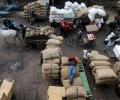
India has already become the world's fifth largest economy in the 75th year of Independence and will reach the $3.5 trillion mark by end-March, said the Economic Survey tabled in Parliament on Tuesday. In real terms, the economy is expected to grow at 7 per cent for the year ending March 2023. This follows an 8.7 per cent growth in the previous financial year.

Gandhi, who is usually flanked by senior party colleagues, was also greeted by both President Droupadi Murmu and Vice President Jagdeep Dhankhar.
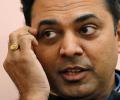
Chief Economic Advisor (CEA) K V Subramanian will be leaving the finance ministry and returning to academia on completion of his three-year term. The government had appointed Subramanian, an ISB Hyderabad professor, as the CEA in December 2018. He had succeeded Arvind Subramanian, who quit the position close to a year ahead of his extended tenure. Subramanian's three-year term would have come up for renewal in December but he decided to return to academia.

Foreign direct investment into the country is expected to rebound in the coming months on account of India's high economic growth, and steps to further improve the business environment of India, the Economic Survey said on Tuesday. The rise in global uncertainty in the wake of the Russia-Ukraine conflict, FDI equity inflows in the manufacturing sector in the first half of the current fiscal (April-September) fell below its corresponding level in the first half of 2021-22, the document, which was tabled in Parliament, said. The monetary tightening at the global level has further restricted the FDI equity inflows, the survey said.

The Union Budget's focus on capital expenditure is expected to crowd-in private investment and push the GDP growth rate close to 7 per cent in the next financial year beginning April 1, said a Reserve Bank article on 'State of the Economy'. In 2023-24, capital expenditure is budgeted at Rs 10 lakh crore which will constitute 3.3 per cent of GDP. "We believe that India will decouple from macroeconomic projections of current vintage and also from the rest of the world.


Eminent economist Arvind Panagariya has said India is on the cusp of returning to a high growth trajectory and voiced confidence that the country will become the world's third-largest economy by 2027-28. Currently, India is the fifth largest economy "so it's another five years.We are already in (the year) 2023. "So 2027-28, India should be the third-largest economy," Panagariya, Columbia University Professor and former Vice Chairman of NITI Aayog, told PTI in an interview in New York.
Enthused by higher than expected GDP numbers in the fourth quarter of 2022-23, Chief Economic Adviser (CEA) V Anantha Nageswaran on Wednesday said India's economic growth may exceed the initial estimate of 6.5 per cent in the current fiscal and the country can look for another year of solid economic performance.

NITI Aayog has not said what the reasons were for having achieved or not having achieved what was sought to be achieved, or what lessons can be learned for the future, points out Aakar Patel.

Online video platform YouTube's ecosystem has contributed over Rs 10,000 crore to India's GDP and supported more than 7.5 lakh full-time equivalent jobs in the country, according to a report. In India, over 4,500 channels had over 10 lakh subscribers and the number of YouTube channels in India making Rs 1 lakh or more in their annual revenue increased by over 60 per cent year-over-year in 2021, the YouTube Impact Report based on analysis by Oxford Economics said. "YouTube's creative ecosystem contributed over Rs 10,000 crore and supported more than 7,50,000 full-time equivalent jobs in the Indian economy in 2021. "That economic impact shows up in four ways, through direct, indirect, induced, and catalytic impacts," the report said.

Chief Economic Advisor (CEA) V Anantha Nageswaran on Thursday said describing India's recovery as 'K-shaped' was wrong as both rural and urban economies were recovering, albeit at different paces. Speaking to reporters at the Finance Ministry, Nageswaran said the gross domestic product (GDP) growth print for the recent October-December quarter (Q3FY23) will likely be revised upwards. "The notion of using the letter 'K' to denote urban and rural is somewhat wrong because it is almost as if one is growing and one is contracting. "I would say one segment's slope is more positive, and the other one slope is less positive but it is positive," Nageswaran said.

The Economic Survey seems convinced that 2019-2020 saw the bottom of the economic cycle, points out Abheek Barua, chief economist, HDFC Bank.

Following are the highlights of the Economic Survey 2022-23 tabled in Parliament on Tuesday

One could argue that India is not troubled in the same way as China is by a declining population and structural problems in real estate/construction and finance. But India has serious trade and fiscal imbalances, and excessive dependence on capital expenditure by the government, points out T N Ninan.

Since March 31, 2022, the PSBs' market cap has risen 43.7 per cent, from Rs. 7.29 trillion to Rs. 10.47 trillion. It's time for the government, the majority owner of public sector banks, to reap the benefit of the rally in bank stocks, recommends Tamal Bandyopadhyay.
Watch all the proceeding from the Parliament.

'The actions of Indian monetary authorities will depend on how quickly they want the inflation to come down to 4 per cent.'

Finance Minister Nirmala Sitharaman will have to do a tight-rope walk between staying fiscally prudent and general public expectations of lower taxes and a wider social security net, while at the same time firing the engines of the economy before general elections. Sitharaman will on Wednesday present her fifth straight Budget at a time when the economy is slowing due to global headwinds and specific sectors need attention. In the run-up to the Budget presentation, expectations are rife that she may tweak income-tax slabs to provide relief to the middle class and increase spending on the poor through programmes such as the rural job scheme while ramping up financial incentives for local manufacturing.
The government on Monday said that matters regarding Chinese intrusion can't be discussed in Parliament as it concerns the security of the country.

'The government should act proactively to instil confidence in the private investors, and also boost the purchasing power of people directly or indirectly by ensuring minimum wages.'

Why did Karnataka's economic prosperity fail to influence the nature of electoral promises made by political parties in the run-up to the assembly elections? asks A K Bhattacharya.

The farm sector has been resilient to the COVID-19 shock and is estimated to grow at 3.9 per cent this fiscal, the Economic Survey said on Monday, while suggesting to the government to give priority to crop diversification, allied farm sectors and alternative fertilisers like Nano urea. The Economic Survey 2021-22 also pitched for increasing agriculture research and development (R&D) and organic farming, besides use of new technologies like drones. "The performance of the agriculture and the allied sector has been resilient to the COVID-19 shock. ...Growth in allied sectors including livestock, dairying and fisheries has been the major drivers of overall growth in the sector," the Survey said. The agriculture sector has experienced buoyant growth in the past two years.
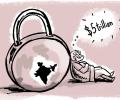
In order to achieve $5 trillion GDP by FY'25, India needs to spend about $1.4 trillion over this period on infrastructure, according to the Economic Survey. During financial years 2008-17, India pumped in about $1.1 trillion on infrastructure. However, the challenge is to step up infrastructure investment substantially, the Economic Survey 2021-22 said.
It would be a difficult task for the Indian economy to reach the $5-trillion mark a year before the International Monetary Fund (IMF) projection of 2026-27. Pankaj Chaudhary, minister of state for finance, said in the Rajya Sabha on Tuesday that the government is taking steps to make the country a $5-trillion economy at a date earlier than the IMF's projection. In that context, it would not be difficult to meet the projection in the third quarter of FY27.
 © 2026 Rediff.com - Investor Information - Advertise with us - Disclaimer - Privacy Policy - Sitemap - Feedback - About us - Terms of use - Grievances