
Jaishankar described as a "reasonable supposition" to expect some improvement in the relations between India and China following the last round of disengagement but hesitated to say that there could be a reset of the ties.

The government's annual Economic Survey on Friday strongly defended new farm laws, saying they herald a new era of market freedom which can go a long way in improving lives of small and marginal farmers in India. These legislations were designed "primarily" for the benefit of "small and marginal farmers", which constitute around 85 per cent of the total number of farmers and are the biggest sufferer of the "regressive" APMC-regulated market regime, the survey said. The pre-budget document defended the farm laws in the backdrop of long-running farmers' agitation at various borders of the national capital seeking repeal of these legislations expressing concern that they are pro-corporate and could weaken government regulated mandis, also called Agriculture Produce Marketing Committees (APMCs).

Finance Minister Pranab Mukherjee presented the Economic Survey for 2010-11 in the Lok Sabha.

The industry today said the Economic Survey has reaffirmed reforms agenda in areas like agriculture, education and skill development but several other risk factors to the growth of the corporate sector has been "glossed over."

The short-term inflation outlook for India is benign, and the expectation of a normal monsoon and moderating global prices of key imported items give credence to the projections made by the RBI and IMF, the Economic Survey said on Monday. However, to ensure long-term policy stability, the Survey 2023-24 suggested making focused efforts to increase the production of major oilseeds, expanding the area under pulses, and assess the progress in developing modern storage facilities for specific crops.
Projecting a 7 per cent growth rate in 2005-06, government's pre-budget Economic Survey on Friday outlined reforms in tax and expenditure and labour laws as a priority in the budget.

'Consider 40% to 50% in equities, 10% in gold as a hedge, and the remaining 30% to 40% split between multi-asset funds and hybrid funds.'
Economic growth projected at 8.1 per cent in 2005-06.\nAgriculture growth at 2.3 per cent.

'Not paying workers enough will end up being self-destructive or harmful for the corporate sector itself.'

ITC, State Bank of India, HCL Technologies and IndusInd Bank were the other big laggards. NTPC, UltraTech Cement, HDFC Bank and Mahindra & Mahindra were among the gainers.

Recommending an end to all cesses and surcharges on taxes, and free pricing of fertiliser and fuel ahead of the Union Budget for 2009-10, the Economic Survey on Thursday suggested aggressive divestment and financial sector reforms to bring the economy back to high growth track.

India needs to create buffers for future economic downturns.

The stock market, the Survey felt, had run away from underlying real economy indicators and asked if this indicated rational confidence or irrational exuberance.

Sanjay Malhotra takes charge as the 26th RBI governor at a time when headline retail inflation has shot up to 6.2%.

The Reserve Bank's growth projection for next financial year is lower than 8-8.5 per cent projected by the finance ministry in the recent Economic Survey which was tabled in Parliament on January 31. Unveiling the bi-monthly policy, RBI governor Shaktikanta Das said, "Recovery in domestic economic activity is yet to be broad-based, as private consumption and contact-intensive services remain below pre-pandemic levels."

Sensex firm on favourable GDP numbers for FY16.

Do we have enough trained oncologists and medical professionals in India to man these over 4,500 beds in the public sector?
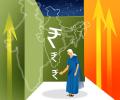
India no longer needs big ticket reforms but small and basic ones to drive the growth forward, Chief Economic Advisor V Anantha Nageswaran said on Monday. Addressing the media after the Economic Survey 2023-24 presented in Parliament, Nageswaran said there is a need to pursue all possible approaches without any ideological orientation. "In terms of the kind of reforms that we need to do, it is no longer big-ticket reforms that dominate your front pages but more about grunt works.

Beti Bachao Beti Padhao is for protection and education of girl child

India's GDP growth is likely to moderate from 8.2 per cent in 2023 to 7 per cent in 2024 and 6.5 per cent in 2025 because the pent-up demand accumulated during Covid has exhausted, as the economy reconnects with its potential, the International Monetary Fund (IMF) said on Tuesday. About the global economy, the IMF said the battle against inflation has largely been won, even though price pressures persist in some countries.

Chief executive officers (CEOs) across sectors have expressed intentions to expand capacities, expecting the government's target to invest a record Rs 11.11 trillion on infrastructure development will act as a catalyst for a jump in consumer demand. "With the government planning a capex of Rs 11.11 trillion, private sector investment will come in a big way. Companies will be preparing for it right from today," H M Bangur, chairman of Shree Cement, told Business Standard. For the past few years, the investment scene in India has been dominated by government capital expenditures; private investments in the manufacturing sector have remained muted.
The report noted that the value of food coupons needs to be indexed to food inflation. Public distribution system is a major initiative of the government to ensure food security for the poor.

Diesel price needs to be revised upward, or subjected to higher taxes, as misuse of subsidized diesel was adding to pollution and public health costs, the government's pre-budget economic report card said on Thursday.
Diesel price needs to be revised upward, or subjected to higher taxes, as misuse of subsidized diesel was adding to pollution and public health costs, the government's pre-budget economic report card said on Thursday.

A barrier-free market -- coupled with removal of controls, licensing system, intermediaries and state-imposed levies on farm commodities -- will benefit both sellers and buyers.

'How many jobs will be created when you complete your course?' 'How many people will compete with you?' 'What is the minimum and maximum salary you can expect?' 'Which are the companies that will offer you a job?' 'What skills do you have to develop?' 'How long will it sustain?'
Steps to be taken to achieve 7-8 per cent GDP growth.\n\nExpanding industry fast, by at least 10 per cent.

Union Finance Minister Nirmala Sitharaman on Tuesday commended Indian financial sector regulators for doing a "world-class job" and bringing greater transparency into the system. Underlining that she is not against questioning or critiquing regulators, Sitharaman said there is a need to be "extremely conscious" about contributions made by them as well. Speaking at the Financial Express Best Banks Awards, the finance minister said, "I strongly recommend that facts are taken on board before we discuss anything to do with the regulators, strictly speaking."

The Survey also said that the borrowings by banks have increased significantly.

At a time when the government is nudging the private sector to ramp up its capital expenditure (capex), the Ministry of Statistics and Programme Implementation (MoSPI) is poised to kick-start the first-of-its-kind annual survey on the status of private sector capex from next month. "The inaugural edition of the annual exercise will start in October and will be completed by December. "The results will be made public by February next year," said Geeta Singh Rathore, director general, National Sample Survey Office (NSSO), at a data users' conference on Thursday.

A lot of the 100-day programmes would be 'milestone-based' with timelines for achieving targets for social-sector schemes.
A day before the Budget, the Economic Survey on Thursday predicted up to 8.75 per cent growth in 2010-11 while recommending a gradual roll back of stimulus -- a move that could entail hike in excise duty and service tax.This is what the Economic Survey 2009-10 says!

India's GDP is likely to grow at 6.5 to 7 per cent in the current fiscal year amid global challenges which may impact exports, said Economic Survey 2023-24 tabled in Parliament on Monday. The growth projected for 2024-25 is lower than the economic growth rate of 8.2 per cent estimated for the previous financial year. The Reserve Bank has projected the GDP growth for the fiscal year ending March 2025 at 7.2 per cent.

'I tell young entrepreneurs if you don't have a great idea, if you don't have a good business model, don't think of a start-up.'
Suggesting a rebound, the government has projected the economy to grow by about 7.6 per cent in the next fiscal, up from 6.9 per cent estimated in 2011-12 on the back of declining inflation and softening interest rate.

After tabling the Survey, Jaitley told reporters that fiscal deficit for the current year will be 4.5 per cent which needs to go down further in the next two years.

Gandhi said just like the Constitution, the "caste census" is a policy framework and a guide for the Congress.

'It is the responsibility of industry to take the very bright talent whose knowledge of software engineering basics is very high, and then give them additional skills.'

The outlook for India's financial sector appears bright, but it needs to brace for likely vulnerabilities, said Economic Survey 2023-24 tabled in Parliament on Monday. The Indian financial sector is at a "turnpike moment", it said, adding that the dominance of banking support to credit is being reduced, and the role of capital markets is rising. For a country that aspires to be a developed nation by 2047, this is a long-awaited and welcome development, it said.

Union Finance Minister Nirmala Sitharaman, along with her team of bureaucrats, delved into the fine print of the 2024-25 Budget documents in a press conference, detailing the government's road map on bringing down the debt-to-GDP ratio and bold tax measures.
 © 2026 Rediff.com - Investor Information - Advertise with us - Disclaimer - Privacy Policy - Sitemap - Feedback - About us - Terms of use - Grievances