
The Indian government has amended its e-commerce rules to enhance price transparency, prevent manipulation of search results, mandate clear disclosure of sponsored listings, and combat 'dark patterns' to protect consumers.

The Indian government has permitted Foreign Direct Investment (FDI) in an inventory-based e-commerce model exclusively for the export of domestically manufactured or produced goods, aiming to boost outbound shipments without affecting small local retailers.

The Central Board of Indirect Taxes and Customs (CBIC) has eliminated the Rs 10 lakh value cap per consignment for courier-based commercial exports, effective April 1, aiming to significantly boost e-commerce shipments, particularly for MSMEs and artisans.

The Karnataka government has suspended the food licences of Amazon, Swiggy Instamart, and Bigbasket due to the online sale of toxic Dhatura fruits/seeds. Citing public health and food safety concerns, authorities have also ordered the suspension of licences for suppliers to these platforms and mandated the removal of all Dhatura-related listings.

The United States and the European Union have strongly criticised India's trade policies at the World Trade Organization review, highlighting concerns over high tariffs, quality-control orders (QCOs), and restrictions on digital trade and services, which they argue undermine India's economic openness.

India's food safety regulator, FSSAI, has issued notices to five-star hotels JW Marriott and Andaz Delhi following inspections that revealed serious hygiene and food-safety violations, including cockroach infestations, expired food, poor sanitation, and improper food storage.

India's food regulator, FSSAI, has prohibited Dabur India from selling products like honey, cow ghee, and edible oils with '100 per cent' claims, deeming such labelling misleading and against regulations.

An independent study reveals that while Geographical Indication (GI) registration has boosted the identity of Kerala's traditional handloom products, it has not uniformly translated into economic benefits across weaving clusters. Challenges include an ageing artisan population, competition from powerloom products, rising raw material costs, and inadequate marketing.

Maharashtra Food and Drug Administration Commissioner Tukaram Mundhe has urged consumers to avoid buying loose or unsealed edible oil due to safety concerns, announcing a compliance order for the entire edible oil sector after detecting widespread violations, including adulteration and improper packaging.

'Chandrasekaran wanted a five-year extension, but the Tata Group has a policy of 65 years as the retirement age for its executive chairman.'

The Food Safety and Standards Authority of India (FSSAI) has clarified that the display of expiry and 'best before' dates on packaged food products sold on e-commerce platforms is governed by the Legal Metrology (Packaged Commodities) Rules, 2011, which are administered by the Department of Consumer Affairs (DCA).

The Maharashtra Food and Drug Administration has issued a comprehensive order mandating free drinking water for customers in all food establishments, banning food served in newspapers, and introducing rigorous operational standards. These new regulations aim to improve food safety, hygiene, and transparency across hotels, restaurants, and other food service providers in the state.

Amazon plans to significantly expand its use of automation and advanced robotics, including systems like the SLAM labeler, across its Indian fulfilment centres. The company, which has committed substantial investments in India, also highlighted its global rollout of autonomous robots like Proteus and cautioned against premature AI regulation that could stifle innovation.

The Reserve Bank of India (RBI) has introduced its 'Payments Vision 2028' document, outlining initiatives to enhance digital payment security, introduce electronic cheques, and expand regulatory oversight to include e-commerce entities.

The Bureau of Indian Standards (BIS) will engage stakeholders in the e-commerce space to establish standards with the objective of self-regulation, said its deputy director Parul Gupta at the Internet Commerce Summit 2022 in Bengaluru. "Standardisation will allow parties to transact qualified commodities and services at any location and time," said Gupta. BIS recently released standards for e-commerce players, travel portals, and food delivery platforms that publish consumer reviews online, as part of the government's efforts to crack down on fake reviews, said Gupta.

Hindustan Unilever (HUL) exceeded consensus estimates in Q4FY26, driven by lower overheads and 6 per cent consolidated volume growth. However, the company anticipates further price hikes to counter an expected 8-10 per cent material cost inflation, while maintaining a mid-term margin guidance of 22.5-23.5 per cent.

As many as 26 top e-commerce companies, including Zepto, BigBasket and Zomato, have given an undertaking that their platforms are free from misleading claims and unfair trade practices which constitute 'dark patterns', the government said on Thursday.

SIS Ltd, a security and facility management services provider, aims to cross Rs 20,000 crore in revenue by FY27, driven by strong double-digit growth, expansion of its service network, and a simplified regulatory framework under new labour codes, said its Group Managing Director Rituraj Sinha.

"We are concerned about the data localisation law and the new e-commerce regulations...they do not fully take into account the needs of all stakeholders, including American and other foreign companies," acting principal deputy assistant secretary of the US, Thomas Vajda said.

The Swadeshi Jagran Manch (SJM) is advocating for the termination of the moratorium on customs duties for electronically transmitted digital products, arguing that it hinders self-reliance, causes revenue losses, and restricts India's ability to tax emerging technologies like AI.

The Income Tax Department has clarified that income from the transfer of investments made before April 1, 2017, is excluded from the scope of the General Anti-Avoidance Rules (GAAR), addressing industry concerns about retrospective application.

Last November, a lawyer for Future Retail Limited (FRL) told Delhi high court that Amazon is interfering with its lawful business and thousands may lose their jobs and FRL may go bankrupt. Senior advocate Harish Salve, who appeared for FRL, likened Amazon to East India Company. Senior advocate Gopal Subramanium, who represented Amazon, told the Future counsel to keep the "East India Company" rhetoric aside, as Amazon has invested $6.5 billion all over India and created 900,000 jobs. This drama played out in the case in which Amazon has challenged Future's $3.4-billion deal with Reliance, alleging the retailer's deal breached an agreement with the American e-commerce firm.

'If movement remains stalled for three to four months, more than 300,000 recruitments from India could be affected.'

Delhi Police have registered a case against Blinkit for allegedly selling knives that violate government specifications, after discovering that criminals had purchased them online.

Many industry executives have said the draft e-commerce policy is being perceived as nationalistic but not overly protectionist and it is providing preference to Indian players against foreign companies. This might have an impact on investment by large players such as Walmart and Amazon in the country, said the executives. They said e-commerce was a very small portion of the retail industry and at a nascent stage and did not require heavy hammer regulations. Though the policy talks about being equally applicable to foreign and domestic players, it mentions that foreign direct investment (FDI) takes precedence over the e-commerce policy in any area of overlap.

'Given that the population is almost evenly split, the Indian economy cannot grow without women participating in the workforce.' 'While women's participation has increased, it is still well below 40 per cent,' says Kartik Narayan, CEO of the professional networking and jobs platform, Apna.
While the new norms are part of the draft policy's guidelines to fight counterfeit and fake products on platforms, they might end up helping brands and e-commerce firms sign exclusive sale deals.

The Enforcement Directorate (ED) is learnt to have offered the option of closing a FEMA violation case against e-commerce major Flipkart if the Walmart group firm admits its mistake and pays a penalty, sources aware of the development said.

Competition Commission of India (CCI) has notified the regulations for determining the cost of production, a move that will help the watchdog to more effectively assess alleged predatory pricing and deep discounting practices especially in the quick commerce and e-commerce segments. As part of efforts to update the framework for assessing predatory pricing, the watchdog came out with the draft rules in February.
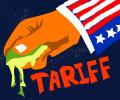
A trade deal makes sense only if it is fair and reciprocal. If the cost is strategic dependence or loss of policy space, waiting is the wiser option, asserts Ajay Srivastava.
Among other things, taking note of complaints against several Chinese e-commerce players such as Shein, Ali Express etc for sending shipments as 'gifts' to customers in India and avoiding duties, the government has now mandated that all e-commerce sites and apps must have a registered business entity. This will be the importer on record and subject to customs rules, report Subhayan Chakraborty, Neha Alawadhi and Karan Choudhury.

The case may drag for a few years, experts say, as CAIT and DVM have said they will appeal against the interim relief granted to Amazon.

Tata Group's CLiQ is the latest to join the e-commerce club, to compete with the likes of Amazon, Flipkart and Snapdeal.

Recalling or relabelling medicines already in the supply chain before September 22 will not be mandatory, the finance ministry said on Tuesday, issuing a fresh set of frequently asked questions (FAQs) to address industry concerns following the announcement of goods and services tax (GST) revisions.

Online companies would look forward to an integrated and uniform approach for tax laws and regulatory policies

'Where rostering systems are automated and duty time software interfaces directly with DGCA, the assertion that they suddenly discovered crew shortages is simply implausible.' 'If adequate crew planning hasn't materialised within 12 to 24 months from inception, how will 45 days -- from December 5 to February 12 -- suddenly resolve matters?'

The threat may be a decade away, but it has brick-and-mortar sellers rethinking their strategies and banking on the govt to regulate online companies.

Industry body to write to commerce ministry, seek regulation for e-tailers.

'Amazon, Meta, Google, Microsoft have large operations in India and rely on smooth trade and data flows.' 'Restrictions could raise their costs, limit AI chip exports, and complicate their India strategies.'

The overall e-commerce opportunity in India and China is comparable, yet it's hard to see any single player in India emerging with Alibaba-like market share.
