'The expeditious enactment of labour codes and strategic measures to bridge the skills jobs gap are critical.'

The rising goods and services tax (GST) and personal income-tax collections may bolster the Narendra Modi government's ability to announce new schemes or enhance existing ones.
In November, the fiscal deficit widened by Rs 2.2 trillion, the highest ever in any month this financial year.
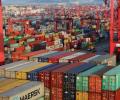
Uncertainty looms over India's export outlook, with the new Covid-19 variant Omicron spreading rapidly across the country's key shipment destinations. With the US and parts of Europe witnessing more than 100,000 Covid-19 cases a day, exporters expect some disruption. However, there may not be an immediate decline in exports from India because the order books remain strong at least for the next few weeks, they said.

After a very weak December quarter and a poor year-to-date fiscal year volumes-when sales plunged to the lowest in nine years, the signs in the first 15 days of January haven't been encouraging either. "Though the severity of the current wave is not as high as the previous one, it has hit the sentiments hard impacting conversion of enquiries into sales," said Vinkesh Gulati, president, Federation of Automobile Dealers Association (FADA).

The share of total health expenditure as part of the gross domestic product (GDP) went down to 3.3 per cent in 2017-18 from 3.8 per cent in the previous two years, according to the national health account data released on Monday by the health ministry. The share of government expenditure as part of total expenditure as well as GDP has gone up from from 3.78 per cent to 5.12 per cent between 2013-14 and 2017-18, which could also explain a decline seen in out of pocket expenditure in 2017-18. Health ministry also emphasised the increase in the government health expenditure as part of the total GDP from 1.15 per cent in 2013-14 to 1.35 per cent in 2017-18.

From Covid-19 essentials, such as Vitamin C supplements and thermometers, to bicycles, laptops, and personal weighing scales, demand for certain items galloped during last financial year as the pandemic altered what Indians used on a day-to-day basis. Imports of outdoor sports equipment, handbags for women, and dentures, among others, plummeted. With outdoor activities coming to a halt last year and schools functioning virtually, imports of sports goods witnessed a decline, while inbound shipments of laptops and battery chargers saw a sharp uptick, according to the import data for the financial year 2020-21.
India's economy is unlikely to see double-digit growth and may grow between 8 per cent and 9 per cent this fiscal year (2021-22, or FY22), against the estimated 11.5 per cent, according to leading economists and rating agencies. The downward revision of growth projections to as low as 10 per cent is mostly on account of stringency in restrictions by states, relatively slow vaccination pace, and the possibility of a third wave of the pandemic. However, they say the impact will not be as severe as the first wave, and expect the first quarter to see positive growth.

A communiqu sent by the department of investment and public asset management (DIPAM) to the heads of all PSUs, said the move would help the government to get predictable and periodic dividends before Budget estimates are firmed up.

After the government sought Parliament's nod for a second batch of supplementary demand for grants that will cause a hit of Rs 2.99 trillion to the exchequer, doubts suddenly arose about the government's ability to meet the Budget projections of reining in its fiscal deficit at 6.8 per cent of gross domestic product (GDP), or Rs 15.06 trillion, for the current financial year. Till now, many were of the opinion that the government would succeed in checking the deficit at a much lower figure than what was given in the Budget Estimates (BE). The government had sought Parliament's approval to spend Rs 3.74 trillion extra, but Rs 74,517.01 crore will be matched by equal savings on other heads.

To enable widen the fiscal deficit beyond the permissible limit under the present legislation, the government may have to propose amendment to the FRBM Act in the Finance Bill.

India's dependence on imported crude oil to meet domestic demand has been a matter of concern for years. Delivering the inaugural address at the global energy summit - Urja Sangam - in 2015, Prime Minister Narendra Modi had called for enhancing domestic oil and gas production to cut the import burden. He aimed at lowering it by at least 10 per cent by 2022 - to coincide with the platinum jubilee of India's independence. But this target is far from being achieved and the country's import reliance has only risen.

In the manufacturing sector, output is expected to decline by about 70 per cent as only food-processing, and drugs and pharma industries are allowed to operate while other segments, such as engineering and metals, have shut operations.
According to data compiled by the World Bank, the UK's economy grew to $2.82 trillion and the French economy expanded to $2.78 trillion in 2018, against India's $2.73 trillion, showed the data.

While the UN report said that FDI inflows rose 6 per cent in 2018 to $ 42 billion, the government's own data for the entire FY19 period has shown that inbound equity investments declined for the first time in six years in FY19.
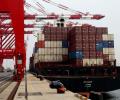
The WTO's quarterly outlook indicator, comprising seven trade parameters, stood at 96.3, the lowest since March 2010 and down from 98.6 in November. Exports from India would be hit if there is a slowdown in world trade.

If the government cuts wasteful expenditure as it is trying now, the deficit would at most fall to 8 per cent, not less than that.
Govt squeezed capital expenditure, and also cut revenue expenditure, that does not go into creating assets, by 11% in H1

If imputed inflation for April and May is used, then you have inflation of over 6 per cent for two consecutive quarters, which is a worrying signal for the RBI.

Economic affairs secretary S C Garg said that all macroeconomic parameters are performing well.
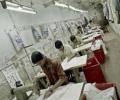
The MSME sector, which is employment-intensive, accounts for 45 per cent of the country's manufacturing, 40 per cent of exports and nearly 8 per cent of gross domestic product.
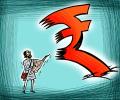
Historically, there has been no correlation between growth in bank credit to industry and lower benchmark interest rate
For the first eight months of the current financial year, the figure stood at Rs 7.17 trillion.
However, if the rupee depreciates much, the economy in dollar terms would be that much smaller.
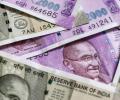
Post office savings deposit, recurring deposit accounts and the senior citizen savings scheme account have shown the highest growth in the current financial year.

While the farmers are not getting remunerative prices for their produce, at the same time they are forced to pay high prices for items they consume.

Government gets Rs 17.1 lakh crore in its kitty
By no means do economists see the Reserve Bank of India stop at just a 25-bp cut. Some of the economists such as Soumyakanti Ghosh of State Bank of India are of the firm view that rates have room to fall by a total of 75 bps in the current financial year, starting with 25 bps in the August 7 policy.
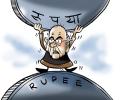
With India's imports exceeding exports, weak rupee does more harm than good. Analysts, however, say that rupee depriciation is positive for export-oriented sectors such as IT services, pharmaceuticals, textiles and automobiles
Softening of global commodity prices might not help much
Some say the MPC will raise the rate, while others are of the view that there is already de facto interest rate tightening through rising bond yields, which might prompt the central bank to go for a pause.
Economists have said if a stimulus is needed it should be different from what was provided in 2008-09, when the economy faced the ripple effects of a global meltdown following the Lehman Brothers collapse.

Home Minister Rajnath Singh said that the decision could cost the government roughly Rs 15,000 crore.

As the liquidity crunch reaches crisis levels and getting tax refunds remain a big headache, exporters saw orders fall by 15 per cent till October.

The decline is attributed to lower salary growth and a rise in households' financial liabilities.

Depreciating the rupee against the dollar to boost economic growth has fiscal constraints and monetary limitations
The services sector, which plays the biggest role in shaping the economy, is facing loads of issues currently. The largest segments, financial and real estate, are struggling to cope with bad debts and low demand for houses.

Significant portion of the funds used to fuel urban demand have become illegal and inoperative.

The combined share of customs and excise duties, service tax, and value-added tax in India's gross domestic product reached an all-time high of 10.5%.

The government managed to raise revenues by sending notices to high net individuals to did not file I-T returns last year.
 © 2026 Rediff.com - Investor Information - Advertise with us - Disclaimer - Privacy Policy - Sitemap - Feedback - About us - Terms of use - Grievances