
Tony O'Reilly, chief executive of Independent News and Media Group, is keen on an estimated 30% stake in Dainik Jagran, one of the largest circulated Hindi-language dailies.
A facsimile edition of British daily The Independent will soon be brought out from New Delhi by its Indian joint venture partner Jagran Prakashan Ltd, which publishes the popular Hindi daily Dainik Jagran.
With the hindi-belt politicians opposing the Women's Reservation Bill, it is mostly the Hindi newspapers that have been covering the issue with some intensity.
In an interview to Dainik Jagran the prime minister said a 'good beginning' could be made to improve ties from next month's SAARC summit in Islamabad.
Trinamool Congress leader and West Bengal Chief Minister Mamata Banerjee on Tuesday said the unity of opposition parties will take shape on its own, sidestepping questions of her taking on the leadership role.
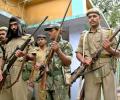
According to Singh, four youths entered in his office and wanted to know that who had written the news about man arrested for intimidating voters during Panchayat elections a few days ago.
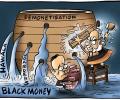
November 8 marks 6 years after demonetisation. A K Bhattacharya reveals how the prime minister and the RBI worked together for months before Modi's 8 pm speech. A riveting excerpt from The Rise Of Goliath: Twelve Disruptions That Changed India.

The data reimbursed via Gigato is unrestricted.

Monetising online readership, a deeper focus on content and getting revenue from the reader are ways to make the business future-proof, observes Vanita Kohli-Khandekar.
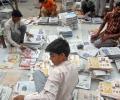
Hindi language dailies are the highest selling, at 22 million copies a day, followed by English at 8.55 million, Malayalam (4.55 million) and Marathi (4.33 million).

Prime Minister Modi highlighted the importance of public participation in a democracy and said that the definition of democracy could not be restricted only to elections and the governments.

He launched the "cleanliness is service" exercise to push for greater public participation in one of his government's centrepiece programmes launched on October 2, 2015.

The growth of Indian newspapers continues to startle.

The manner in which a large proportion of common people have mortgaged their rationality and questioning spirit to let hatred, prejudice, and bigotry take over their minds is a cause of worry, observes Mohammad Sajjad.
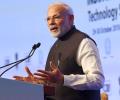
The Congress hit back saying the PM could not mislead the people by 'lying' as he had been 'exposed'.

A range of retaliatory measures are being weighed by India's generals.

Mohammad Sajjad raises important questions about the response to lynchings.

In first major growth in 5 years, 2,000 advertisers were added in Jan-Sep 2015.

'Facing foes with a common intent is not something Modi-Shah's BJP has done before,' points out Saisuresh Sivaswamy.

'Of all the PMs of India, I had the closest relationships with Morarji and Rajiv.' Mark Tully, the most famous foreign correspondent in India, remembers some encounters with prime ministers, dictators and militants.

The return of Indian Readership Survey numbers has met with a silent response.

'N Ram and I met on the lawns of Mani Shankar Aiyar's bungalow.' 'I pulled out a rolled printout from my jacket and handed it to him.' 'In the cut-throat world of journalism, this was like high treason.' 'But letting a story be killed because you can't publish it is a bigger crime than passing it to the competition,' recalls Shekhar Gupta.

In an exclusive chat with Rediff.com, AAP leader Ashutosh says the biggest challenge for the party would be to "develop a model for alternate politics"
 © 2026 Rediff.com - Investor Information - Advertise with us - Disclaimer - Privacy Policy - Sitemap - Feedback - About us - Terms of use - Grievances