

The regulator is more carefully scrutinising applications by infrastructure investment vehicles that have a limited number of investors. They have been asked to broaden their investor base before application approval, according to two people familiar with the matter. The Securities and Exchange Board of India is concerned about the structure being used for getting around tax requirements, according to one of the sources.

The stimulus package announced by Finance Minister Nirmala Sitharaman "fails to involve" banks in the economic revival process, a member of the Reserve Bank of India's central board said on Wednesday. The stimulus package is "imaginative and forward looking, yet fails to involve banks as frontline warriors in revival of economy," Satish Marathe, a member of RBI's central board, said in a social media post.

India has a history of jugaad, and retrofitting vehicles is one such manifestation of the legendary Indian skill. Not so long ago autorickshaws and small Marutis used to strap on subsidised LPG cylinders and power themselves to a cheap ride. There were the odd explosions, lives were lost, but the jugaad continued. Then compressed natural gas (CNG) was introduced in Delhi following a court order. Initially, customised CNG kits were fitted to conventional (internal combustion engine or ICE) autos cheaply, enabling commuting at less than half of what you would cough up for diesel. The industry is better organised now with Suzuki and Hyundai designing CNG-fired vehicles, and Mahindra and TVS manufacturing liquefied petroleum gas (LPG)-powered three wheelers.

Ajit Mishra, vice president, research, Religare Broking, answers your queries.

Ratings are based on the overall exposure to default risk, with regard to timely receipt of payments from the investments the scheme has made.
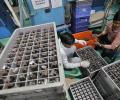
Auto component makers in India are bracing for a tough time. High absenteeism among workers owing to Covid-19, shortages of critical parts, and temporary closures of plants by automobile manufacturers have thrown a spanner in the works for the Rs 3.2-trillion sector, which derives 60 per cent of its revenues from automobile original equipment manufacturers (OEMs), with the balance split equally between replacement demand and exports. Car market leader Maruti Suzuki India on Saturday said it was extending the maintenance shutdown, which was from May 1 to 9, till May 16, "keeping in view the current pandemic situation". Some activities will continue in the plants.
Pressure on credit quality of Indian corporates is on the rise suggesting a decline in creditworthiness, a study by rating agency Crisil has revealed.

"Higher IPO-graded companies typically tend to operate in higher growth industries, have superior management strengths and follow good corporate governance practices," says Chetan Majithia, head, Crisil Equities.
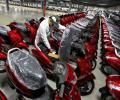
Retail sales of cars are back to January 2018 levels in August 2021. Two-wheeler retail sales are 22 per cent lower, nearly four years down the line.

A digital economy can only work with uninterrupted electricity supply. So, states now face the unpleasant task of telling their citizens that electricity rates need to be hiked. Subhomoy Bhattacharjee reports.

This payment of Rs 962 crore is inclusive of the Rs 500 crore DHFL received from exiting its entire stake in subsidiary firm Aadhar Housing Finance Ltd.
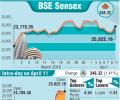
Investors are keenly awaiting the announcement of the macroeconomic data.

Rogue lending under political influence was rife in the Congress-led regime and is not happening in the Modi regime, certainly not on that scale. But if PSBs cannot lend as indiscriminately as they did last time in the name of 'credit expansion', how well will these banks do, asks Debashis Basu.
Crisil reaffirmed its 'AAA' rating, which reflects the highest degree of safety with regard to timely payment of financial obligations, on the bank's Upper Tier II bonds, Tier I Perpetual bonds and bonds/debentures. Crisil expects the bank's market position to remain strong despite moderating advances growth, because of the 580 new branches it is likely to add in 2009-10, and its wide presence across segments.

The deal size and project completion deadline were not disclosed in the announcement, but people in the know have pegged the deal at over Rs 6,000 crore, reports Aneesh Phadnis.

"I don't think the only solution for us is a bank, though it could be a bank. On the other hand, if the financial system continues to grow at 20-25 per cent, there's no reason why in our current construct, we can't comfortably keep growing at that same pace," says Rajiv Lall, CEO and Managing Director, IDFC.
The roads in India is a powerful stimulant to rural employment. It will have a strong multiplier effect on the local economy, says Subir Gokarn.

Direct economic stimulus measures such as tax cuts for individuals and industry would have helped to prop up the Indian economy which was hit hard by the lockdowns across several states in India, say economists and corporate leaders. While the measures announced on Monday are focussed more on the supply side, these steps would take a lot of time to move the needle for the economy.

RBI's draft guidelines on computation of base rate, if implemented in its current form, will significantly impact the profitability of banks.
The economy is expected to grow by 6.75-7 per cent during 2005-06 and inflation is likely to hover around 5-5.5 per cent, rating agency Crisil said on Friday.

Banks are set to sell dud-loans worth Rs 90,000 crore of 22 firms in the first tranche to the National Asset Reconstruction Company (NARCL). It's reason for cheer given that such sales to asset reconstruction companies (ARCs) have been poor in recent times. In fiscal 2020, their assets under management (AUM) contracted by 4 per cent; and in fiscal 2021, it fell by another 100 basis points to Rs 1.07 trillion. So, why are we where we are?

Ninety-nine companies, which also include some unlisted ones, have more than Rs 100 crore each of minimum alternate tax credit on their books, cumulatively adding up to Rs 75,000 crore. By utilising MAT credit, many companies will be able to bring down their effective tax cost.

Lifting of deposit withdrawal moratorium on March 18 could open flood gates and will require a calibrated approach along with active support and signaling from the RBI, government and investor banks.

Stating that COVID-19 has not yet been contained in India, the rating agency in a statement said the government stimulus package is low relative to countries with similar economic impacts from the pandemic. "The COVID-19 outbreak in India and two months of lockdown -- longer in some areas -- have led to a sudden stop in the economy. That means growth will contract sharply this fiscal year (April 2020 to March 2021)," it said. "Economic activity will face ongoing disruption over the next year as the country transitions to a post-COVID-19 world."

New norms are in place to strengthen regulations for this set of lenders which has been playing a critical role in Asia's third largest economy, notes Tamal Bandyopadhyay.

This make it the first domestic firm to sell such a long-tenure rupee debt instrument.
According to Crisil, home prices had fallen by 18 to 20 per cent in March 2009, from the highs seen in the first half of 2008, due to the global slowdown, fears of job security and slowing growth in the domestic economy, the report said. 'However, despite this drop in capital values, home buyers have adopted a 'wait and watch' policy,' the report added.

Khara will replace SBI Chairman Rajnish Kumar, whose three-year term comes to an end on October 7.

Vegetable, fruit prices to be on the rise over weak supply, crop damage

The deadline for the commercial launch of the Navi Mumbai airport is set at 2021-end
'The effect will be seen two-three quarters down the line.'

Banks put the airline's trademarks including Kingfisher logo and the once-famous tag-line 'Fly the Good Times' on the block

If you have been planning to buy a house, don't postpone your purchase. Developers are offering discounts, freebies and attractive payment plans.

According to latest data, crops have been sown in around 72.13 million hectares, which is 8.90 per cent less than the same period last year.

The rupee is likely to strengthen to 60-61 level by this fiscal-end on expectations of improvement in current account deficit (CAD) and higher inflows from overseas investors.

In spite of a severe second wave of the coronavirus pandemic, and a widespread disruption in public life therefore, India's fast-moving consumer goods (FMGC) sector seems to have emerged as one of the most resilient segments of the economy. The early numbers and estimates for the April-June quarter indicate a steady recovery in FMCG players' business, which is now set to exceed the pre-pandemic level. Amid nationwide lockdowns because of the first Covid wave, FMCG revenues had been severely affected in mid-2020.

Now with 13-14 million-tonne capacity, Nirma will emerge as a serious player in India's cement landscape.

Revenue from divestment has fetched Rs 40,000-50,000 crore against target of Rs 2.10 trillion.
